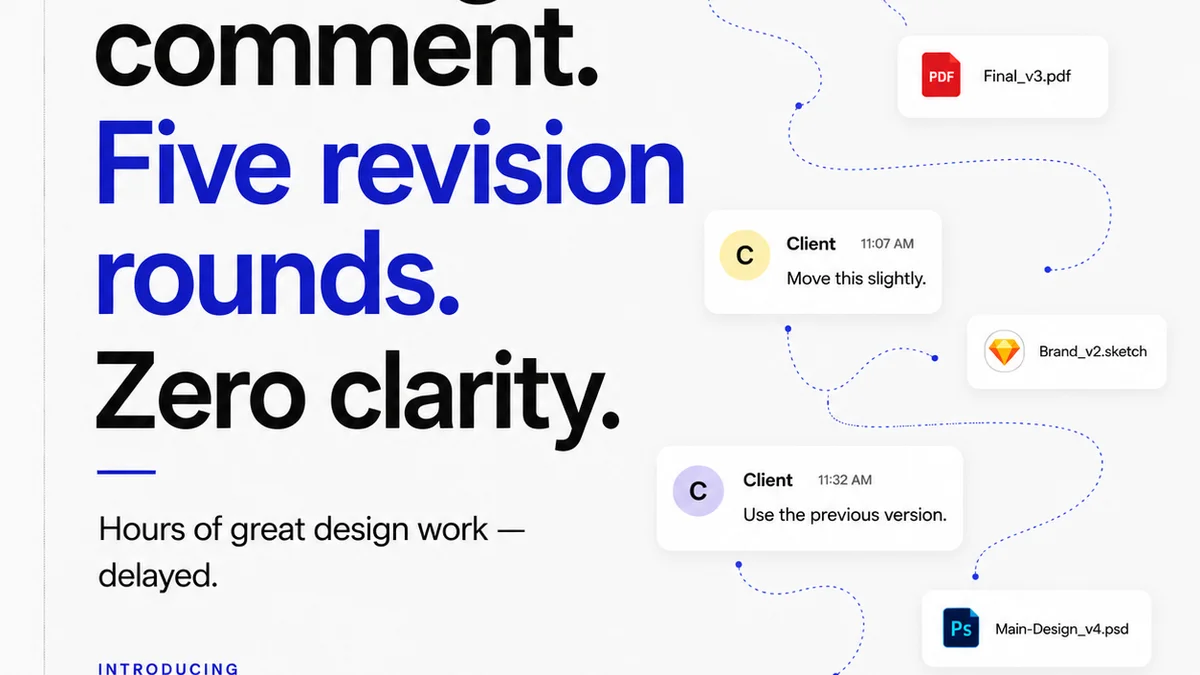
Creative teams often complain about client feedback. It’s vague. It’s contradictory. It kills momentum. Everyone nods along. None of that is wrong. But it’s incomplete.
The hard truth? The real problem isn’t just the feedback itself. It’s how we *manage* and *interpret* it. We treat feedback like a mystical decree instead of a data point.
1. The Vague Feedback Cycle: A Self-Inflicted Wound
Ever get a comment like “Make it pop more”? Or “I’m not feeling this”?
This is common. And it’s a symptom of a broken process, not just a difficult client.
When feedback is unstructured, it’s impossible to act on effectively. It becomes a guessing game. The creative team scrambles, trying to decipher intent. More often than not, they guess wrong. Then the client is unhappy. And the cycle repeats.
Why This Happens
- Lack of Clear Briefing: If the initial brief is fuzzy, the feedback will be too.
- Unclear Feedback Channels: Emails, Slack messages, carrier pigeons — scattered communication breeds confusion.
- No Defined Success Metrics: How do we know when “popped” is achieved if we never defined what that meant?
- Fear of Direct Questions: Teams sometimes avoid asking clarifying questions, fearing they’ll seem incompetent or confrontational.
This isn't about blaming clients. It's about recognizing our own role in creating the conditions for poor feedback.
2. The Cost of Ambiguity: Beyond Frustration
Bad feedback doesn’t just cause headaches. It has tangible business costs.
- Wasted Time: Revisions based on guesswork eat up billable hours.
- Missed Deadlines: Endless revision loops push project timelines.
- Client Dissatisfaction: Projects that drag on or miss the mark erode trust.
- Team Burnout: Constant rework and unclear direction demotivate your best people.
Your team’s creative energy is a finite resource. Don’t let it be squandered on deciphering riddles.
3. Shifting from Vague to Verifiable Feedback
The goal isn’t to eliminate subjective input. It’s to make it *actionable*. We need to move from vague opinions to specific, verifiable insights.
Key Principles for Actionable Feedback
- Context is King: Always tie feedback back to the original brief and objectives. What are we trying to achieve with this design/copy/campaign?
- Specificity Over Generality: Instead of “more energy,” ask “What specific elements convey energy to you? Colors? Typography? Imagery?”
- Focus on the ‘What,’ Not the ‘How’: Clients should tell you *what* needs to change, not *how* to change it (unless they have a specific technical constraint). Let your experts handle the ‘how’.
- Quantifiable Goals: Where possible, define measurable outcomes. “Increase click-through rate by 15%” is more actionable than “make the CTA stand out.”
- Visual Cues: Use annotation tools to pinpoint exact areas for revision.
This requires a proactive approach. It’s about guiding the feedback process, not just passively receiving it.
4. The Power of Clarifying Questions
Your team needs to feel empowered to ask questions. Not just any questions, but smart, probing ones.
When a client says, “I don’t love the blue,” don’t just change it to green. Ask:
- “What specifically about the blue isn’t working for you?”
- “Does it feel too dark, too bright, or the wrong hue?”
- “What feeling or message were you hoping the color would convey?”
- “Are there any competitor examples where you like the color choices?”
These questions uncover the underlying need. They transform a subjective dislike into an objective requirement.
5. Building a Feedback Framework
A consistent framework makes feedback easier to give and receive.
Consider a simple structure for feedback requests:
Feedback Request Template
- Project Goal: [Brief reminder of the objective]
- Specific Deliverable: [Link to asset, specific page/section]
- Key Questions for Review: [Guide the reviewer – e.g., “Does the headline clearly communicate the offer?”]
- Areas for Feedback: [Specify what needs input – e.g., “Focus on the user flow for checkout.”]
- What to Avoid: [Things the client *shouldn’t* comment on – e.g., “Minor copy edits at this stage.”]
- Deadline for Feedback: [Crucial for momentum]
This template ensures reviewers focus their attention and provide structured input. It sets expectations for everyone involved.
Where Revue Fits In
Managing feedback effectively is challenging, especially with multiple stakeholders and complex projects. This is where a centralized platform becomes invaluable.
Revue helps by providing a single source of truth for creative assets and their associated feedback. Instead of chasing comments across emails and Slack, all feedback is logged against the specific version of the creative work.
This means:
- Centralized Feedback: All comments, annotations, and discussions live in one place, linked directly to the asset.
- Version Control: Track revisions and see how feedback has been addressed over time.
- Clear Approval Workflows: Define clear stages for review and approval, reducing ambiguity.
- Actionable Insights: Tools to pinpoint feedback and assign tasks ensure clarity for the creative team.
When feedback is organized, it’s easier to see patterns, identify misunderstandings, and ensure everyone is aligned. It turns a chaotic process into a manageable workflow.
Final Thought
Is your team waiting for perfect feedback, or are you actively shaping it? The difference determines whether feedback is a roadblock or a catalyst.
Frequently asked questions
How can I get clients to provide more specific feedback?
Guide them by asking clarifying questions tied to project goals. Use structured feedback templates that prompt specific areas for review. Instead of asking 'What do you think?', ask 'Does the call-to-action clearly state the benefit?'
What's the difference between subjective and actionable feedback?
Subjective feedback is an opinion, like 'I don't like the color.' Actionable feedback provides context and direction, like 'The current blue feels too muted for a youthful brand; let's explore brighter, more energetic blues that align with our target demographic.'
How do I handle conflicting feedback from different stakeholders?
Establish a clear feedback hierarchy or point person for final decisions. Centralize all feedback so you can see discrepancies and facilitate a discussion to resolve conflicts before implementation.
Can feedback management really save time and money?
Absolutely. By reducing guesswork, minimizing unnecessary revisions, and streamlining approval processes, you prevent wasted billable hours, meet deadlines more consistently, and improve client satisfaction, all of which contribute to cost savings and increased profitability.