You’ve probably seen countless agency production workflow checklists. They’re everywhere. Filled with tasks like: ‘brief received,’ ‘design concepts,’ ‘client review,’ ‘revisions.’
None of that is wrong. But it’s incomplete.
The hard truth is, a checklist alone doesn’t guarantee a smooth production workflow. It’s the *understanding* behind each step, the *communication* flowing through it, and the *accountability* attached to it that truly matters.
Let’s cut through the noise and talk about what makes an agency production workflow actually work. Not just what’s on paper, but what’s happening on the ground.
1. The Illusion of 'Done'
We love ticking boxes. It feels productive. But in creative production, ‘done’ is a dangerous word if it’s not universally understood.
What does ‘done’ mean for a design concept? Does it mean three distinct directions? Or one direction with minor variations?
What does ‘client review’ entail? Is it a quick glance, or a deep dive with actionable feedback?
The ambiguity here is where projects get bogged down. Assumptions lead to wasted time and frustration.
Defining 'Done' for Every Stage
- Briefing: ‘Client brief approved’ means all questions answered, scope confirmed, and assets/access provided.
- Concepting: ‘Concepts delivered’ means X number of distinct strategic directions presented, with rationale.
- Feedback: ‘Client feedback received’ means consolidated, clear, actionable notes from the designated approver.
- Revisions: ‘Revisions complete’ means all requested changes are implemented and signed off.
- Final Delivery: ‘Final assets delivered’ means all files are correctly formatted, named, and uploaded to the agreed-upon location.
This level of specificity transforms a generic checklist item into a concrete deliverable.
2. The Bottleneck is Rarely the Task
Most agencies focus their workflow checklists on the *tasks* themselves. They map out the sequence of creative work.
But the real bottlenecks aren’t usually the creative tasks. They’re the handoffs. The communication gaps.
Think about it: where do projects most often stall?
- Waiting for client feedback.
- Waiting for internal approvals.
- Chasing down missing assets.
- Misinterpreting feedback.
- Unclear scope changes.
These aren’t creative problems. They’re operational and communication problems.
Identifying Your True Bottlenecks
Your checklist needs to account for these friction points. It’s not just about listing tasks; it’s about defining the process *around* the tasks.
- Clear Ownership: Who is responsible for each step and each handoff?
- Communication Protocols: How is feedback gathered, consolidated, and communicated? What’s the expected turnaround time?
- Approval Gates: Who needs to sign off at each stage, and what does that sign-off entail?
- Asset Management: Where are all necessary assets stored, and who is responsible for their delivery?
A robust production workflow checklist anticipates these issues and builds in solutions.
3. Feedback Isn't Just 'Received'—It's Processed
The ‘client review’ or ‘feedback’ stage is a common culprit for workflow breakdown. It’s not enough to just have a line item for it.
Agencies often fall into the trap of receiving feedback, making the requested changes, and moving on. But this often leads to:
- Conflicting feedback from different stakeholders.
- Vague or unactionable comments.
- Scope creep disguised as ‘minor tweaks.’
- Revisions that miss the mark entirely.
The real work happens *after* the feedback is received. It’s about interpretation, clarification, and strategic implementation.
The Art of Feedback Management
Your workflow must include explicit steps for processing feedback:
- Consolidation: Gather all feedback in one place. Use tools that allow for annotation and comments directly on the creative.
- Clarification: Schedule a quick call if feedback is unclear. Ask clarifying questions *before* starting revisions.
- Prioritization: Determine which feedback is critical, which is advisory, and which falls outside the original scope.
- Scope Assessment: If feedback significantly alters the scope, flag it immediately and initiate a change order process.
- Internal Review: Before going back to the client, have an internal review to ensure revisions meet the brief and are executed correctly.
This structured approach to feedback prevents endless revision cycles and ensures creative integrity.
4. Visibility is Non-Negotiable
If your team operates in silos, your production workflow is already doomed. Everyone needs to know where a project stands.
This isn't about micromanagement. It's about enabling proactive problem-solving and efficient resource allocation.
When a designer is waiting on copy, and the copywriter is waiting on a client approval, that’s a breakdown in visibility.
Creating a Transparent Workflow
How do you ensure everyone has the information they need?
- Centralized Project Management: A single source of truth for all project tasks, statuses, and deadlines.
- Clear Handoffs: Notifications or automated triggers when a task is completed and the next can begin.
- Shared Calendars/Timelines: Visibility into key milestones and potential delays.
- Status Updates: Regular, concise updates that are easily accessible to the whole team and relevant stakeholders.
Without this visibility, your checklist becomes a static document that nobody truly relies on.
Where Revue Fits In
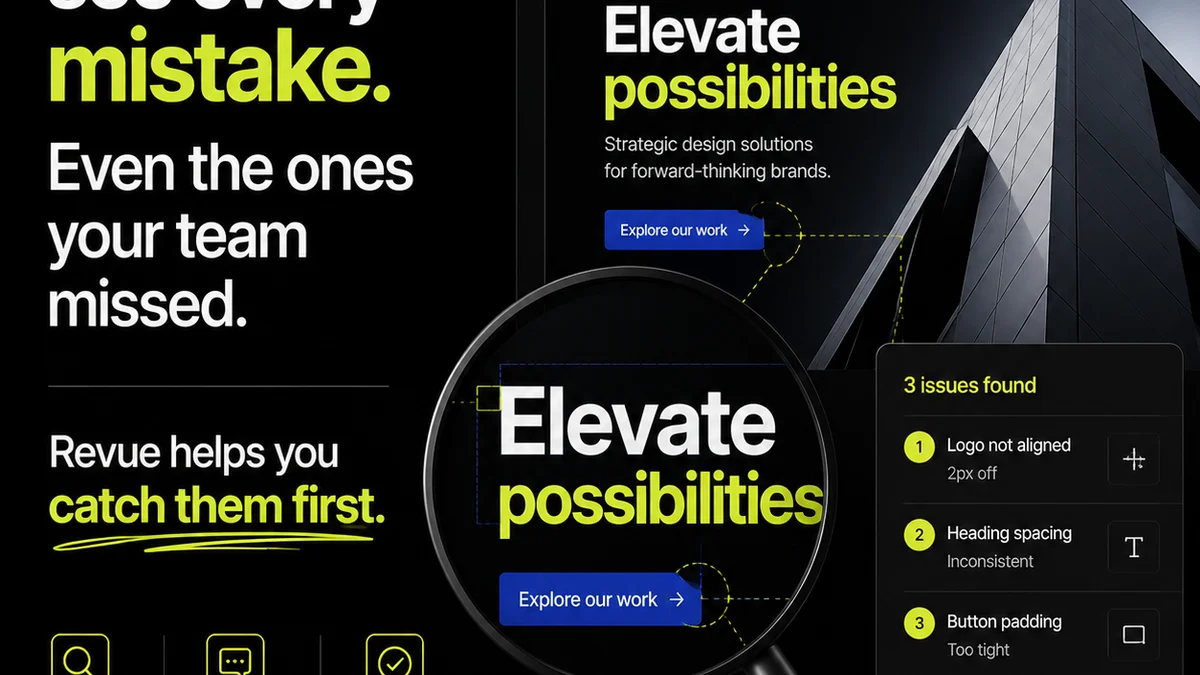
Managing complex agency production workflows requires more than just a static checklist. It needs a system that facilitates communication, centralizes feedback, and provides clear visibility into every stage.
Revue is built for this. It’s designed to streamline the entire creative review and approval process.
Imagine a world where client feedback isn’t scattered across endless email threads or Slack messages. Where revisions are tracked, annotated, and approved directly within the context of the work itself.
Revue provides that centralized hub. It ensures that every stakeholder, from your internal team to the client, is on the same page. This clarity eliminates ambiguity, reduces the back-and-forth, and keeps your production pipeline moving efficiently.
By centralizing feedback and streamlining approvals, Revue helps transform your checklist from a passive document into an active, dynamic workflow.
5. The 'Quality Check' Isn't Just for the End
Many checklists have a final ‘quality check’ step. This is essential, but it’s often too late.
If your quality check is only happening at the very end, you’re relying on last-minute saves. This puts immense pressure on the final reviewer and increases the risk of missing crucial errors.
Think about it: if a campaign needs a major overhaul after the final QA, the timeline is blown. The budget is strained.
Embedding Quality Throughout
Quality assurance should be baked into every stage of your production workflow, not tacked on at the end.
- Brief Scrutiny: Does the brief itself make sense? Are there any inherent contradictions or impossible requirements?
- Concept Review: Do the initial concepts align with the strategic goals outlined in the brief?
- Mid-Revision Check: Before finalizing revisions, do a quick internal check to ensure changes are correctly implemented and haven't introduced new issues.
- Format & Spec Check: As assets are prepared for delivery, ensure they meet all technical specifications (file type, resolution, naming conventions, etc.).
- Proofreading: For any copy or text-based elements, proofreading should happen at multiple stages, not just once.
A proactive approach to quality control saves time, money, and client headaches.
6. Adaptability is the Only Constant
The most rigid production workflows are the ones that break first.
Clients change their minds. Market conditions shift. New technologies emerge. Your workflow needs to be flexible enough to adapt without collapsing.
A checklist that doesn’t allow for variations or exceptions is a liability.
Building Resilience into Your Process
How do you create a workflow that’s both structured and adaptable?
- Modular Tasks: Break down larger projects into smaller, manageable modules that can be rearranged or swapped if needed.
- Contingency Planning: Build buffer time into your schedule for unexpected issues or scope changes.
- Clear Change Management: Have a defined process for evaluating, approving, and integrating scope changes.
- Regular Retrospectives: Hold team meetings after projects (or at key milestones) to discuss what worked, what didn’t, and how the workflow can be improved.
Your checklist should be a living document, constantly refined based on real-world experience.
Final Thought
Is your agency’s production workflow checklist a tool for genuine efficiency, or just another layer of process for process’s sake? The difference lies not in the list itself, but in the clarity, communication, and accountability woven into each step. True workflow mastery is about anticipating friction and building systems that empower your team, not just dictate tasks.
Frequently asked questions
What is the most common mistake agencies make with production workflow checklists?
The most common mistake is treating a checklist as a complete solution. Agencies often focus on the sequence of tasks without defining what 'done' means for each step, how feedback will be processed, or where communication bottlenecks typically occur. This leads to ambiguity and inefficiency.
How can an agency make its production workflow more adaptable?
Adaptability comes from building flexibility into the process. This includes using modular task breakdowns, incorporating contingency time for unexpected issues, having a clear change management process, and regularly conducting team retrospectives to identify areas for workflow improvement.
Why is visibility so crucial in an agency production workflow?
Visibility ensures that all team members and relevant stakeholders know the current status of a project. This transparency prevents delays caused by waiting for information, enables proactive problem-solving, and allows for better resource allocation. Without it, tasks can fall through the cracks.
When should quality checks be implemented in a production workflow?
Quality checks should not be an afterthought. They should be embedded throughout the production process, starting from scrutinizing the initial brief, reviewing concepts, checking revisions mid-way, and verifying final asset specifications. This proactive approach prevents major issues from arising at the last minute.