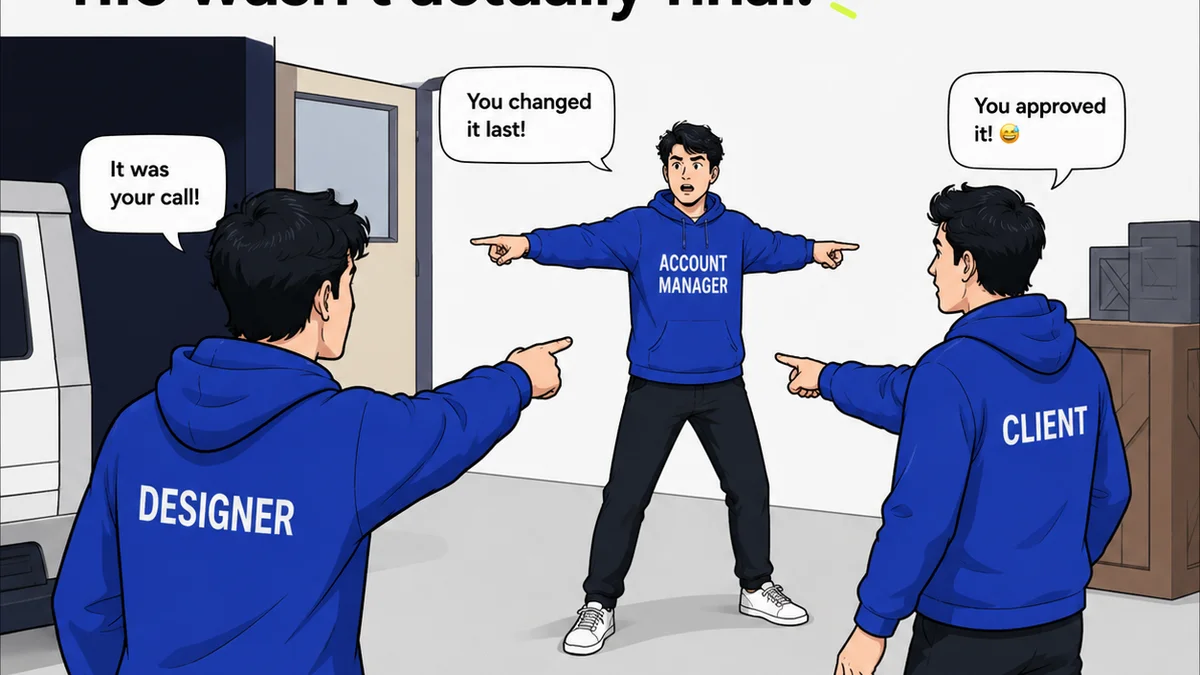
Everyone talks about managing client feedback. They say you need clear briefs, good communication, and defined revision rounds. None of that is wrong. But it’s incomplete.
The hard truth is, your agency’s revision workflow isn't just about collecting notes. It's about the *system* you use to process, act on, and approve those changes. And most agencies have a broken one.
This broken system bleeds time, breeds frustration, and erodes client trust. It’s not a communication problem; it’s an operational one.
1. The Myth of the "One More Revision"
The phrase “just one more revision” is a lie. It’s the siren song luring creative teams onto the rocks of scope creep and burnout. It signals a lack of clarity, not a desire for perfection.
This happens when clients aren't confident in the direction, or when the feedback process itself is confusing. They latch onto small details because they don't trust the overall vision or the decision-making process.
What you’re really seeing is:
- Uncertainty about the project goals.
- Lack of a clear decision-maker on the client side.
- Feedback that’s subjective rather than objective.
- No accountability for the feedback provided.
Your agency needs to move beyond simply accepting feedback and start strategically managing it.
2. Deconstructing Your Current Revision Process
Before you can fix your agency's revision workflow, you need to see it clearly. Most teams operate on assumptions, not data. What does your current process look like, really?
Start by mapping it out. Every step. From initial brief to final sign-off.
The Feedback Black Hole
Where does feedback live? Is it:
- Scattered across email chains?
- Buried in Slack messages?
- Scribbled on screenshots?
- Collected verbally in meetings?
This fragmentation is the enemy of efficiency. It’s impossible to track, impossible to prioritize, and impossible to ensure nothing gets missed.
The Revision Round Rollercoaster
How are revisions tracked? Do you:
- Create new versions for every minor change?
- Manually merge feedback into a single document?
- Rely on tribal knowledge to remember what changed?
Each of these methods introduces errors and delays. The goal is a clear, auditable trail of changes.
The Approval Abyss
When is a revision *actually* approved? Is it:
- A casual “looks good” in an email?
- A handshake agreement?
- A formal sign-off on a PDF that might not reflect the latest changes?
Lack of formal, documented approval is a massive risk. It opens the door for disputes and makes it hard to define project completion.
3. The Real Cost of Inefficient Revisions
Think your agency can afford to let revisions drag on? Think again.
The cost isn't just billable hours. It's deeper.
- Team Morale: Constant, unclear revisions crush creative spirit. Burnout becomes a real threat.
- Profitability: Every extra hour spent on revisions is an hour not spent on new business or other profitable projects. Scope creep kills margins.
- Client Relationships: A messy revision process breeds client frustration. They feel their money is being wasted, and their trust erodes.
- Reputation: Projects that drag on, miss deadlines, or require excessive back-and-forth damage your agency's reputation for reliability and efficiency.
You're not just managing feedback; you're managing risk and profitability.
4. Building a Bulletproof Revision Workflow
Let’s get practical. How do you build a system that actually works?
A. Establish Clear Project Scope and Goals (Upfront)
This sounds basic, but it’s where most breakdowns start. Before any creative work begins:
- Define project objectives with the client.
- Agree on key performance indicators (KPIs).
- Document the scope of work, including deliverables and *out of scope* items.
- Identify the *single* point of contact and decision-maker for feedback.
This isn't just a formality. It’s your shield against endless revisions.
B. Standardize Your Feedback Intake
No more scattered notes. Implement a single source of truth for all client feedback.
- Use a dedicated platform for all comments, markups, and approvals.
- Ensure feedback is contextual – tied directly to the creative asset.
- Require clients to provide specific, actionable feedback.
This centralizes everything, making it easy to track, prioritize, and action. It removes ambiguity.
C. Define Your Revision Rounds (and Stick to Them)
Agencies often fail by letting revision rounds become open-ended.
- Clearly state the number of revision rounds included in the SOW.
- Communicate the process: feedback submission deadline, your team’s turnaround time.
- Batch feedback: Consolidate all client notes from a single round before acting on them.
- Avoid implementing feedback piecemeal outside of official rounds.
This sets expectations and creates accountability on both sides.
D. Implement Formal Approval Gates
Don't move forward without a clear
Frequently asked questions
What is the biggest mistake agencies make with revisions?
The biggest mistake is treating revisions as an endless, unstructured process. Agencies often accept scattered feedback across emails and chats, leading to missed details, scope creep, and team burnout. A structured workflow with a single source of truth for feedback is crucial.
How can I prevent scope creep from revisions?
Prevent scope creep by clearly defining project scope, deliverables, and the number of revision rounds in the initial SOW. Implement a formal approval process for each stage and ensure all feedback is contextual and actionable. Use a dedicated platform to track changes and prevent out-of-scope requests from slipping through.
What are the key benefits of a streamlined revision workflow?
A streamlined workflow leads to increased profitability by reducing wasted hours, improved team morale by minimizing frustration and burnout, stronger client relationships through clear communication and efficient processes, and a better agency reputation for reliability and professionalism.
How important is a single source of truth for feedback?
Extremely important. A single source of truth, like a dedicated feedback platform, eliminates ambiguity, ensures no feedback is missed, provides an auditable trail of communication, and makes it easier to manage, prioritize, and act on client input efficiently. It's the foundation of an effective revision process.