The buzz around AI in creative agencies is deafening. You hear about AI generating copy, designing visuals, even scripting entire campaigns. It sounds like magic, a shortcut to mind-blowing creative output.
None of that is wrong. But it’s incomplete.
The deeper truth? AI's most immediate and profound impact isn't on the *creation* itself, but on the *operations* surrounding it. It’s the ultimate tool for cutting through the friction that kills agency profitability and team morale.
Forget the sci-fi fantasies for a moment. Let’s talk about the real, tangible ways AI can streamline your agency’s engine.
1. Automating the Mundane, Amplifying the Human
Think about the hours your team spends on tasks that don't require a creative spark. Data entry, scheduling, basic reporting, categorizing assets, transcribing meeting notes. These aren't just time sinks; they’re drainers of energy and focus.
AI excels at these repetitive, rule-based activities.
The Hidden Cost of Manual Processes
- Endless email chains for simple approvals.
- Manual tracking of project hours that are rarely accurate.
- Copy-pasting feedback from multiple sources into a single document.
- Searching through shared drives for the ‘right’ version of a file.
- Onboarding new clients with repetitive information gathering.
These tasks, individually small, add up. They distract from client strategy, creative problem-solving, and business development. They breed errors and frustration.
AI's Operational Playbook
AI-powered tools can:
- Automate routine client communication and status updates.
- Extract key information from documents and emails.
- Categorize and tag vast libraries of creative assets.
- Generate initial drafts of project reports or meeting summaries.
- Help schedule and manage internal and external meetings.
This isn't about replacing people. It’s about freeing them.
2. Smarter Workflows, Faster Turnarounds
Operational friction isn't just about wasted time; it’s about bottlenecks that slow down the entire project lifecycle. Feedback loops that drag, revision rounds that get lost, approvals that sit in limbo.
AI can inject intelligence and speed into these critical stages.
The Bottleneck Blame Game
Where does the real drag happen?
- Waiting for client feedback that’s vague or late.
- Chasing down stakeholders for sign-offs.
- Manually consolidating feedback from disparate channels (email, Slack, PDFs).
- Misinterpreting feedback due to lack of context.
- The sheer overhead of managing multiple revision cycles.
This isn't a creative problem; it's an operational one. It directly impacts your ability to deliver on time and on budget.
AI-Powered Workflow Acceleration
AI can help by:
- Analyzing client feedback for clarity and actionable insights.
- Identifying potential conflicts or ambiguities in feedback.
- Predicting project timelines based on historical data and current progress.
- Automating the routing of deliverables and feedback to the correct parties.
- Flagging overdue tasks or approvals automatically.
Imagine a world where feedback is captured, analyzed, and acted upon with unprecedented speed and accuracy. That’s AI’s operational promise.
3. Data-Driven Decisions, Not Gut Feelings
Agencies often operate on a mix of experience and intuition. That’s valuable. But relying solely on it can lead to blind spots in operational efficiency and profitability.
AI turns your agency’s data into actionable intelligence.
The Perils of Guesswork
Without clear data, agencies struggle with:
- Accurately estimating project costs and timelines.
- Identifying which types of projects are most (or least) profitable.
- Understanding resource allocation and team capacity.
- Pinpointing recurring operational inefficiencies.
- Forecasting future revenue and resource needs.
This lack of insight means you’re often reacting, not proactively managing.
Leveraging AI for Operational Insights
AI can analyze your agency’s historical project data to:
- Identify patterns in project scope creep.
- Forecast resource needs with greater accuracy.
- Benchmark project performance against similar past projects.
- Detect anomalies in billing or time tracking that indicate problems.
- Provide insights into client profitability over time.
This data empowers you to make smarter strategic decisions, from pricing to staffing.
4. Enhancing Quality Control, Reducing Errors
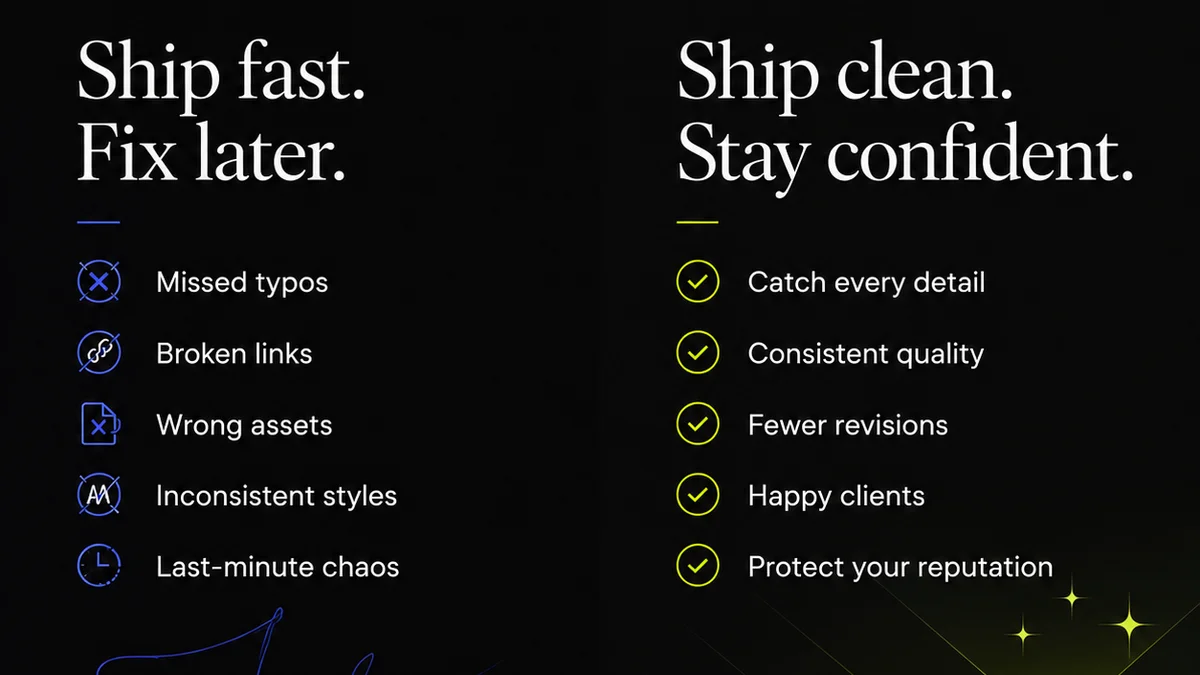
Creative quality is paramount. But operational slip-ups can undermine even the best creative work. Typos, broken links, incorrect specs, brand guideline violations – these are the silent killers of client satisfaction.
AI can act as a tireless, objective quality assurance layer.
The Human Error Factor
Even the most diligent teams make mistakes. Common quality control failures include:
- Missing small errors in copy or design during final checks.
- Inconsistent application of brand assets across deliverables.
- Failure to adhere to technical specifications for different platforms.
- Overlooking minor but noticeable inconsistencies in visual elements.
- Approving work that doesn't fully meet the brief due to misinterpretation.
These are often caught too late, leading to frustrating rework or client dissatisfaction.
AI as Your QA Co-Pilot
AI tools can perform automated checks for:
- Grammar, spelling, and punctuation errors.
- Broken links in digital assets.
- Consistency in brand colors, fonts, and logos.
- Adherence to technical specifications (e.g., image resolution, file formats).
- Compliance with accessibility standards.
This isn't about replacing human review, but augmenting it. AI catches the easily missed details, allowing your team to focus on the strategic and creative nuances.
Where Revue Fits In
You might be thinking, “This all sounds great, but how do I manage it?” The answer lies in centralizing your workflow and feedback.
Revue was built to tackle operational friction head-on, long before AI became a household word. We focus on the core processes that bog down creative teams.
- Centralized Feedback: No more hunting through emails or Slack messages. All client comments live in one place, attached directly to the creative asset. AI can even help analyze this consolidated feedback for clarity.
- Revision and Approval Visibility: Track every version, every comment, every approval status in real-time. This transparency eliminates bottlenecks and ensures everyone is on the same page, reducing the operational overhead of managing revisions.
- Quality Checks: While Revue doesn't perform AI-driven grammar checks, its structured review process ensures that feedback is captured systematically, reducing the chance of critical comments being missed. This structured approach is the foundation upon which AI-powered QA can later be built.
By providing a single source of truth for feedback and approvals, Revue creates the clean, organized data streams that AI tools need to operate effectively. It reduces the very friction that AI is best suited to solve.
Final Thought
AI isn't a silver bullet that will magically make your agency’s creative output superior overnight. It’s a powerful tool for operational efficiency.
The agencies that thrive won’t be the ones chasing the latest generative AI model. They’ll be the ones who master the mundane, who ruthlessly eliminate operational friction, and who leverage technology – AI included – to empower their people.
Are you using AI to fix your operations, or just dreaming about its creative potential?
Frequently asked questions
How can AI reduce operational friction in a creative agency?
AI can reduce operational friction by automating repetitive tasks like data entry, scheduling, and basic reporting. It also streamlines workflows by improving feedback consolidation, accelerating revision cycles, and providing better visibility into project status, freeing up human creativity.
Is AI going to replace creative jobs in agencies?
AI is more likely to augment rather than replace creative jobs. By handling mundane and repetitive tasks, AI allows human creatives to focus on higher-value strategic thinking, complex problem-solving, and innovative ideation.
What are the biggest operational bottlenecks AI can help solve?
AI can help solve bottlenecks related to inefficient client feedback loops, manual tracking of revisions and approvals, time-consuming data entry, inconsistent quality control, and inaccurate project time/cost estimations.
How does a tool like Revue complement AI in improving operations?
Revue centralizes feedback and manages revision/approval workflows, creating organized data. This structured data is essential for AI tools to function effectively. Revue tackles the core friction points, providing a solid foundation for AI-driven enhancements.
Can AI really improve creative quality control?
Yes, AI can significantly enhance quality control by performing automated checks for errors such as typos, grammatical mistakes, broken links, brand guideline inconsistencies, and adherence to technical specifications. This acts as a vital layer of automated review.