Everyone’s talking about AI search trends. They point to ChatGPT, Bard, and the latest generative AI models as the future of information discovery. And that’s not wrong.
But it’s incomplete.
The real challenge isn’t just knowing *that* AI is changing search. It’s understanding *how* to navigate and leverage these shifts to benefit your creative agency’s workflow, client communication, and overall output. The hard truth? Simply observing AI search trends is passive. Actively mastering them requires a strategic shift in how you think about information, feedback, and creative execution.
1. Deconstructing the AI Search Landscape
AI search isn’t a monolith. It’s a rapidly evolving ecosystem with distinct characteristics that impact how we find, process, and use information.
Generative vs. Informational AI
We often conflate AI search with generative AI tools like ChatGPT. While these are powerful, they represent only one facet. Informational AI, on the other hand, focuses on synthesizing and presenting existing data in new ways, often with more direct citations and less creative interpretation.
Understanding this distinction is crucial for knowing which tool to use for which task. Do you need a creative idea, or a factual summary? The answer dictates your AI search strategy.
The Shift from Keywords to Intent
Traditional search relies on precise keyword matching. AI search, particularly in its conversational and generative forms, focuses on understanding user intent. It infers context, nuance, and the underlying need behind a query.
This means your approach to information gathering needs to evolve. Instead of just searching for terms, you need to think about the *questions* you’re trying to answer and the *problems* you’re trying to solve.
Data Integration and Synthesis
AI’s power lies in its ability to process and synthesize vast amounts of data far beyond human capacity. This allows for trend identification and pattern recognition that were previously impossible.
For agencies, this means AI can surface insights from client feedback, market data, and creative performance metrics that might otherwise remain hidden.
2. Identifying Meaningful AI Search Trends
The media bombards us with AI news. How do you filter the signal from the noise and identify trends that actually matter?
Focus on Workflow Impact
The most relevant AI search trends are those that directly impact how your agency operates. Ask yourself:
- Does this AI development speed up research?
- Does it improve the quality of client briefs?
- Does it streamline the feedback and revision process?
- Does it help identify new creative opportunities?
If an AI trend doesn’t have a clear, practical application for your team’s daily tasks or strategic goals, it’s likely just hype.
Look for Data-Driven Insights
True trends are supported by observable shifts in user behavior or technological capability, not just speculative pronouncements. For instance, the increasing use of AI for summarizing long documents or generating initial content drafts are observable trends with tangible impacts.
Consider Client-Centric Applications
How can AI search trends help you serve your clients better? This might involve:
- Faster competitive analysis
- Deeper audience insights
- More personalized content recommendations
- Automated reporting on campaign performance
If AI can help you deliver superior value and insights to your clients, it’s a trend worth exploring.
3. Practical Applications for Creative Agencies
Let’s move beyond theory. How can you integrate AI search into your agency’s day-to-day?
Enhanced Research and Discovery
AI can accelerate initial research phases dramatically. Instead of sifting through dozens of articles, you can ask an AI to summarize key findings, identify opposing viewpoints, or extract specific data points.
This frees up your team for higher-level analysis and creative thinking.
Streamlined Briefing and Ideation
AI can help flesh out project briefs by suggesting target audience personas, potential creative angles, or even initial mood board concepts based on client requirements.
It acts as a powerful brainstorming partner, offering diverse perspectives.
Optimized Feedback and Revision Loops
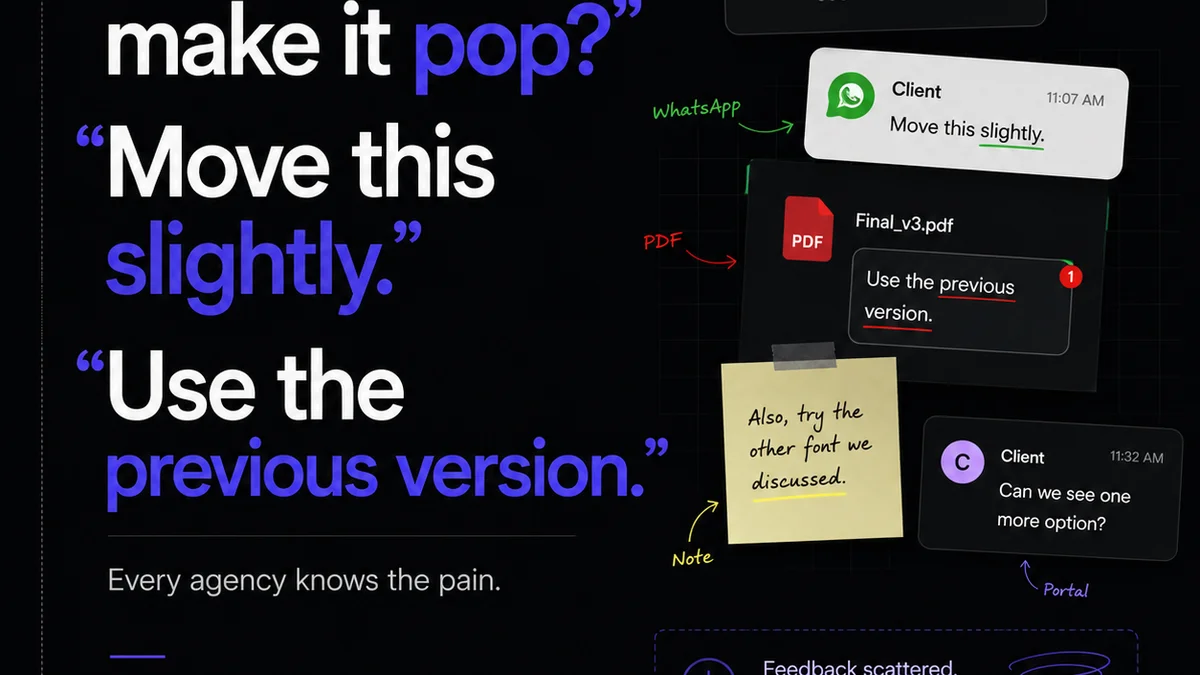
This is where AI search can be transformative. Instead of endless email chains or scattered comments, AI can help synthesize feedback from multiple sources, identify contradictions, and even suggest revisions based on common themes. Imagine an AI that can:
- Aggregate feedback from various stakeholders (clients, internal teams).
- Categorize feedback by type (e.g., copy edits, design suggestions, strategic concerns).
- Flag conflicting feedback for clarification.
- Generate draft revisions based on consensus.
This directly addresses the chaos of creative approvals.
Content Generation and Optimization
AI can assist in drafting initial copy, generating variations of headlines, or even suggesting SEO improvements for web content. It’s a tool for augmentation, not replacement.
Competitive Analysis and Market Monitoring
AI can continuously monitor competitor activities, market shifts, and emerging consumer behaviors, providing your agency with real-time intelligence to inform strategy.
4. The Human Element: Where AI Falls Short
AI is a tool, not a panacea. Its limitations are as important to understand as its capabilities.
Nuance and Empathy
AI struggles with true emotional intelligence, cultural nuance, and the subtle interpersonal dynamics that are critical in client relationships and creative collaboration.
Strategic Judgment and Vision
While AI can process data and identify patterns, it lacks the foresight, intuition, and ethical judgment of experienced human strategists and creatives. True innovation often comes from leaps of faith and understanding unspoken needs, something AI can’t replicate.
Originality and True Creativity
Current AI models are trained on existing data. While they can generate novel combinations, true groundbreaking originality—the kind that shifts paradigms—remains a human domain. AI is excellent at iteration and variation, less so at invention.
Accountability and Ethics
Who is responsible when AI makes a mistake? How do we ensure AI outputs are unbiased and ethically sound? These are complex questions that require human oversight and decision-making.
5. Where Revue Fits In
Navigating AI search trends and their impact on creative workflows requires robust systems for managing information, feedback, and approvals. This is precisely where Revue excels.
Revue centralizes all client communication and feedback related to creative assets. Instead of relying on fragmented AI summaries or disparate communication channels, you have a single source of truth. This ensures that the insights derived from AI research or generated by AI tools are properly contextualized and integrated into actionable tasks.
Our platform provides clear visibility into the revision and approval process. When AI suggests changes or generates options, Revue helps track which versions were reviewed, by whom, and what feedback was provided. This traceability is essential for maintaining quality and accountability, especially when leveraging AI-generated content or insights.
Furthermore, Revue’s quality check features ensure that all creative output, whether AI-assisted or purely human-driven, meets project requirements and client expectations before final delivery. It bridges the gap between AI-powered discovery and human-led execution.
Final Thought
AI search trends are not just about new technologies; they represent a fundamental shift in how we access, process, and act upon information. The agencies that thrive will be those that move beyond passive observation to active mastery. They will integrate AI tools strategically, understanding both their power and their limitations, while always prioritizing the human judgment, creativity, and client relationships that define true agency value.
Are you prepared to evolve your agency’s approach to information and creative execution in the age of AI?
Frequently asked questions
How does AI search differ from traditional keyword search?
Traditional search relies on matching keywords. AI search focuses on understanding user intent, context, and nuance, often through natural language processing, leading to more relevant and synthesized results.
What are the key benefits of using AI for creative agency research?
AI can significantly speed up research by summarizing vast amounts of data, identifying patterns, extracting key information, and providing synthesized insights much faster than manual methods, freeing up human creatives for strategic tasks.
Can AI replace human creativity in agencies?
No. While AI can assist with ideation, content generation, and iteration, it lacks the nuanced understanding, emotional intelligence, strategic judgment, and true originality that human creatives bring to the table. AI is an augmentative tool.
How can an agency manage AI-generated feedback effectively?
By using a centralized platform like Revue to aggregate, categorize, and track feedback, whether it's AI-assisted or direct client input. This ensures clarity, identifies conflicts, and streamlines the revision process.