Everyone talks about features, pricing, and network coverage when discussing B2B SaaS success in telecom. They assume that if the tech works and the price is right, the business will follow. None of that is wrong. But it’s incomplete.
The hard truth? In telecom, where complex solutions meet demanding enterprise clients, the user experience crafted through deliberate B2B SaaS design is often the deciding factor. It’s not just about looking good; it’s about working seamlessly, reducing friction, and proving value at every touchpoint.
1. The Hidden Cost of Poor UX in Telecom SaaS
Telecom is a high-stakes industry. Downtime costs millions. Miscommunication leads to critical failures. Customers expect rock-solid reliability and intuitive interfaces, even for the most complex network management or provisioning tools.
When B2B SaaS design fails, the consequences ripple:
- Increased support tickets and agent load.
- Lengthy, costly onboarding processes.
- High customer churn due to frustration.
- Missed upsell and cross-sell opportunities.
- Damage to brand reputation and trust.
Think about a network operations center (NOC) manager trying to troubleshoot a critical outage. If the dashboard is cluttered, alerts are unclear, and performing diagnostic actions is a multi-step nightmare, that’s not just an annoyance. That’s a direct hit to their ability to do their job, and by extension, a hit to the client’s bottom line. The SaaS itself becomes the bottleneck, not the technology it’s meant to manage.
The Onboarding Black Hole
Many telecom SaaS products are powerful but intimidating. The onboarding phase is where many potential clients are lost forever. If the initial user experience is confusing, overwhelming, or requires a week of dedicated training for basic tasks, the perceived value plummets.
Effective B2B SaaS design anticipates this. It guides users, provides clear feedback, and breaks down complex workflows into manageable steps. It’s the digital equivalent of a patient, expert guide, not a dense instruction manual.
2. Design as a Competitive Differentiator
The telecom SaaS market is crowded. Giants and nimble startups alike are vying for market share. Relying solely on feature parity or aggressive pricing is a race to the bottom.
Superior B2B SaaS design becomes a powerful differentiator. It signals quality, attention to detail, and a deep understanding of the user’s needs.
Consider two platforms offering similar core functionalities for managing fiber optic deployments. One is a maze of menus and cryptic error codes. The other features a clean, task-oriented interface, visual progress indicators, and contextual help. Which one is more likely to win and retain clients? Which one will clients recommend?
Beyond Pretty Pixels: Usability and Efficiency
Good design in this space isn’t about flashy animations. It’s about:
- Clarity: Information is presented logically and is easy to understand.
- Efficiency: Common tasks can be completed with minimal clicks and cognitive load.
- Consistency: UI elements and interaction patterns are predictable across the platform.
- Feedback: The system clearly communicates what’s happening, what’s been done, and what needs to be done next.
- Error Prevention & Recovery: The design helps users avoid mistakes and makes it easy to correct them when they happen.
This focus on usability directly impacts the client’s operational efficiency. If your SaaS helps them provision services faster, manage their network with less effort, or resolve issues more quickly, you’re not just selling software; you’re selling tangible business outcomes.
3. Driving Adoption and Upselling Through User Journeys
The initial sale is just the beginning. True growth in B2B SaaS comes from deep adoption, expansion, and retention. This is where thoughtful user journey design is paramount.
Think about the entire lifecycle of a telecom client using your SaaS:
- Discovery & Evaluation: Clear product marketing and intuitive demo environments.
- Onboarding & Training: Guided setups, in-app tutorials, and accessible documentation.
- Daily Use: Efficient workflows, clear dashboards, and reliable performance.
- Advanced Features: Easy discovery and adoption of more complex capabilities.
- Support & Troubleshooting: Seamless access to help and clear resolution paths.
- Expansion & Upselling: Clear pathways to upgrade or add new services within the platform.
Each of these stages is a design challenge. If the journey is fragmented or frustrating, users will stick to the basics, limiting their reliance on your platform and their potential to scale with you.
Designing for Expansion
A well-designed B2B SaaS product makes it easy for users to discover and adopt new features or higher-tier plans. When a client is successfully using your core offering, a well-placed, contextually relevant prompt to explore a related advanced feature—perhaps one that could automate a manual process they’re still doing—is far more effective than a generic sales email.
This requires understanding user behavior within the application and designing prompts and feature discoverability that feel helpful, not intrusive. It’s about showing them the next logical step in their own success, powered by your software.
4. The Role of Accessibility in Enterprise Adoption
While often overlooked in B2B contexts, accessibility is crucial, especially in enterprise telecom. Diverse teams mean diverse needs, and regulatory compliance is increasingly important.
Designing for accessibility means ensuring your SaaS can be used by people with disabilities. This includes considerations for:
- Visual impairments (e.g., screen reader compatibility, sufficient color contrast).
- Motor impairments (e.g., keyboard navigation, large enough click targets).
- Cognitive impairments (e.g., clear language, predictable layouts).
Adhering to standards like the Web Content Accessibility Guidelines (WCAG) isn't just about compliance; it broadens your potential user base and demonstrates corporate responsibility—a factor increasingly weighed by large enterprise clients.
Furthermore, accessible design principles often lead to more robust and usable interfaces for *everyone*. Clear structure, logical navigation, and understandable content benefit all users, regardless of ability.
5. Where Revue Fits In
Managing complex B2B SaaS projects, especially within large telecom organizations, involves countless stakeholders, iterative feedback loops, and rigorous quality assurance. Keeping this process smooth requires more than just good design principles; it requires robust workflow tools.
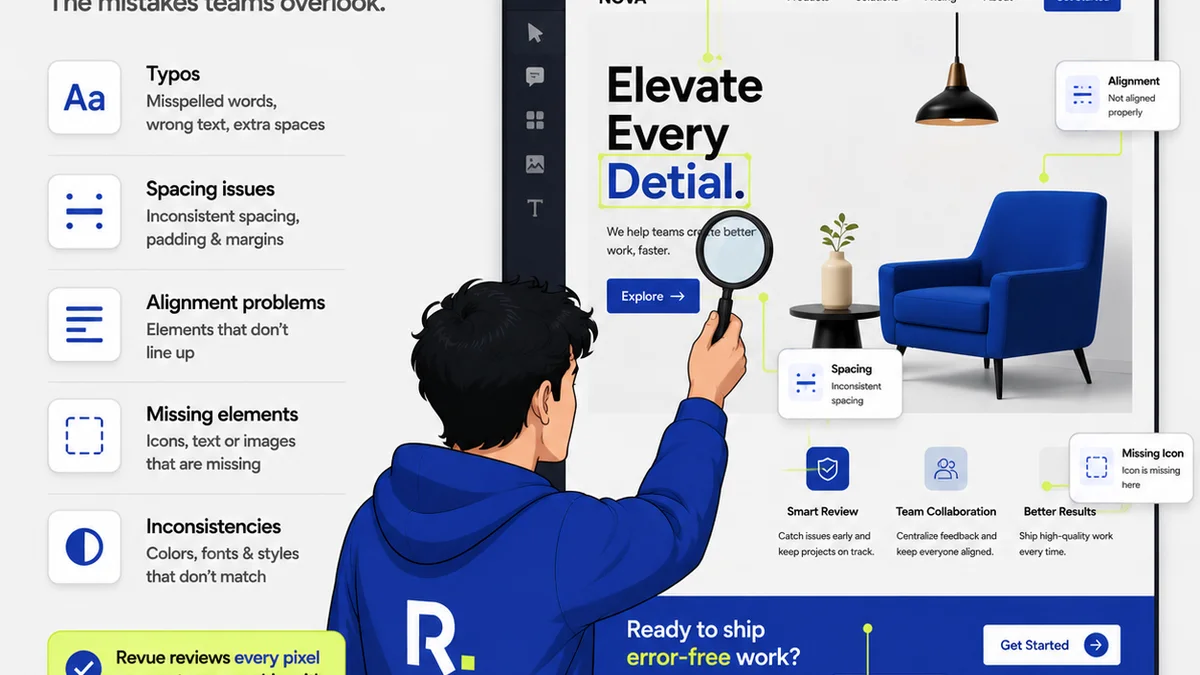
Revue is built for this reality. It centralizes client feedback, providing a single source of truth for comments and revisions on creative assets and software interfaces. Instead of sifting through scattered emails or chat messages, teams can see all feedback in context, directly on the design or prototype.
This visibility extends to revision and approval tracking. When stakeholders can easily see the history of changes and approve specific versions, it streamlines the path to deployment. For telecom SaaS, where accuracy and timely updates are critical, this clarity minimizes errors and accelerates time-to-market.
Finally, Revue aids in quality checks by ensuring that all feedback is addressed and that the final product aligns with client expectations before launch. It transforms the often chaotic feedback process into a structured, manageable workflow, allowing design and development teams to focus on building better products, faster.
Final Thought
B2B SaaS design in telecom is far more than an aesthetic layer. It’s a strategic imperative that directly impacts user adoption, operational efficiency, customer loyalty, and ultimately, revenue growth. Are you treating your SaaS design as a critical business driver, or just a line item?
Frequently asked questions
What is the primary impact of poor B2B SaaS design in telecom?
Poor B2B SaaS design in telecom leads to increased support costs, lengthy onboarding, high customer churn, and damage to brand reputation, directly hindering business growth and customer satisfaction.
How does good UX design differentiate B2B SaaS in telecom?
Good UX design differentiates B2B SaaS by providing clarity, efficiency, consistency, and clear feedback, making complex telecom solutions easier to use and adopt. This leads to better operational outcomes for clients and a stronger competitive edge.
Can B2B SaaS design influence upsells and expansion?
Yes, thoughtful user journey design can make it easier for clients to discover and adopt advanced features or higher-tier plans within the SaaS platform, naturally leading to expansion opportunities.
Why is accessibility important for B2B SaaS in telecom?
Accessibility is important because it broadens the potential user base, ensures compliance with regulations, and reflects corporate responsibility, all of which are increasingly considered by large enterprise clients in the telecom sector.