Everyone talks about the importance of a strong brand. They focus on visual identity, messaging, and market positioning. And sure, that’s all crucial.
But it’s not the whole story. Not even close.
The real differentiator, the engine that quietly drives sustainable business growth, is often overlooked. It’s not the flashy campaigns or the award-winning designs. It’s your brand architecture.
Many leaders assume brand architecture is a complex, academic exercise reserved for massive corporations or M&A events. They think it’s about organizing a sprawling portfolio of sub-brands, a problem they don’t have (yet).
That’s a dangerous assumption.
The hard truth? A poorly defined brand architecture creates internal friction, external confusion, and ultimately, stunts growth. A well-defined one, however, clarifies your offerings, streamlines operations, and builds a stronger, more resilient business.
1. The Misconception: Brand Architecture is Just for Big Companies
This is where most agencies and creative teams get it wrong. They believe that unless they have dozens of distinct service lines or acquired multiple smaller businesses, they don’t need to think about brand architecture. They operate on a day-to-day basis, adding services or product lines as opportunities arise, without a strategic framework to connect them.
This ad-hoc approach leads to a cluttered offering. Clients don’t understand what you *really* do. Your sales team struggles to articulate your value proposition. Your marketing efforts become diluted because you’re trying to be everything to everyone.
The Symptom: A Jumbled Offering
Think about these symptoms:
- Clients ask, “So, what exactly is your core business?”
- Your sales collateral feels inconsistent, jumping between different service names and benefits.
- New service offerings are tacked on without clear relation to existing ones.
- Internal teams struggle to understand which services complement each other.
- Brand messaging becomes a confusing mix of disparate value propositions.
This isn’t a problem of branding; it’s a problem of structure. It’s a brand architecture issue.
2. The Hard Truth: Architecture is the Blueprint for Clarity and Growth
Brand architecture isn’t just about organizing sub-brands. It’s about defining the relationship between your master brand and all its components – services, products, initiatives, even individual teams. It’s the blueprint that dictates how everything connects, communicates, and contributes to the overall business objective.
A clear architecture ensures that every touchpoint reinforces a consistent, coherent brand story. It makes your value proposition unmistakable. It allows you to scale effectively without diluting your core identity.
Types of Brand Architecture Models
Understanding the basic models helps clarify the strategic choices:
- Monolithic (Branded House): One master brand covers all offerings. Think Google. Services like Google Docs or Google Maps are clearly extensions of the Google parent brand. This is efficient for building brand equity but can limit the ability to diversify into vastly different markets or appeal to niche audiences with distinct needs.
- Pluralistic (House of Brands): Each offering has its own distinct brand, often with little to no visible connection to the parent company. Think Procter & Gamble, which owns Tide, Pampers, and Gillette. This allows for highly targeted marketing and appeals to diverse markets but requires significant investment in building equity for each individual brand.
- Hybrid (Endorsed or Sub-brands): A mix of the above. A master brand endorses or is associated with sub-brands, creating a balance. Think Marriott, which has brands like The Ritz-Carlton (highly distinct) and Courtyard by Marriott (clearly part of the Marriott family). This model offers flexibility, leveraging the master brand’s reputation while allowing sub-brands to carve out their own identities.
The choice isn’t arbitrary. It directly impacts how you market, sell, and operate.
3. Building Your Brand Architecture: Beyond the Org Chart
Many leaders think of architecture as an organizational problem. Who reports to whom? Which department owns which client? While organizational structure is related, brand architecture is fundamentally about external perception and internal coherence of your offerings.
It starts with a deep understanding of your business strategy. What are your long-term goals? Who are your target clients? What problems do you solve for them?
Key Questions to Ask
- What are your core capabilities and services?
- How do these capabilities serve different client segments or markets?
- What is the perceived value and distinctiveness of each offering?
- What is the strength and recognition of your master brand?
- What is the desired future state of your business and offerings?
Answering these questions will guide you toward the right architectural model. For a creative agency, this might mean structuring around core disciplines (e.g., Brand Strategy, Digital Design, Content Marketing) or client industries (e.g., Tech, CPG, Non-profit).
The Role of Naming and Messaging
Once the structure is defined, the naming conventions and messaging become critical. Do your service names clearly indicate their relationship to the master brand? Does your messaging consistently reinforce the architecture?
For example, if you’re a monolithic brand, all service names should feel like extensions of the parent brand (e.g., “Acme Strategy,” “Acme Digital,” “Acme Content”). If you’re using a hybrid model, you might have a master brand name followed by a descriptor (e.g., “Revue Insights,” “Revue Creative Studio”) or distinct sub-brand names that are clearly endorsed (e.g., “Brand X, by Revue”).
4. The Impact on Operations and Scalability
A clear brand architecture isn’t just a marketing asset; it’s an operational one. It impacts everything from how you structure teams to how you develop new services.
Streamlined Sales and Marketing
When your offerings are clearly defined and organized, your sales team can articulate your value proposition with precision. Marketing campaigns become more focused and effective because they’re speaking to specific needs within a defined structure. You stop wasting resources trying to appeal to everyone.
Efficient Product/Service Development
New service development becomes a strategic process, not an opportunistic scramble. You can identify gaps or opportunities that logically fit within your existing architecture, building upon your established brand equity rather than diluting it.
Internal Alignment
Your team understands how different parts of the business work together. This fosters collaboration, reduces internal competition, and ensures everyone is working towards a unified vision. It’s much easier to onboard new team members when the company’s structure and offerings are clear.
Client Perception and Trust
Clients appreciate clarity. When they understand what you do, how you do it, and how different services fit together, it builds trust. They see you as a strategic partner, not just a vendor providing disconnected services. This clarity can lead to larger project scopes and longer-term relationships.
5. Where Revue Fits In
Managing a clear brand architecture, especially as your agency or team grows, requires robust systems. This is where Revue becomes indispensable.
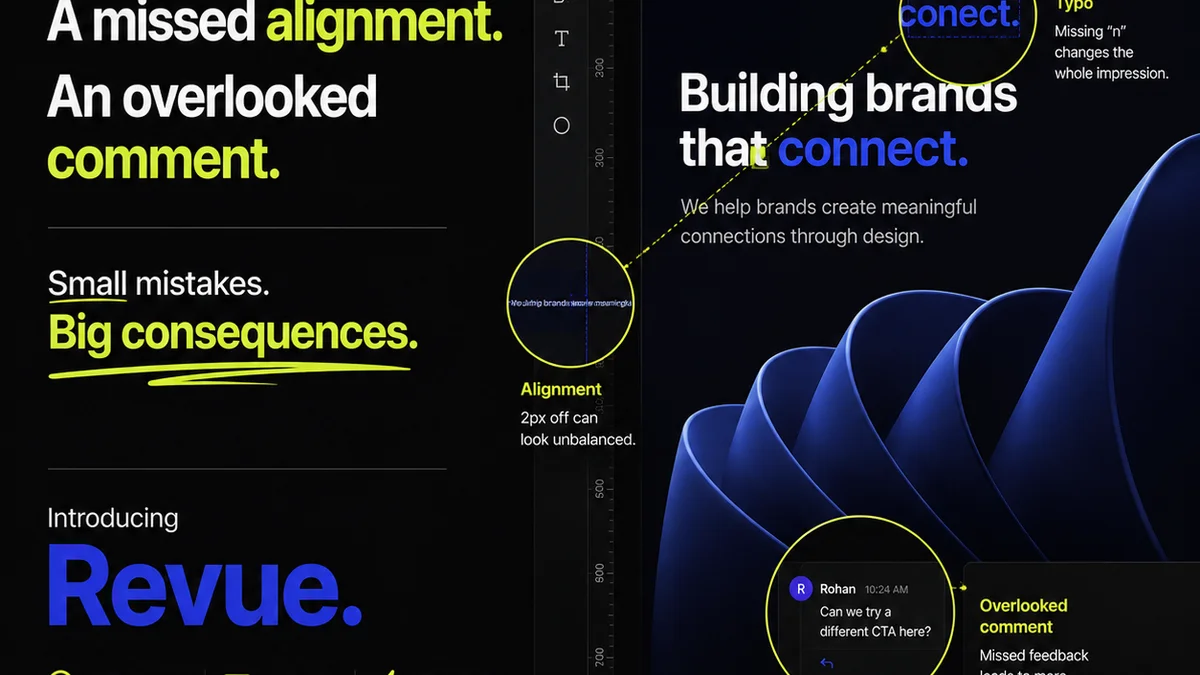
Centralizing client feedback is paramount. When feedback is scattered across emails, Slack messages, and random documents, it’s impossible to maintain consistency. Revue provides a single source of truth for all client input on specific projects and deliverables.
This visibility is key to managing revisions and approvals effectively. You can track every iteration, ensuring that changes align with the project brief and the overarching brand strategy. No more guessing what the client *really* wanted or why a particular direction was taken.
Furthermore, Revue helps maintain quality checks. By having a clear record of feedback, approvals, and revisions, you can ensure that the final output meets both client expectations and your internal brand standards. It’s about operationalizing your brand architecture to deliver consistent, high-quality work that fuels growth.
6. Common Pitfalls to Avoid
Even with a clear strategy, implementation can go awry. Be mindful of these common traps:
- Over-Complication: Trying to create too many distinct sub-brands or overly complex relationships where a simpler model would suffice.
- Inconsistency: Failing to apply the chosen architecture consistently across all communications, internal and external.
- Ignoring Evolution: Sticking rigidly to an architecture that no longer serves the business’s strategic direction.
- Lack of Buy-in: Not involving key stakeholders in the definition process, leading to resistance or confusion during implementation.
- Focusing Only on New Business: Neglecting to apply the architecture to existing services or how internal teams operate.
Your brand architecture should be a living framework, adaptable to business evolution while maintaining its core purpose: clarity and growth.
Final Thought
Brand architecture isn't a one-time project; it's an ongoing strategic discipline. It’s the invisible scaffolding that supports your entire business. Are you building on solid foundations, or are you letting your brand structure become a tangled mess that hinders your growth?
Frequently asked questions
What is brand architecture?
Brand architecture is the organizational structure of a company's brands, sub-brands, products, and services. It defines how they relate to each other and to the master brand, guiding how they are presented to the market and internally.
Why is brand architecture important for business growth?
A clear brand architecture provides clarity for clients and internal teams, streamlines marketing and sales efforts, enables efficient service development, and builds stronger, more consistent brand equity, all of which contribute to sustainable growth.
Is brand architecture only for large corporations?
No. While large corporations often have complex brand architectures, the principles apply to businesses of all sizes. Even a small agency benefits from a clear structure to define its services and value proposition.
What are the main types of brand architecture?
The main types are Monolithic (Branded House), where one master brand covers all offerings (e.g., Google); Pluralistic (House of Brands), where each offering has a distinct brand (e.g., P&G); and Hybrid, which blends elements of both (e.g., Marriott).
How can Revue help with brand architecture?
Revue helps operationalize brand architecture by centralizing client feedback, managing revisions and approvals systematically, and ensuring quality checks. This maintains consistency and reinforces the defined brand structure across all client work.