Everyone talks about brand guidelines. They’re the pretty PDFs that sit on a shelf, or more likely, a forgotten folder in cloud storage. The common assumption is that as long as the logo is the right color and the font is correct, you’re ‘on brand.’
None of that is wrong. But it’s incomplete.
The hard truth is that effective brand review is not about policing pixels; it's about safeguarding strategic intent and ensuring creative work actually *performs*. It’s the operational backbone that keeps client work sharp, consistent, and aligned with business goals.
1. Beyond the Logo: Brand as Strategy
Your brand guidelines are more than just aesthetic rules. They are the distilled essence of a client’s business strategy, target audience, and competitive positioning.
When a brand review focuses solely on visual elements, it misses the deeper strategic alignment.
The Strategic Imperative
A strong brand communicates a promise. Every piece of creative—from a social media post to a full campaign—is an opportunity to reinforce or erode that promise. A superficial review might catch a wrong shade of blue, but it won’t catch a message that alienates the target audience or contradicts a core value.
Consider these common oversights:
- Messaging that doesn't resonate with the defined customer persona.
- Visuals that, while technically correct, feel out of step with the brand's established tone of voice.
- Campaigns that don't clearly articulate the unique selling proposition (USP).
- Creative that fails to differentiate from key competitors in a meaningful way.
2. The Cost of Inconsistency
Inconsistency is the silent killer of brand equity. When a brand’s presentation shifts wildly from one touchpoint to the next, customers get confused. They don’t know what to expect. This erodes trust.
And trust is the currency of business.
The Ripple Effect of Drift
Think about the last time you encountered a brand that felt… off. Maybe the tone was suddenly too casual, or the imagery felt cheap. It might have been a single instance, but it planted a seed of doubt.
For agencies and in-house teams, this means:
- Wasted creative hours on revisions that could have been avoided with clearer initial direction or a more robust review process.
- Client frustration when work doesn’t meet expectations, leading to scope creep or damaged relationships.
- Diluted marketing impact because the message isn't landing consistently.
- Difficulty in building long-term brand loyalty when the customer experience is fragmented.
A structured brand review process acts as a gatekeeper, ensuring that every deliverable is a strong, consistent ambassador for the brand.
3. Driving Business Performance Through Review
This is where the contrarian view really bites. Many see brand review as a purely creative or compliance function. It’s not. It’s a performance driver.
Well-executed creative, aligned with brand strategy, performs better.
The Performance Link
Why? Because it’s clear, targeted, and builds on existing equity. Customers understand it. It’s memorable. It resonates.
A rigorous brand review process helps ensure that creative:
- Speaks directly to the intended audience's needs and desires.
- Clearly communicates the value proposition.
- Stands out in a crowded marketplace.
- Reinforces brand trust and recognition.
- Ultimately, drives desired actions (e.g., purchase, sign-up, engagement).
This isn't about subjective taste; it's about objective effectiveness. A review process that considers strategic alignment alongside visual execution is a competitive advantage.
4. Building a Robust Review Workflow
So, how do you move beyond the superficial PDF check? You build a process.
This means defining clear criteria, involving the right stakeholders, and leveraging tools to manage the feedback loop.
Key Components of Effective Review
A strong review workflow should:
- Define Clear Objectives: What is this creative supposed to achieve? Who is it for? What’s the core message?
- Establish Brand Pillars: What are the 3-5 non-negotiable aspects of the brand's identity and voice?
- Integrate Strategic Checkpoints: Review at key stages, not just at the end. Does the concept align? Does the messaging?
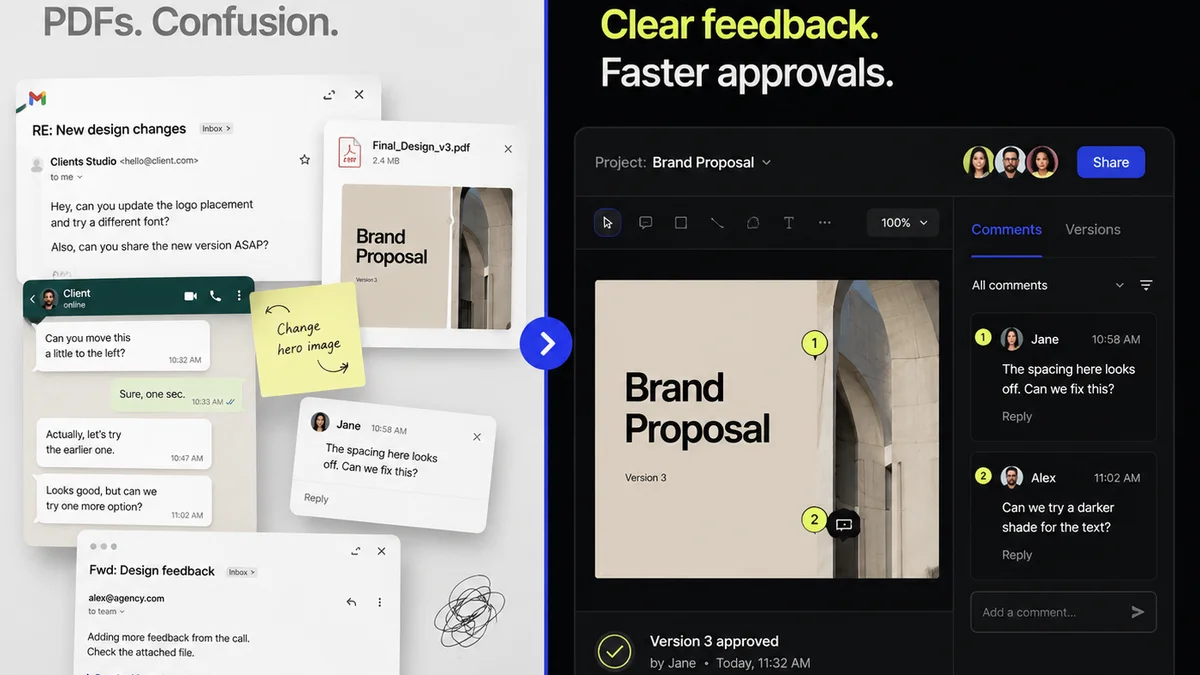
- Centralize Feedback: Avoid scattered email chains and Slack messages. Use a single source of truth for comments and approvals.
- Ensure Accountability: Who is responsible for final sign-off? Who provides the feedback?
- Document Decisions: Keep a record of feedback, revisions, and approvals for future reference and learning.
This structured approach transforms review from a bottleneck into a quality assurance mechanism that strengthens the final output.
Where Revue Fits In
Managing the complexity of creative projects and client feedback can quickly become chaotic. This is precisely why tools like Revue exist.
Revue helps agencies and in-house teams streamline their entire creative workflow, with a particular focus on feedback, revisions, and approvals.
- Centralized Feedback: All client comments, annotations, and stakeholder feedback live in one place. No more hunting through emails or deciphering confusing spreadsheets.
- Revision Visibility: Track every iteration of a creative asset. Understand the evolution of the work and who requested what changes. This clarity is vital for brand consistency.
- Clear Approval Flows: Define who needs to approve what, and when. Get clear sign-offs that confirm alignment with brand strategy and project goals.
- Quality Assurance: By having a clear record of feedback and approvals, you build a stronger case for why the final output meets the brief and adheres to brand standards.
Revue doesn’t just manage tasks; it provides the structure needed to ensure that the creative output is strategically sound and consistently on-brand, directly impacting its effectiveness.
Final Thought
Is your brand review process merely a quality control step, or is it a strategic engine driving business performance? The answer reveals a lot about how effectively your creative work is truly serving your clients’ goals.
Frequently asked questions
What’s the difference between visual review and strategic brand review?
Visual review focuses on aesthetic elements like logo usage, color, and typography. Strategic brand review goes deeper, assessing if the creative aligns with the brand's core message, target audience, business objectives, and overall market positioning.
How can inconsistency harm a brand?
Inconsistency confuses customers, erodes trust, dilutes marketing impact, and makes it harder to build brand loyalty. When a brand's presentation varies, customers don't know what to expect, weakening their connection.
Can a review process actually improve creative performance?
Yes. By ensuring creative is strategically aligned, clearly targeted, and consistent with brand promise, it resonates better with the audience. This clarity and consistency lead to more effective communication and drive desired business outcomes.
What are the essential elements of a good brand review workflow?
A robust workflow includes defining clear objectives, establishing brand pillars, integrating strategic checkpoints, centralizing feedback, ensuring accountability, and documenting decisions. This moves review from a simple check to a strategic safeguard.