Everyone talks about brand strategy. It’s the bedrock of great marketing, the secret sauce for long-term growth. That’s the common wisdom.
None of that is wrong. But it’s incomplete.
The hard truth is, most agencies and in-house teams struggle to connect brand strategy directly to measurable business outcomes. They can articulate the vision, the values, the target audience. But when the CFO asks, “What’s the return on this investment?” the answer gets fuzzy. It devolves into talk of ‘brand lift’ or ‘share of voice’ – metrics that are hard to pin down and even harder to prove.
This isn't about devaluing strategy. It's about operationalizing it. It's about moving beyond subjective 'good branding' to demonstrable, predictable ROI.
1. The Disconnect: Strategy vs. Execution
The biggest hurdle is the perceived separation between strategy and execution. We treat brand strategy like a beautiful, abstract painting – something to admire, but not necessarily to interact with daily.
This separation breeds inefficiency. Here’s what it looks like:
- Strategy documents gather dust on digital shelves.
- Marketing campaigns pull in different directions, lacking a cohesive narrative.
- Creative teams operate on guesswork, unsure if their work truly aligns with strategic goals.
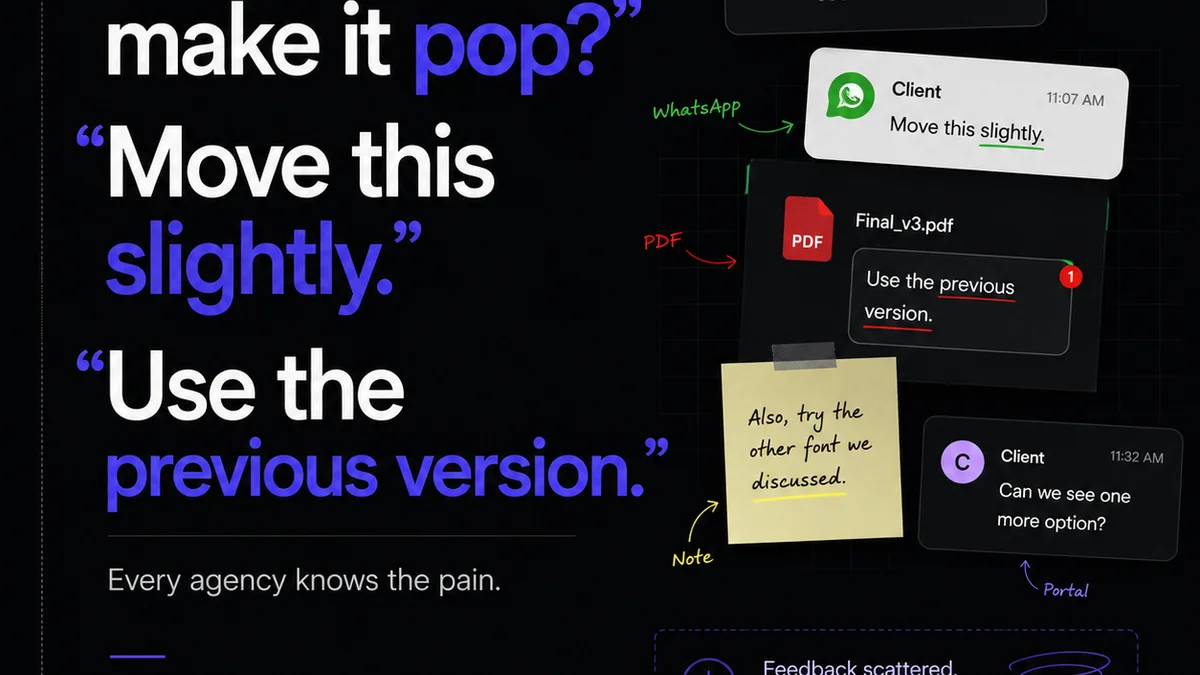
- Client feedback becomes a chaotic back-and-forth, disconnected from the original strategic brief.
- Measuring impact becomes an exercise in correlation, not causation.
This leads to wasted time, budget, and ultimately, missed revenue opportunities. The brand strategy isn't failing; it's simply not being *applied* effectively.
The Real Cost of Ambiguity
When brand strategy isn't a living, breathing part of daily workflow, the costs mount:
- Wasted Creative Resources: Designers and copywriters spend hours on assets that miss the strategic mark.
- Ineffective Campaigns: Marketing spend yields lower returns because messaging is diluted or misaligned.
- Client Frustration: Endless revision cycles, driven by unclear strategic direction, erode client trust and satisfaction.
- Lost Sales Opportunities: A weak or inconsistent brand fails to attract and convert the right customers.
This isn't just an agency problem. It’s an in-house challenge, too. Teams get bogged down in internal politics or siloed thinking, losing sight of the strategic North Star.
2. Defining Brand Strategy ROI: Beyond 'Awareness'
Let's get specific about what Brand Strategy ROI actually means. It’s not just about how many people *see* your logo. It’s about how the *perception* of your brand influences purchasing decisions and customer loyalty, and how that translates into tangible business value.
True Brand Strategy ROI is about predictable revenue and sustainable growth.
Consider these core components:
- Customer Acquisition Cost (CAC): A strong brand, clearly communicated, should lower your CAC. Potential customers understand what you offer and why it matters, reducing the effort and expense needed to win them over.
- Customer Lifetime Value (CLV): A compelling brand builds loyalty. Customers who connect with your brand are more likely to make repeat purchases and less likely to churn, increasing their CLV.
- Conversion Rates: Clear, consistent brand messaging across all touchpoints makes it easier for prospects to understand your value proposition and move through the sales funnel.
- Premium Pricing: Strong brands often command higher prices because customers perceive greater value, quality, or status.
- Employee Retention & Productivity: A clear, inspiring brand purpose attracts and retains talent, boosting morale and productivity.
These are quantifiable metrics. They are the real indicators of whether your brand strategy is working.
The 'Hard Truth' About Measurement
Many teams rely on vanity metrics like social media likes, website traffic, or even brand recall surveys. These are often lagging indicators or, worse, proxies for actual business impact.
The real work lies in connecting strategic intent to these bottom-line metrics. This requires a system, not just a plan.
3. Operationalizing Brand Strategy: From Brief to Approval
How do you move brand strategy from a static document to a dynamic, revenue-generating engine? You embed it into your workflow. You make it the filter for every decision.
This starts with a crystal-clear brief, built directly from the strategy. It needs to be more than a list of deliverables. It must articulate:
- The core strategic objective.
- The target audience and their specific needs/desires.
- The key message and unique value proposition.
- The desired emotional and rational response.
- The success metrics tied to business outcomes.
This brief then becomes the single source of truth for all subsequent creative and marketing efforts. Every piece of copy, every visual asset, every campaign element must be evaluated against it.
Systemizing Feedback and Revisions
The biggest friction point in applying strategy consistently? Feedback and revisions. Without a structured process, it’s easy for subjective opinions or tangential ideas to derail strategic intent.
Imagine a client reviewing a new campaign concept. If their feedback is simply “I don’t like the blue,” and there’s no strategic rationale to push back or guide the revision, the strategy is already compromised.
A structured approach requires:
- Centralized Feedback: All comments and annotations in one place, linked to specific project elements.
- Contextual Clarity: Feedback linked directly to the strategic brief and objectives. Why is this change being requested? How does it serve the strategy?
- Clear Approval Workflows: Defined stages and responsible parties for review and sign-off.
- Version Control: Easy tracking of changes and the rationale behind them.
This isn't about preventing feedback. It's about ensuring feedback is *strategic*, actionable, and contributes to the overall business goals, not just aesthetic preferences.
4. Where Revue Fits In
This is where operationalizing brand strategy becomes manageable. Revue is built to bridge the gap between strategic intent and creative execution, ensuring your brand strategy consistently drives measurable results.
Centralized Feedback: Instead of scattered emails and Slack messages, all client feedback lives within Revue, attached to the specific creative asset. This ensures feedback is contextual and easily referenced against the original strategic brief.
Revision and Approval Visibility: Track every revision, every comment, and every approval. This transparency means you can always see how a project evolved and whether those changes stayed true to the core brand strategy. It eliminates the ‘he said, she said’ and provides an auditable trail.
Quality Checks Aligned with Strategy: Use Revue’s structured review process to ensure creative output doesn't just look good, but *performs* strategically. Is the messaging clear? Does it resonate with the target audience? Does it support the overarching business objective?
By centralizing these crucial workflow steps, Revue helps ensure that your brand strategy isn't just a document, but an active, guiding force in every project. This operational discipline is key to unlocking genuine Brand Strategy ROI.
5. Calculating Your Brand Strategy ROI
So, how do you actually calculate it? It requires moving beyond simple attribution models and looking at the interplay between brand perception and business performance.
Step 1: Define Baseline Metrics. Before any major strategic initiative, understand your current CAC, CLV, conversion rates, and average order value.
Step 2: Link Strategy to Initiatives. Clearly define which marketing and creative initiatives are designed to impact specific strategic objectives (e.g., increasing perceived quality to justify premium pricing).
Step 3: Track Post-Initiative Performance. Monitor the defined metrics after the initiatives have been live for a statistically relevant period. Look for shifts.
Step 4: Isolate Brand Impact (The Hard Part). This is where it gets tricky. You can’t always isolate brand impact perfectly. However, by controlling for other variables (e.g., competitor actions, market trends) and using A/B testing where possible, you can infer the contribution of your brand strategy.
- Example: If a brand refresh focused on communicating 'premium quality' leads to a measurable increase in average order value and a reduction in price sensitivity (fewer customers abandoning carts due to price), you can attribute a portion of that gain to the brand strategy's success.
Step 5: Calculate the Return.
ROI = [(Gain from Investment - Cost of Investment) / Cost of Investment] * 100%
The 'Gain from Investment' here is the incremental revenue or profit directly attributable to the improved brand perception and its impact on metrics like CLV, conversion rates, or premium pricing capabilities. The 'Cost of Investment' includes the cost of developing the strategy, implementing it across all touchpoints, and the operational tools (like Revue) that ensure its consistent application.
It’s not always a perfect science, but it’s a far cry from guessing based on likes and shares.
Final Thought
Is your brand strategy a guiding star, or just a pretty constellation? The difference lies in how systematically you translate its vision into everyday execution and measure its impact on the bottom line. If you can’t connect your brand strategy to revenue, you’re not just missing out on ROI – you’re missing out on the fundamental purpose of business.
Frequently asked questions
What is the difference between brand awareness and Brand Strategy ROI?
Brand awareness is about recognition and reach (how many people see your brand). Brand Strategy ROI is about the measurable business impact of your brand's perception, directly influencing revenue through factors like customer acquisition cost, lifetime value, and conversion rates.
How can I prove the ROI of my brand strategy?
To prove ROI, define baseline business metrics (like CAC, CLV, conversion rates) before implementing strategic initiatives. Track performance post-initiative, isolate the impact of brand perception on these metrics, and then calculate the return using the standard ROI formula: [(Gain - Cost) / Cost] * 100%.
What are the key components of Brand Strategy ROI?
Key components include lower Customer Acquisition Cost (CAC), increased Customer Lifetime Value (CLV), improved Conversion Rates, the ability to command Premium Pricing, and better Employee Retention & Productivity. These are all directly influenced by a strong, well-executed brand strategy.
How does feedback management affect Brand Strategy ROI?
Unmanaged feedback can dilute strategic intent, leading to misaligned creative and ineffective campaigns, thus lowering ROI. Centralized, contextual feedback linked to strategic goals ensures that revisions strengthen, rather than weaken, the brand's impact on business outcomes.