Everyone says you need to find a creative agency that 'gets your brand.' That they need to be 'innovative' and 'strategic.' That their portfolio should 'wow' you.
None of that is wrong. But it’s incomplete. It’s the surface-level checklist that distracts from the real work of selecting a partner who can actually execute and deliver tangible results, not just pretty pictures.
The hard truth? The most crucial factor in choosing a creative agency isn't their aesthetic or their pitch deck. It's their operational DNA. It’s how they manage feedback, revisions, and approvals. It’s their workflow. Because a brilliant idea stuck in a feedback loop is just a lost opportunity.
1. Beyond the Portfolio: Unpacking Operational Rigor
Your agency's portfolio is their highlight reel. It shows their best work, polished to perfection. What it doesn’t show is the messy middle: the back-and-forth, the missed deadlines, the scope creep, the communication breakdowns that plague even the most talented teams.
When evaluating an agency, look past the shiny case studies. Ask pointed questions about their internal processes. How do they handle client feedback? What’s their revision process like? How do they ensure quality control before a deliverable hits your desk?
The Feedback Black Hole
This is where most agencies falter. They might promise agility, but their systems are built for chaos. Unstructured feedback, endless email chains, and subjective opinions disguised as critiques can derail projects.
- Does the agency have a clear system for collecting, organizing, and responding to feedback?
- How do they differentiate between subjective opinion and actionable critique?
- What tools do they use to manage feedback and track revisions?
- How do they communicate changes and get final sign-off?
An agency that can’t articulate a clear, efficient feedback loop is an agency that will waste your time and money. They’re a black hole where good ideas go to die.
Revision Rounds: A Measure of Efficiency
Revisions are inevitable. The *number* of revisions, and how they're managed, is a critical indicator of an agency's operational health.
Are they transparent about their revision policy? Is it clearly defined in the SOW? Or is it a nebulous 'we'll keep working on it until you love it' promise that opens the door to endless scope creep?
- What is their standard revision round policy?
- How are additional revision rounds priced?
- What’s their process for documenting and implementing requested changes?
- How do they handle 'out-of-scope' requests?
An agency that respects your budget and timeline will have a firm, fair revision process. They won’t be afraid to say 'no' to unreasonable demands, and they’ll be able to justify it with clear communication.
2. The 'Creative Director' Assumption
You might assume the Creative Director (CD) is the ultimate gatekeeper of quality and vision. And they are, to an extent. But a great CD can’t operate in a vacuum. They need a solid production and project management team behind them.
A brilliant CD with a disorganized team is a recipe for disaster. They might have the vision, but can they execute? Can they translate that vision into a tangible asset on time and on budget?
The Role of Project Management
This is often overlooked. You're not just hiring creatives; you're hiring a team that can execute. A strong Project Manager (PM) is the linchpin. They are the ones who:
- Translate client needs into actionable tasks for the creative team.
- Manage timelines and budgets rigorously.
- Facilitate communication between the client and the internal team.
- Identify and mitigate risks before they derail the project.
- Ensure that creative vision aligns with practical constraints.
Don’t just ask about the CD. Ask about their PMs. Ask about their process for project planning, resource allocation, and risk management. A stellar PM can elevate a good creative idea into a great, delivered project.
Production vs. Concept
Some agencies excel at conceptualization but struggle with execution. Others are production powerhouses but lack true creative spark. The best agencies find the balance.
When you see a portfolio piece, ask:
- Who was responsible for the execution?
- What production challenges did they overcome?
- How did they ensure the final output matched the initial concept?
This reveals whether their brilliance is conceptual or deeply embedded in their production capabilities.
3. Understanding 'Strategic Alignment'
Every agency claims to be strategic. They’ll talk about brand positioning, market research, and ROI. But what does that actually look like in practice?
True strategic alignment means the agency understands your business goals, not just your marketing goals. They should be asking about your P&L, your customer acquisition costs, your retention rates. They should be measuring success not just in likes or impressions, but in business impact.
The Business of Creativity
Creativity is a tool to solve business problems. An agency that doesn't understand your business is just applying a tool blindly.
Ask how they measure the success of their campaigns. Is it just vanity metrics, or do they tie it back to:
- Customer acquisition cost (CAC)
- Lifetime value (LTV)
- Conversion rates
- Revenue growth
- Market share
An agency that can’t speak your business language is an agency that’s not truly aligned with your strategy.
Data-Driven Creativity
The best agencies don't just rely on gut feeling. They use data to inform their creative decisions. This doesn't mean creativity is dead; it means creativity is *smarter*.
How does the agency use data?
- Do they conduct user research?
- Do they A/B test creative assets?
- Do they analyze campaign performance to iterate and improve?
- Do they use data to understand audience behavior and preferences?
An agency that blends creative intuition with data analysis is your best bet for impactful work.
4. Where Revue Fits In
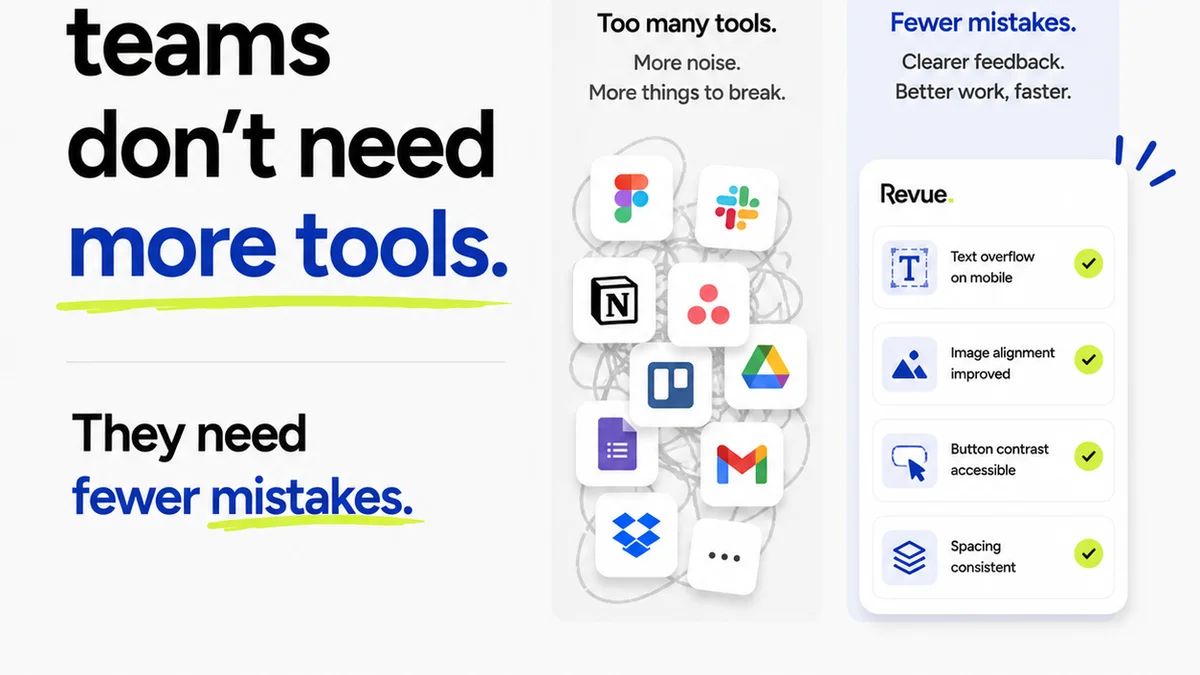
Managing client feedback, tracking revisions, and ensuring quality control are operational challenges that Revue is built to solve.
Instead of relying on scattered email threads, clunky spreadsheets, or endless Zoom calls, Revue centralizes all client communication and asset review in one place. This transparency and organization are critical for any agency serious about efficient delivery.
- Centralized Feedback: All comments, markups, and approvals live on the asset itself, eliminating ambiguity and lost messages.
- Revision Visibility: Easily track every iteration, compare versions, and understand the history of changes. This provides accountability for both the agency and the client.
- Quality Assurance: With clear feedback and approval trails, teams can run final quality checks with confidence, knowing all stakeholders have signed off.
Choosing the right agency is about finding a partner whose operational backbone supports their creative muscle. Tools like Revue are designed to amplify that operational strength, ensuring that great ideas translate into great, delivered work, efficiently and effectively.
Final Thought
The 'perfect' creative agency doesn't exist. But the right operational fit for *your* business absolutely does. Stop prioritizing the pitch deck. Start dissecting the workflow.
Is your potential agency built for clarity, efficiency, and accountability? Or are they just selling you a dream that will crumble under the weight of their own disorganization?
Frequently asked questions
What's more important: an agency's portfolio or their process?
While a strong portfolio is essential, an agency's process is ultimately more critical for successful project delivery. A great portfolio shows potential; a robust process ensures execution. Look for an agency that can clearly articulate how they manage feedback, revisions, and approvals efficiently.
How can I assess an agency's project management capabilities?
Ask specific questions about their Project Managers (PMs). Inquire about their methods for planning, resource allocation, risk mitigation, and client communication. A strong PM is the linchpin for keeping creative projects on time and on budget.
What does 'strategic alignment' really mean when choosing an agency?
It means the agency understands your broader business objectives, not just marketing goals. They should be able to discuss your P&L, CAC, LTV, and how their creative work directly impacts these metrics. They use data to inform strategy and measure success beyond vanity metrics.
How should an agency handle client feedback and revisions?
An effective agency has a clear, documented process for collecting, organizing, and responding to feedback. They differentiate between subjective opinions and actionable critiques, have a defined revision round policy, and manage out-of-scope requests transparently. Tools that centralize this communication, like Revue, are a good sign.