Everyone thinks choosing a visual identity agency is about picking the one with the prettiest portfolio. That’s what you see on Dribbble, right? Shiny logos, slick websites. None of that is wrong. But it’s incomplete. Dangerously incomplete.
The hard truth is, a beautiful brand identity is only half the battle. The other half—the part most clients overlook—is operational. It’s about how that identity will be managed, scaled, and consistently applied across every touchpoint, every day, by your team and your partners.
1. Beyond the Pretty Picture: What Business Problem Are You Solving?
Before you even look at an agency’s website, ask yourself: What business problem is our current visual identity failing to solve? Are sales stagnant? Is market share eroding? Are we struggling to attract a specific customer segment? Or is it just that the logo feels dated?
A visual identity agency’s job isn’t just to make things look good. It’s to solve business problems through strategic design. A great agency will dig into your objectives, your audience, and your market position before sketching a single line.
The Strategic Brief: Your First Filter
A robust creative brief is non-negotiable. If an agency skips this, or treats it as a formality, run. A strong brief forces clarity. It outlines:
- Business goals
- Target audience(s)
- Competitive landscape
- Brand personality and values
- Key messaging
- Deliverables required
- Success metrics
The agency’s response to your brief is your first real test. Do they ask clarifying questions? Do they challenge your assumptions? Do they propose solutions that align with your business objectives, not just aesthetic trends?
2. The Portfolio Paradox: Don’t Just Look at the Final Product
It’s easy to be swayed by a gallery of stunning logos and branding systems. But a portfolio is a curated highlight reel. You need to see the behind-the-scenes.
Ask agencies to walk you through their process on 2-3 case studies. Don’t just look at the final logos. Look at:
- How did they define the problem?
- What research did they conduct?
- How did they translate insights into strategic design decisions?
- How did they handle client feedback and revisions?
- How did they ensure the identity was adaptable and scalable?
- What were the measurable business outcomes?
A truly effective visual identity is built on a foundation of strategy and research, not just intuition. The best agencies can articulate the ‘why’ behind every design choice.
The Deliverables Deep Dive
A brand identity isn't just a logo. What else are you getting? A comprehensive package should include:
- Brand strategy documentation
- Logo variations (primary, secondary, icon)
- Color palettes (primary, secondary, accent)
- Typography guidelines
- Imagery/photography style
- Voice and tone guidelines
- Application mockups (web, print, social, etc.)
- A comprehensive brand style guide
The style guide is crucial. It’s the operational manual for your brand. A poorly documented brand identity is a ticking time bomb for inconsistency.
3. Operational Readiness: Can They Build for the Long Haul?
This is where most agencies and clients fall short. A beautiful brand is useless if it’s a nightmare to implement. Your chosen agency needs to think about the practicalities of your day-to-day operations.
Consider these questions:
- How will the brand guidelines be delivered? Are they easily accessible?
- Does the agency provide digital assets in formats that are easy for your team to use?
- Do they offer a digital brand hub or asset management system?
- Can they train your team on implementing the new identity?
- Do they anticipate future needs and design for scalability?
A strong visual identity system is designed for flexibility and ease of use. It should empower your team, not create more work.
The Tech Stack Alignment
Think about your existing tools. Will the new brand assets integrate smoothly with your website CMS, your marketing automation platform, your design software? An agency that understands the technical side of implementation can save you significant headaches.
For example, ensuring that logos are provided in vector formats (SVG, AI) and raster formats (PNG, JPG) for different uses is basic, but critical. Color values should be provided in HEX, RGB, CMYK, and Pantone.
4. Agency Culture and Chemistry: The Unspoken Factor
You’ll be working closely with this agency. Sometimes for months. Culture fit isn't just a nice-to-have; it’s a business imperative. Misalignment here can derail even the most strategically sound project.
Look for:
- Communication Style: Are they responsive? Transparent? Do they listen?
- Collaboration: Do they treat you as a partner or just a client?
- Problem-Solving Approach: Are they flexible and adaptable, or rigid?
- Passion and Enthusiasm: Do they seem genuinely excited about your brand and your business?
A good working relationship is built on trust and mutual respect. You should feel confident that they have your best interests at heart.
The Proof is in the Process
During your initial conversations, pay attention to how they interact. Do they:
- Ask insightful questions about your business beyond the surface level?
- Demonstrate a clear understanding of your industry challenges?
- Explain their process in a way that makes sense to you?
- Show genuine curiosity about your team and your goals?
This early interaction is a strong indicator of how the partnership will feel long-term.
5. Pricing Models and Value: Beyond the Hourly Rate
Agency pricing can be opaque. Resist the urge to simply go with the lowest bid. Value is what matters, not just cost.
Understand how the agency structures its fees:
- Project-based: A fixed price for a defined scope.
- Retainer: Ongoing monthly fee for a set amount of work or availability.
- Time and materials: Billed based on actual hours worked.
Ask for a detailed breakdown of what’s included in their proposed fee. Does it cover strategy, design, revisions, asset creation, style guide development, and any required training or handover?
A higher upfront investment in a truly strategic and well-documented brand identity often yields greater long-term returns by preventing costly mistakes and ensuring brand consistency. Think about the cost of fixing a poorly implemented brand versus doing it right the first time.
Where Revue Fits In
Once your visual identity is established, the real work begins: consistent application and management. This is where a tool like Revue becomes invaluable for agencies and in-house teams.
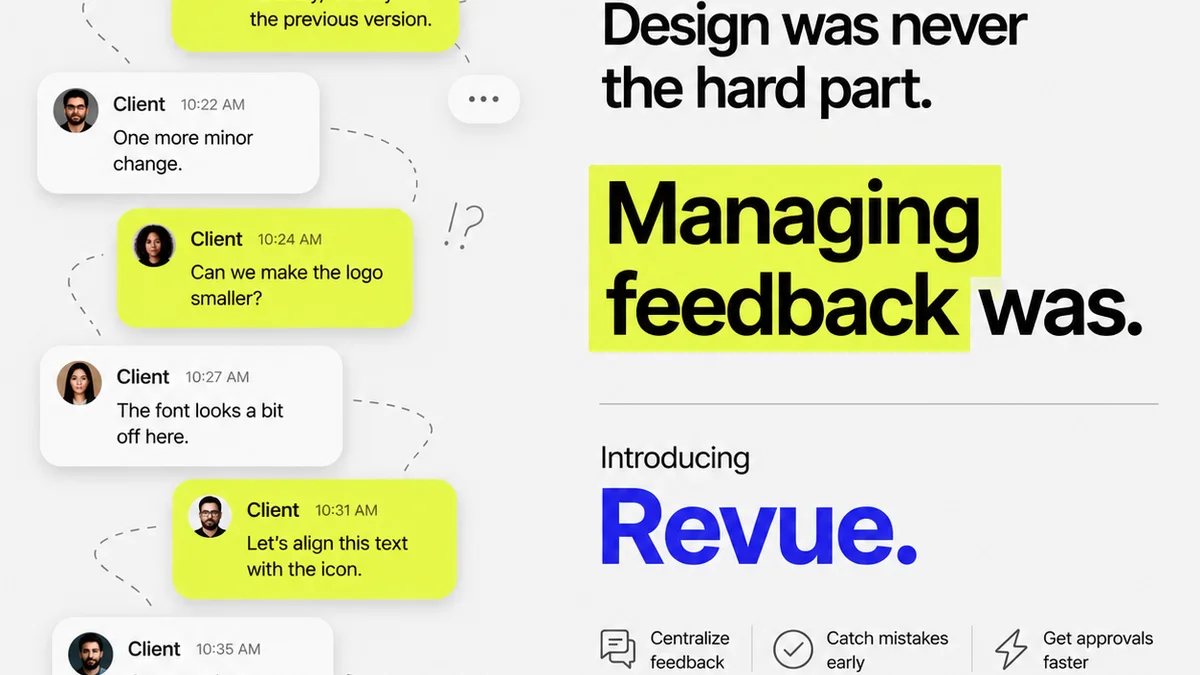
Revue centralizes client feedback, making it easy to track comments, manage revisions, and get clear approvals on all creative assets, including brand identity elements. This visibility ensures that the new visual identity is implemented precisely as intended, reducing ambiguity and speeding up the approval process.
It helps maintain the integrity of the brand by providing a single source of truth for feedback and revisions, ensuring that every iteration aligns with the strategic goals set during the initial branding phase.
Final Thought
Choosing a visual identity agency is a strategic decision that impacts your business for years to come. Don't get lost in the aesthetic. Focus on the strategy, the process, the operational readiness, and the partnership. The agencies that excel at these will deliver not just a beautiful brand, but a powerful business asset.
Are you prioritizing beauty over business impact when selecting your next brand partner?
Frequently asked questions
What is the most important factor when choosing a visual identity agency?
Beyond aesthetics, the most crucial factor is the agency's strategic approach and their ability to translate business objectives into a cohesive visual identity. Look for an agency that prioritizes understanding your business problems and designing solutions, not just creating pretty pictures.
How can I evaluate an agency's process?
Ask agencies to walk you through case studies, focusing on their research, strategic decision-making, and how they handled client feedback and revisions. A strong process involves deep dives into the client's business, not just surface-level design.
What deliverables should I expect from a visual identity project?
A comprehensive package typically includes brand strategy, logo variations, color palettes, typography guidelines, imagery style, voice and tone guidelines, application mockups, and a detailed brand style guide. The style guide is essential for consistent implementation.
Why is operational readiness important for a visual identity?
Operational readiness ensures the brand identity is easy to implement and manage across all touchpoints. This includes providing assets in usable formats, clear guidelines, and potentially training your team, preventing future inconsistencies and saving time and resources.
How should I approach agency pricing?
Don't just compare costs; evaluate value. Understand the pricing model (project-based, retainer, time & materials) and ensure the proposal includes all necessary deliverables. A higher investment in a strategic, well-documented identity often yields better long-term business results.