Everyone agrees that managing client feedback is crucial for creative agencies. You’ve probably heard that better communication, clear briefs, and organized file sharing are the keys to success.
None of that is wrong. But it’s incomplete.
The real hard truth is that the *process* of gathering, managing, and acting on client feedback is the bedrock of agency profitability and client satisfaction. And the right software isn't just a nice-to-have; it's a fundamental operational requirement.
What most agencies miss is that client feedback software isn't about making clients happy; it’s about making your internal team efficient. It’s about reducing ambiguity, cutting down revision cycles, and ensuring quality.
1. Beyond Basic Annotation: True Workflow Integration
You see software that lets clients drop pins on a PDF. It feels modern. It feels like progress.
But if that annotation tool doesn’t talk to your project management system, your version control, and your internal review stages, it’s just another silo.
The best client feedback process software does more than just capture comments. It bridges the gap between external input and internal action.
The Illusion of Simplicity
Many tools offer simple markup. Click here, type there. Easy for the client.
The problem? This often creates a tangled mess of unstructured data. How do you translate those scattered comments into actionable tasks for your designers, copywriters, or developers?
What to Look For:
- Contextual Task Creation: Can you turn a client comment directly into a task assigned to a team member? Does it retain the original annotation and file version?
- Version Control Integration: Does the feedback apply to the specific version of the asset being reviewed? Can you easily track revisions and compare versions side-by-side with feedback?
- Status Tracking: Can your team mark feedback as 'Received,' 'In Progress,' 'Resolved,' or 'Closed'? Can clients see the status of their feedback?
- Automated Notifications: Does the system alert the right people when new feedback is added or a task is completed?
If your feedback tool generates more work in trying to manage its output than it saves, it’s failing.
2. Centralizing the Chaos: One Source of Truth
How many times have you chased down feedback via email, Slack, a Word doc, or a carrier pigeon?
This fragmentation is where projects go off the rails. It’s where misinterpretations happen. It’s where scope creep breeds.
Your client feedback process software *must* be the single source of truth for all creative approvals and revisions.
The Email Black Hole
Email is the default. It’s familiar. It’s also a disaster for managing feedback on creative assets.
Threads get lost. Attachments are outdated. Key decisions are buried.
What to Look For:
- Project-Specific Hubs: Does the software allow you to create distinct spaces or projects for each client or campaign?
- Asset Management: Can you upload and organize all relevant creative assets (images, videos, documents, websites) within a project?
- Consolidated Commenting: All feedback, from all stakeholders, for all assets, should live in one place. No more digging.
- Searchability: Can you easily search past feedback, comments, and decisions?
If you’re still wrestling with spreadsheets and email chains to track feedback, you’re bleeding time and money.
3. Visibility and Accountability: Who Said What, When?
Ambiguity kills efficiency. When it’s unclear who requested a change, why it was requested, or if it was even approved, you’re setting yourself up for conflict and delays.
Good client feedback software provides a clear, auditable trail of every interaction.
The 'He Said, She Said' Trap
This is a classic agency problem. A client stakeholder claims they never approved a certain direction. Or a junior account manager agrees to a change without proper sign-off.
Without a clear record, you’re stuck.
What to Look For:
- User Identification: Every comment and decision must be clearly attributed to a specific user.
- Timestamping: When was the feedback given? When was it actioned? When was it approved?
- Decision Logs: Is there a way to formally mark decisions or approvals within the system?
- Revision History: Can you see the progression of an asset through multiple feedback rounds and approvals?
This isn't about blame. It's about clarity. It’s about protecting your team and your client relationships.
4. Streamlining Revisions and Approvals
The goal isn't just to collect feedback; it's to move projects forward. Your client feedback process software should actively facilitate this, not hinder it.
Revision cycles are often the longest and most expensive part of a project. Software should shorten them.
The Endless Loop
Projects can get stuck in revision hell. Feedback is given, changes are made, more feedback is given, and the cycle repeats without end.
Often, this is because the feedback itself isn't structured, or the approval process is vague.
What to Look For:
- Clear Approval Workflows: Can you define stages for review and approval? Can specific stakeholders be assigned approval tasks?
- Redline vs. Decision: Differentiate between suggested edits (redlines) and final approval. Not every comment needs a full revision.
- Status Indicators: Visual cues that show the current state of an asset or a specific piece of feedback (e.g., Pending, Approved, Needs Revision).
- Deadline Management: Can you set deadlines for feedback and approvals to keep things moving?
If your software makes it *harder* to get a final sign-off, you’re using the wrong tool.
5. Ensuring Quality and Consistency
Beyond just client satisfaction, robust feedback management ensures the final output meets quality standards. This is critical for brand integrity and avoiding costly rework down the line.
It’s about building in checks and balances throughout the creative process.
The 'Good Enough' Syndrome
Without a structured way to review and approve, work can sometimes settle for 'good enough.' This erodes quality over time.
It also makes it harder to enforce brand guidelines or technical specifications consistently.
What to Look For:
- Checklist Functionality: Can you build custom quality checklists for different project types or deliverables?
- Brand Guideline Integration: Can you reference or attach brand guidelines for easy team access during reviews?
- Technical Spec Verification: For digital work, can you ensure feedback aligns with technical requirements (e.g., accessibility standards)?
- Final Sign-off Capture: A clear, documented final approval before handover.
Quality isn’t an accident. It’s the result of a well-managed process.
Where Revue Fits In
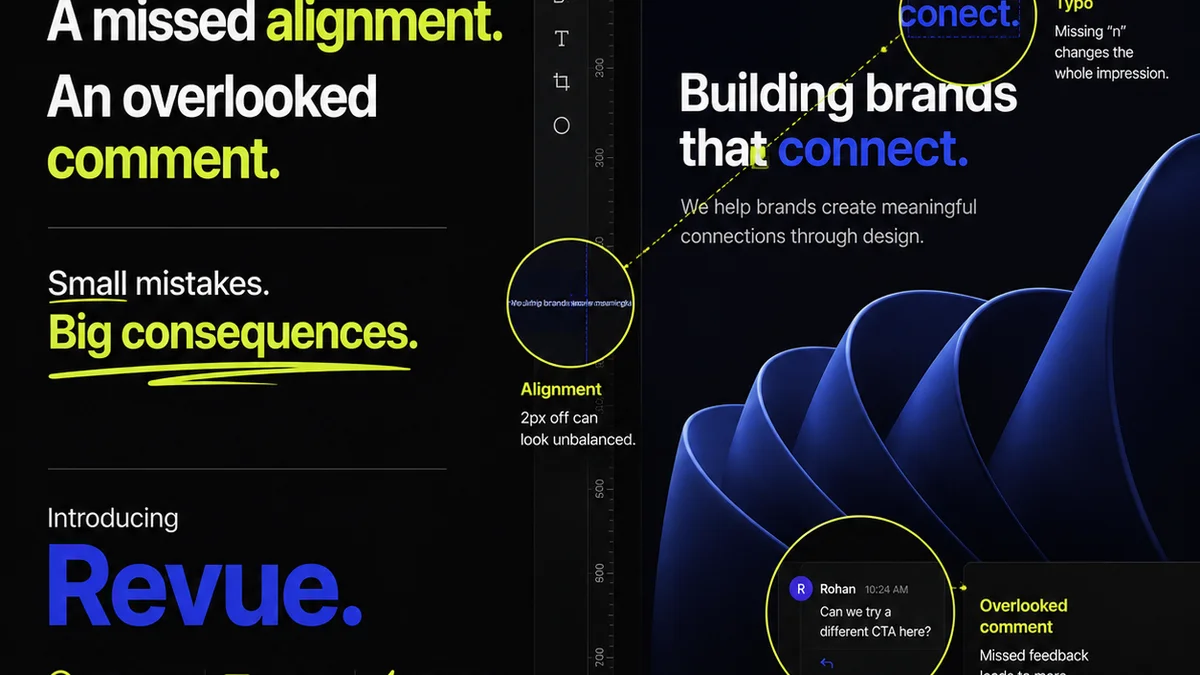
Revue isn't just another annotation tool. It’s built from the ground up to address these core operational needs for creative teams.
We understand that client feedback is a critical touchpoint, but it’s one piece of a larger, complex workflow. Revue centralizes feedback, providing a single source of truth for all communication and decisions related to your creative assets.
Our platform allows for clear version control, contextual commenting, and structured approval workflows. This means your team spends less time deciphering feedback and more time executing. You get clear visibility into revision status and who is accountable for each step, minimizing ambiguity and scope creep.
Revue helps you move beyond the chaos of scattered feedback to a streamlined, efficient, and accountable process, ultimately delivering higher quality work faster.
Final Thought
Is your client feedback process a source of friction or a driver of efficiency?
The software you choose isn't just about making clients feel heard. It's about empowering your team to do their best work, consistently and profitably.
Are you investing in tools that truly support your operational backbone, or just adding another layer of complexity?
Frequently asked questions
What is the biggest mistake agencies make with client feedback software?
The biggest mistake is treating it as just a client-facing annotation tool. Agencies often overlook how crucial integration with internal workflows, task management, and version control is for team efficiency and project success.
How can client feedback software reduce revision cycles?
By centralizing feedback, providing clear attribution and timestamps, enabling structured approval workflows, and distinguishing between suggestions and final decisions, software can minimize ambiguity and prevent endless revision loops.
Is version control important for client feedback?
Absolutely. Feedback must be tied to a specific version of an asset. Without clear version control, it's impossible to know which iteration a comment refers to, leading to confusion and incorrect revisions.
How does client feedback software improve accountability?
Good software logs every comment, decision, and approval, attributing them to specific users with timestamps. This creates an auditable trail, clarifying who requested what and when, thus fostering accountability.