Everyone talks about conversion optimization. They say it’s about A/B testing buttons, tweaking headlines, and maybe running some user surveys. None of that is wrong. But it’s incomplete.
The hard truth? True conversion optimization is a deep, ongoing operational discipline, not a tactical checklist. It’s about understanding user behavior, streamlining workflows, and building trust at every touchpoint. For agencies, this means optimizing not just your marketing site, but also your client onboarding, feedback loops, and project delivery.
1. What Conversion Optimization Really Means (Beyond the Buzzwords)
At its core, conversion optimization (CRO) is the systematic process of increasing the percentage of website visitors who take a desired action. This action could be anything from filling out a contact form to signing up for a newsletter, downloading a resource, or, for agencies, requesting a proposal.
Most discussions focus solely on the website. But for an agency, a “conversion” is much broader. It’s the entire client journey.
The Agency Conversion Funnel
Think about the typical path a potential client takes:
- Initial awareness (finding your agency)
- Interest and consideration (researching your services)
- Evaluation (comparing you to competitors)
- Decision (requesting a quote or consultation)
- Onboarding (becoming a paying client)
- Retention and advocacy (ongoing satisfaction and referrals)
Each step is an opportunity for conversion, and each has its own friction points. Optimizing these requires more than just web design tweaks.
2. The Foundational Pillars of CRO
Effective conversion optimization rests on a few critical pillars:
Data-Driven Insights
You can’t optimize what you don’t measure. This means:
- Web Analytics: Tools like Google Analytics are essential for understanding traffic sources, user flow, bounce rates, and conversion rates on your website.
- Heatmaps and Session Recordings: Tools like Hotjar or Crazy Egg show you where users click, scroll, and get stuck.
- User Feedback: Direct surveys, interviews, and feedback forms provide qualitative insights into user motivations and pain points.
Without this data, you’re just guessing. And guessing is expensive.
Understanding User Psychology
Why do people convert? It’s rarely just about a compelling call to action. It’s about trust, clarity, and perceived value.
- Cognitive Biases: Understanding principles like social proof, scarcity, and authority can inform your messaging and design.
- User Needs: What problem are you solving for them? Your website and communications must clearly articulate this.
- Friction Reduction: Make it as easy as possible for users to take the desired action. Every extra step, every confusing form field, is a potential drop-off point.
Testing and Iteration
Optimization is not a one-time fix. It’s a cycle:
- Hypothesis: Based on data and psychology, form a testable idea (e.g., “Changing the CTA button color from blue to orange will increase form submissions because orange is more attention-grabbing”).
- Testing: Use A/B testing tools or multivariate testing to compare variations.
- Analysis: Determine which variation performed better and why.
- Implementation: Roll out the winning variation.
- Repeat: Continuously look for new hypotheses to test.
3. Optimizing Your Agency's Website for Leads
Your agency’s website is your digital storefront. It needs to work harder than just looking pretty.
Clear Value Proposition
What makes your agency unique? Your homepage and service pages must answer this immediately. Use clear, concise language. Avoid jargon.
Compelling Calls to Action (CTAs)
What do you want visitors to do next? Make it obvious. Use action-oriented language:
- “Get a Custom Quote”
- “Download Our Case Study”
- “Schedule a Free Consultation”
Placement matters. CTAs should be visible above the fold and repeated strategically throughout the page.
Streamlined Contact Forms
Long, complicated forms kill conversions. Only ask for essential information upfront. You can gather more details later during the sales process.
Consider progressive profiling, where returning visitors see slightly different, more specific questions.
Building Trust and Credibility
Agencies sell expertise and reliability. Showcase this:
- Client Testimonials: Use real quotes and, ideally, videos.
- Case Studies: Detail successful projects and quantifiable results.
- Awards and Recognition: Display any accolades prominently.
- Team Bios: Introduce the people behind the work.
Transparency builds confidence.
Mobile Responsiveness
A significant portion of traffic comes from mobile devices. If your site isn’t perfectly responsive, you’re losing potential clients. Test rigorously on various screen sizes.
4. Optimizing Client Workflows for Retention and Referrals
The conversion doesn’t stop when a client signs. The real work of conversion optimization for agencies happens *after* the sale.
Onboarding Clarity
First impressions count. A confusing onboarding process can sour a client relationship before it truly begins.
- Welcome Kits: Clearly outline the next steps, timelines, and what you need from them.
- Kick-off Meetings: Set expectations, introduce the team, and confirm project goals.
- Access to Project Management Tools: Ensure they know how to use them.
Smooth onboarding leads to smoother projects.
Feedback and Revision Management
This is where many agencies struggle. Unclear feedback, endless revisions, and scope creep erode profitability and client satisfaction.
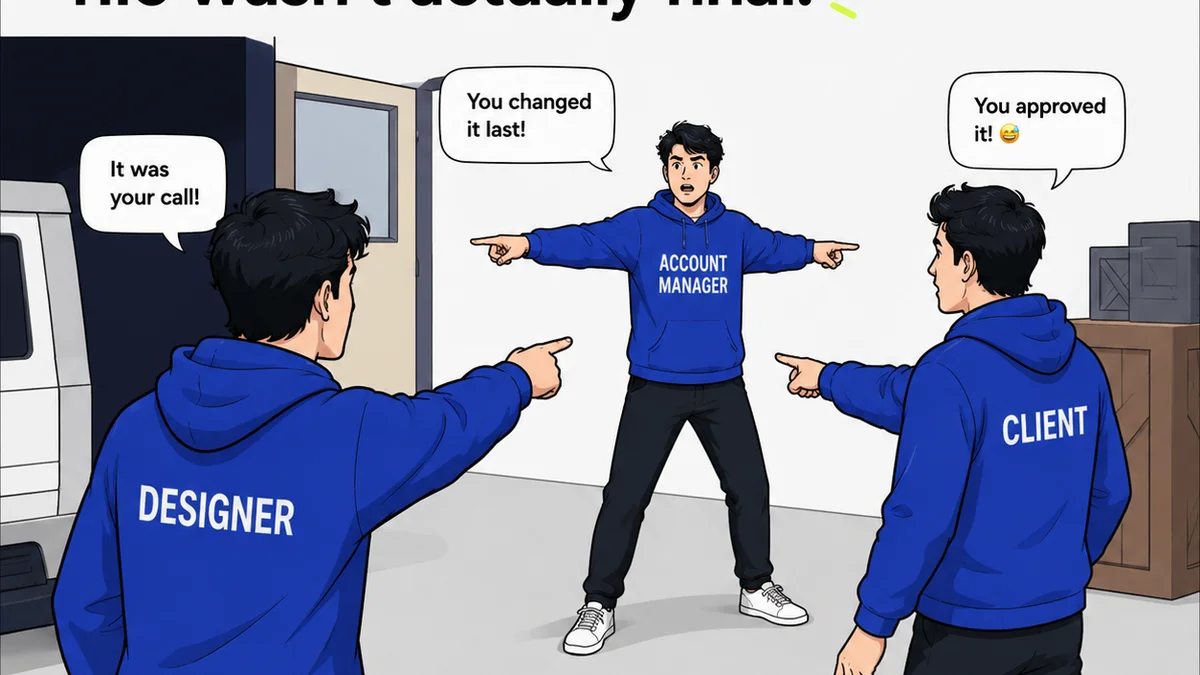
The Hard Truth: Inefficient feedback loops are a major conversion killer. They lead to frustration, missed deadlines, and unhappy clients who won’t refer you.
- Centralized Feedback: All comments and markups in one place.
- Version Control: Track every revision and iteration.
- Clear Approval Workflows: Define who needs to approve what, and when.
- Scope Management: Easily identify and address out-of-scope requests.
This isn’t just about efficiency; it’s about managing client expectations and ensuring clarity.
Deliverable Quality Checks
Before delivering final assets, a robust quality assurance process is critical. This prevents costly post-delivery revisions and reinforces your agency’s professionalism.
- Checklists: Ensure all requirements are met.
- Cross-Browser/Device Testing: For web projects.
- Proofreading: For all copy and content.
- Brand Guideline Adherence: Verify consistency.
A flawless delivery is a powerful conversion tool for repeat business.
5. Where Revue Fits In
Managing client feedback, revisions, and approvals can feel chaotic. This is precisely where a tool like Revue becomes indispensable for conversion optimization in your agency.
Revue centralizes all stakeholder feedback directly on the creative assets themselves. No more digging through emails or Slack threads for that one crucial comment.
This visibility streamlines the entire revision process. You can easily track who has reviewed what, identify bottlenecks, and manage approvals efficiently. This reduces back-and-forth, minimizes misunderstandings, and keeps projects moving forward.
By providing a clear, organized system for feedback and approvals, Revue helps you reduce friction in the client-agency relationship. This leads to happier clients, more efficient project delivery, and ultimately, higher rates of retention and referrals – the ultimate forms of conversion for any service business.
6. Common CRO Mistakes Agencies Make
Many agencies dabble in CRO but miss the bigger picture:
- Focusing only on the website: Ignoring the client lifecycle.
- Guesswork over data: Making changes based on gut feelings.
- Infrequent testing: Treating CRO as a project, not a process.
- Overly complex forms: Creating unnecessary barriers for leads.
- Poor feedback management: Letting revisions spiral out of control.
- Lack of internal alignment: Different teams using different processes.
These mistakes cost time, money, and client relationships.
7. Final Thought
Conversion optimization isn't just about getting more leads through your website. It's about creating a seamless, trustworthy, and efficient experience for your clients at every single stage of their journey with your agency. It’s about operational excellence that translates directly into business growth. Are you treating every client touchpoint as a conversion opportunity?
Frequently asked questions
What is the difference between conversion rate and conversion optimization?
Conversion rate is a metric that measures the percentage of visitors who complete a desired action. Conversion optimization (CRO) is the ongoing process of improving that rate by understanding user behavior and systematically testing changes to your website or processes.
How can a creative agency benefit from conversion optimization?
Agencies benefit by attracting more qualified leads through their website, streamlining client onboarding, improving feedback and revision processes, and ultimately increasing client retention and referrals. It enhances both marketing effectiveness and operational efficiency.
What are the most important metrics for agency CRO?
Key metrics include website conversion rates (e.g., form submissions, demo requests), lead quality, client onboarding time, project completion time, client satisfaction scores, client retention rate, and referral rates. Analyzing these provides a holistic view of performance.
Is A/B testing the only way to do conversion optimization?
No. While A/B testing is a powerful tool for validating specific changes, CRO also involves qualitative research (user interviews, surveys), heatmap analysis, session recordings, and usability testing to understand user behavior and identify areas for improvement before testing.