You hear it everywhere: conversion optimization is key to growth. Agencies promise the moon, touting A/B testing, heatmaps, and fancy analytics setups. And sure, those tools are part of the picture. But they aren't the whole story.
The hard truth? Most conversion optimization services miss the forest for the trees. They focus on isolated tactics instead of the systemic issues that kill conversions before they even happen.
1. The Illusion of 'Optimization' Without Strategy
Many agencies treat conversion optimization as a purely technical exercise. Plug in the tools, run the tests, tweak the buttons. Done.
This is like rearranging deck chairs on the Titanic. You might make the chairs look better, but the ship is still going down.
The Real Problem: Misunderstanding Your Audience
True conversion optimization starts long before you touch a landing page. It begins with a deep, almost uncomfortable understanding of who you're trying to reach and *why* they're hesitant to convert.
Are you targeting the right people? Is your value proposition crystal clear? Does your messaging resonate with their actual pain points, not just the ones you assume they have?
- Lack of clear buyer personas.
- Generic, feature-heavy copy.
- Ignoring user journey mapping.
- Failing to segment audiences effectively.
Without this foundational strategic work, A/B testing becomes a guessing game. You're optimizing for the wrong thing, or worse, optimizing something that was fundamentally flawed from the start.
2. The 'Data Overload' Trap
The digital marketing world is drowning in data. Analytics platforms, heatmaps, session recordings – it’s easy to get lost.
Many conversion optimization services offer endless reports, dense with metrics that look impressive but offer little actionable insight.
The Downside of Vanity Metrics
Bounce rate, time on page, even conversion rate itself can be misleading if you don't understand the context. A high bounce rate on a blog post might be good if the user found the information they needed and left satisfied.
Focusing solely on quantitative data without qualitative context is a recipe for misinterpretation.
- Fixating on clicks instead of outcomes.
- Ignoring user sentiment and feedback.
- Drawing conclusions from insufficient sample sizes.
- Over-analyzing minor variations.
The goal isn't just to collect data; it's to extract *meaning*. That requires more than just a dashboard. It requires empathy and critical thinking.
3. The Disconnect Between Marketing and Product/Service
Often, conversion optimization efforts are siloed within marketing or sales teams.
This creates a major bottleneck. Marketing might drive traffic and generate leads, but if the actual product or service doesn't deliver on the promise, those leads will never convert.
The Crucial Feedback Loop
Effective conversion optimization requires a tight feedback loop between marketing, sales, product development, and customer support. What are customers saying? Where are they getting stuck *after* they sign up or purchase?
If your onboarding process is confusing, your customer support is slow, or your product has critical bugs, no amount of landing page tweaking will fix it long-term.
- Marketing promises what product can't deliver.
- Sales cycles are unnecessarily long due to internal friction.
- Customer support is unresponsive to common issues.
- Product updates don't address user pain points.
Conversion optimization isn't just about getting the first sale. It's about building a sustainable business where the entire customer experience reinforces the value proposition.
4. The Myth of the 'Set It and Forget It' Test
A/B testing is powerful, but it’s not a magic bullet. Running a test, seeing a winner, and declaring victory is often premature.
Many agencies treat optimization as a one-off project rather than an ongoing process.
The Importance of Iteration and Learning
The market shifts. Competitors adapt. User behavior evolves. What worked yesterday might not work tomorrow.
True conversion optimization is a continuous cycle of hypothesis, testing, learning, and iteration. It’s about building a culture of experimentation and adaptation.
- Failing to test multivariate scenarios.
- Not re-testing winning variations over time.
- Ignoring seasonality and market trends.
- Stopping optimization efforts too soon.
The best conversion optimization services understand that it's a marathon, not a sprint. They build systems for ongoing learning and improvement.
Where Revue Fits In
Managing the complexity of client feedback, revisions, and approvals is critical for effective conversion optimization, especially for agencies.
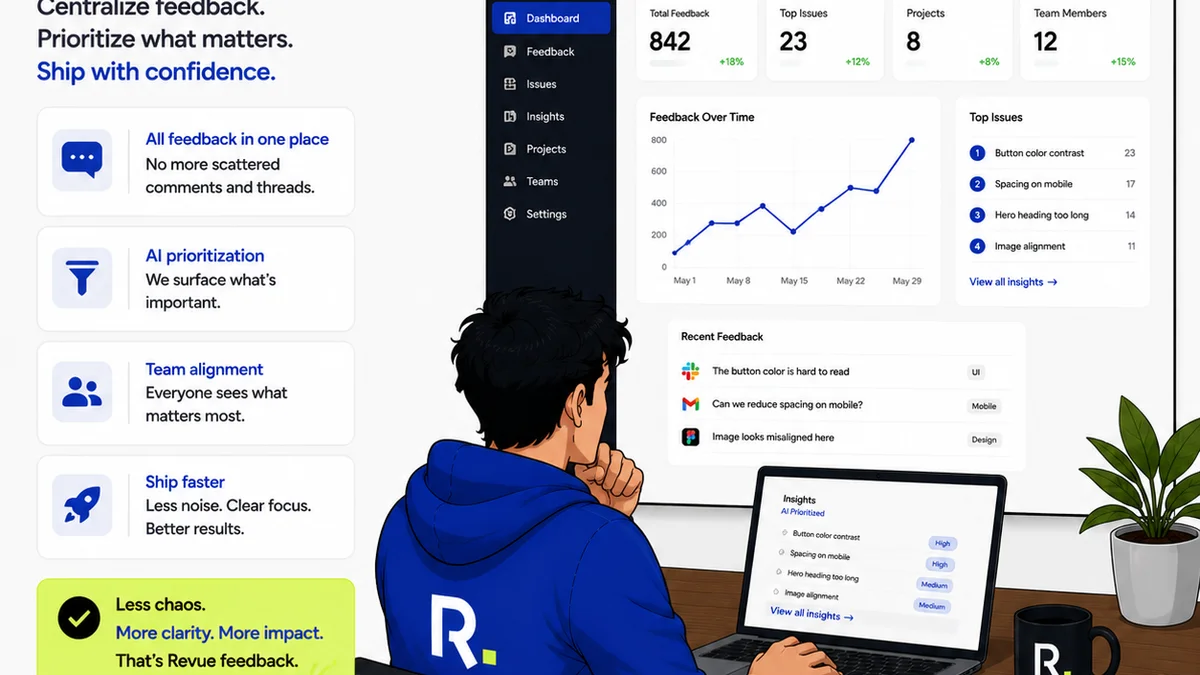
When marketing campaigns are live and client feedback pours in, having a centralized system is crucial. Revue provides a single source of truth for all creative assets and client communication.
This means:
- Clearer Feedback: Clients can annotate directly on designs, videos, and web pages, eliminating vague feedback like 'make it pop'.
- Streamlined Revisions: Track every version, see who approved what, and ensure no feedback gets lost in email chains.
- Faster Approvals: Reduce back-and-forth, getting campaigns and landing pages approved and launched faster.
- Quality Assurance: Ensure final assets meet all requirements before going live, directly impacting conversion performance.
By centralizing these workflows, agencies can reduce friction, speed up deployment, and ensure the creative work truly aligns with the strategic goals driving conversion optimization.
5. The Over-Reliance on Technology Over Insight
Tools are essential, but they are only as good as the people wielding them.
Many conversion optimization services are technology-first, believing that the right software will automatically unlock insights.
Human Expertise Still Reigns Supreme
A heatmap can show you *where* users click, but it can't tell you *why*. Analytics can show you traffic drop-offs, but it can't explain the underlying user frustration.
This is where human insight, experience, and qualitative research become indispensable. Understanding user psychology, market dynamics, and strategic objectives is what separates good optimization from great.
- Interpreting heatmaps and session recordings.
- Conducting user interviews and surveys.
- Analyzing competitor strategies.
- Synthesizing diverse data points into a coherent strategy.
The best conversion optimization services blend cutting-edge technology with deep human expertise to uncover the real drivers of user behavior.
Final Thought
So, what are the best conversion optimization services in the US? The ones that look beyond the button colors and form fields.
They’re the partners who invest time in understanding your business, your audience, and your entire customer journey. They treat optimization not as a checklist of tactics, but as a continuous, strategic imperative.
Are you looking for a partner who truly understands the 'why' behind the 'what', or just someone to tweak your website?
Frequently asked questions
What's the difference between conversion rate optimization (CRO) and general marketing?
CRO is a specific discipline focused on increasing the percentage of website visitors who take a desired action (e.g., make a purchase, fill out a form). While it's a key part of marketing, it emphasizes data-driven experimentation and user experience improvements on existing traffic, rather than just driving more traffic.
How long does it typically take to see results from conversion optimization services?
Results vary significantly based on the complexity of the issues, the quality of the strategy, and the testing velocity. Initial insights might emerge quickly, but significant, sustained improvements often take several months of continuous testing and iteration.
What are the most common mistakes agencies make in conversion optimization?
Common mistakes include focusing solely on A/B testing without a clear strategy, getting lost in data without qualitative insights, treating optimization as a one-off project instead of an ongoing process, and failing to integrate marketing efforts with the overall customer experience.
Can conversion optimization help even if my website traffic is low?
Yes, absolutely. While higher traffic provides more data for testing, conversion optimization is often even *more* critical for low-traffic sites. Maximizing the value of every single visitor becomes paramount. Qualitative research and strategic improvements can yield significant gains even with limited traffic.