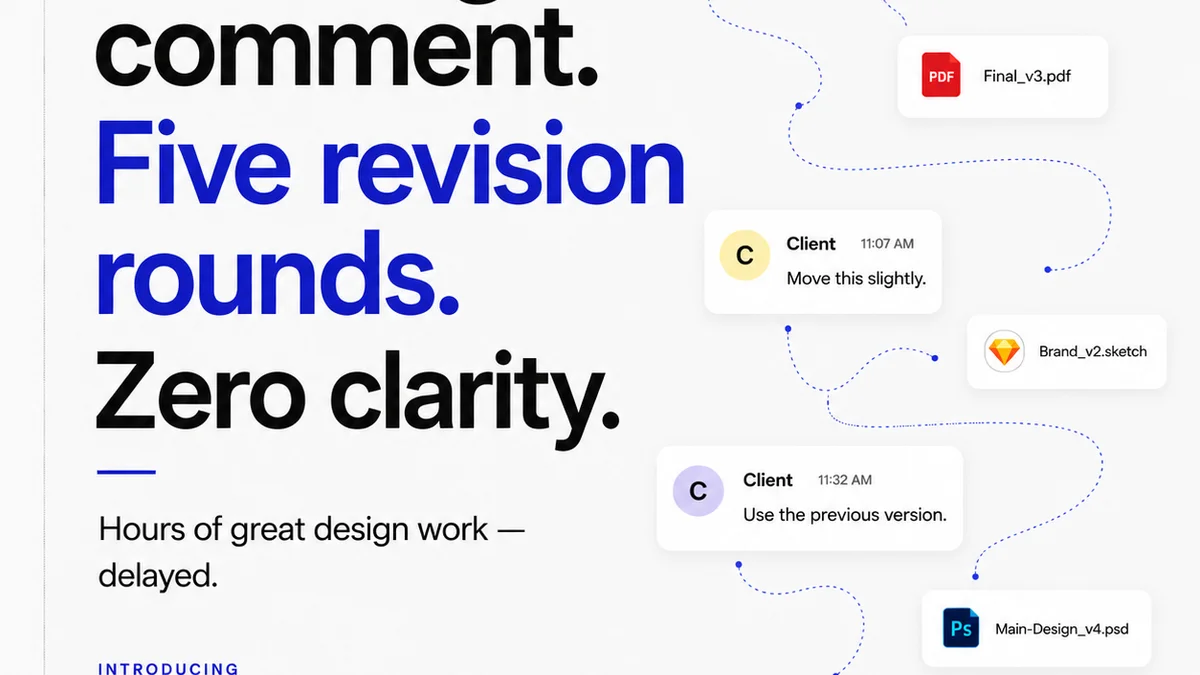
Everyone talks about streamlining the creative approval workflow. The assumption is simple: faster feedback means faster approvals. Make it quicker, make it easier, and clients will sign off in no time.
None of that is wrong. But it’s incomplete.
The deeper truth? A clunky approval process isn't just slow. It's a symptom of bigger issues: unclear briefs, siloed communication, and a fundamental lack of visibility into the revision process. It’s not about shaving minutes off a call; it’s about building a system that prevents miscommunication before it starts.
1. The Brief Isn't Just a Starting Point, It's the Blueprint
A weak brief is the silent killer of efficient creative approval workflows. If the client’s goals, target audience, and desired outcomes aren't crystal clear from day one, every subsequent step becomes an exercise in guesswork.
This leads to feedback like:
- “I don’t like it.”
- “It’s not quite right.”
- “Can we try something… more?”
Sound familiar?
The Hard Truth: Your brief needs to be a contract, not a suggestion. It must define success. If the client can’t articulate what success looks like, your job is to help them figure it out *before* any creative work begins.
Defining Success Metrics
What are the tangible outcomes the client expects? Is it increased engagement, higher conversion rates, or brand recognition? Nail these down.
Establishing Creative Guardrails
What are the non-negotiables? Brand guidelines, technical constraints, legal requirements. These aren't suggestions; they're hard limits.
A well-defined brief sets the stage for objective feedback. It gives you and the client a shared language and a clear benchmark against which to measure the work.
2. Feedback Isn't Just Comments, It's Data
The common mistake is treating client feedback as a monolithic block of text. It’s often a jumble of opinions, preferences, and vague directives that are impossible to action effectively.
This often happens when feedback is gathered through endless email chains or scattered Slack messages. It becomes a treasure hunt for actionable insights.
The Hard Truth: Feedback needs structure. It needs context. And it needs to be tied directly to the creative asset being reviewed.
Qualitative vs. Quantitative Feedback
Understand the difference. “I love the color” is qualitative. “The blue is too dark and doesn’t align with our brand palette, which requires a lighter shade like #ADD8E6” is quantitative and actionable.
Context is King
Feedback without context is useless. When a client says “make it pop,” what does that actually mean in relation to the specific design element they’re pointing at? Is it contrast? Size? Animation? This ambiguity is where approval bottlenecks form.
Your process must force clarity. This means moving feedback from unstructured text to specific, contextual annotations on the work itself. This is where visual review tools excel.
3. Revisions Aren't Just Changes, They're Iterations
Agencies often fall into the trap of thinking of revisions as a simple back-and-forth. Client sees something, client asks for a change, designer makes the change. Rinse and repeat.
This linear view ignores the iterative nature of good design. It also fails to account for the potential for scope creep and the dilution of the original brief.
The Hard Truth: Each revision cycle needs a clear objective and a defined endpoint. It’s not about endless tweaking; it’s about refining the creative vision based on objective criteria.
Version Control is Crucial
How do you track which version is the most current? How do you ensure everyone is looking at the same iteration? Without a clear system, you risk working on outdated files, leading to confusion and wasted effort.
Defining Revision Rounds
How many rounds of revisions are included? What constitutes a significant change versus a minor tweak? These need to be agreed upon upfront. Uncontrolled revisions are a fast track to burnout and budget overruns.
A structured revision process, clearly documented, prevents scope creep and ensures that each iteration moves the project closer to the agreed-upon goals, not further away.
4. Approvals Aren't Just 'Yes' or 'No', They're Milestones
The final sign-off is often seen as the finish line. But in a complex project, approvals happen at multiple stages. A design concept needs approval, a wireframe needs approval, a content draft needs approval.
When these interim approvals are fuzzy or non-existent, the final approval becomes a minefield. The client might have a completely different expectation of the final product than what has been built through a series of unconfirmed steps.
The Hard Truth: Every stage of the creative process requires formal acknowledgment. This creates a trail of decisions and prevents surprises at the end.
Phased Approvals
Break down the project into logical phases. Get sign-off on each phase before moving to the next. This could be concept approval, content approval, design approval, and finally, final sign-off.
Clear Sign-off Mechanism
How is approval recorded? A simple email can be ambiguous. A formal sign-off within a project management tool or review platform provides a clear, timestamped record. This protects both the agency and the client.
These milestones ensure alignment throughout the project, making the final approval a confirmation, not a confrontation.
5. Quality Assurance is Not an Afterthought
Too many teams rush through QA. They see it as a final check for typos and broken links, not as a critical gate that ensures the creative output meets strategic objectives and functional requirements.
This is especially true for digital products where usability, accessibility, and performance are key. Rushing QA means shipping a product that doesn't perform as intended.
The Hard Truth: Quality assurance must be integrated into the workflow from the beginning, not tacked on at the end.
Accessibility Checks
Are your designs accessible to users with disabilities? This isn't just good practice; it's often a legal requirement. Tools and guidelines from organizations like the Web Content Accessibility Guidelines (WCAG) are essential.
Usability Testing
Does the final product work as intended for the end-user? This goes beyond just checking if buttons click. It's about the overall user experience.
Performance and Technical Checks
Is the website loading quickly? Are there any technical bugs? These need to be identified and fixed before launch.
A robust QA process ensures that the final deliverable is not only aesthetically pleasing but also functional, accessible, and meets all project requirements.
Where Revue Fits In
Managing a complex creative approval workflow requires more than just good intentions. It demands a system that brings clarity, context, and control to every stage.
Revue is built for this. It centralizes client feedback, allowing for precise annotations directly on creative assets. No more deciphering vague emails or hunting through Slack threads.
With Revue, you can manage revisions with clear version history, ensuring everyone is working from the latest iteration. Approvals become clear, documented milestones, not ambiguous checkpoints.
This structured approach streamlines the entire process, from initial brief to final sign-off, reducing friction and ensuring higher quality creative output.
Final Thought
The goal of any creative approval workflow isn't just speed, it's confidence. Confidence that the work meets client objectives. Confidence that the team isn't wasting time on miscommunication. Confidence that the final deliverable is something everyone can stand behind.
Are you building a system that fosters that confidence, or just hoping for faster approvals?
Frequently asked questions
What is the most common mistake in creative approval workflows?
The most common mistake is treating approvals as a purely speed-based challenge. In reality, the core issues are often rooted in unclear briefs, unstructured feedback, and a lack of visibility throughout the revision process.
How can I make client feedback more actionable?
Ensure feedback is contextual and specific. Use tools that allow for direct annotations on creative assets. Define what success looks like in the brief, so feedback can be measured against objective criteria rather than subjective opinion.
What's the best way to manage revisions?
Implement clear version control and define the number of revision rounds allowed upfront. Treat each revision cycle as an iteration with a specific goal, rather than an endless back-and-forth. Document changes clearly.
Why is quality assurance important in creative approvals?
QA ensures the final deliverable meets strategic objectives, functional requirements, and quality standards, including accessibility and performance. It should be integrated throughout the workflow, not just a final check.