Everyone talks about the importance of a creative brief. They say it sets expectations, guides the creative process, and ensures alignment. None of that is wrong. But it’s incomplete.
The deeper truth is that the cost of a creative brief isn't just the time spent writing it. It's the cost of what happens when it's done poorly. Or not at all.
Think about projects that went sideways. Missed deadlines, budget overruns, client dissatisfaction. How often did a vague or missing brief play a role? Too often.
Understanding the real cost of a creative brief means understanding the cost of clarity, efficiency, and ultimately, successful creative output. Let’s break down what goes into a good brief and why investing in it pays dividends.
1. The Hidden Costs of a Poor Brief
A bad brief isn’t just a minor inconvenience; it's a silent killer of project momentum and profitability. It’s the duct tape holding together a leaky ship.
What does this look like in practice?
- Endless rounds of revisions because the core objective was never clear.
- Scope creep that balloons budgets and timelines.
- Creative work that misses the mark entirely, requiring expensive re-dos.
- Demotivated teams working on projects without a clear direction.
- Client frustration leading to damaged relationships and lost future business.
These aren't abstract concepts. They are direct hits to your bottom line and your agency's reputation.
The Time Sink
The most immediate cost is wasted time. When a brief is unclear, designers, copywriters, and strategists spend more time asking questions, guessing, and reworking than they do creating.
This isn't billable time, but it’s time your agency is spending. If you’re an in-house team, it means less capacity for other critical tasks.
The Budget Blowout
Rework is expensive. Each revision cycle adds labor costs. If a campaign needs to be scrapped and restarted because the initial direction was wrong, the cost is astronomical.
Clients notice. They see the hours ticking up, the project dragging on, and the final deliverable not matching their vision. This erodes trust.
The Opportunity Cost
Every hour spent fixing a poorly briefed project is an hour *not* spent on a new, profitable project or on client-facing strategy. It’s a drag on your agency’s growth potential.
For in-house teams, it means less time for innovation or strategic brand development.
2. What Goes into a High-Quality Creative Brief?
A good brief is a strategic document. It requires thought, research, and collaboration. It’s not a checkbox exercise.
The core components are universally agreed upon, but the depth of detail matters.
Key Elements of an Effective Brief
- Project Background: What led to this project? What’s the context?
- Objectives: What are we trying to achieve? (SMART goals are best).
- Target Audience: Who are we talking to? Be specific.
- Key Message: What is the single most important thing we want the audience to take away?
- Deliverables: What exactly needs to be produced? (e.g., website banners, social media posts, a video script).
- Tone of Voice: How should the communication feel?
- Mandatories & Constraints: What must be included? What must be avoided? (e.g., brand guidelines, legal disclaimers).
- Budget: What is the allocated budget for the creative work?
- Timeline: Key milestones and final deadlines.
- Success Metrics: How will we measure if the project is successful?
Each of these requires more than a one-liner. For example, defining the target audience means understanding their pain points, motivations, and media consumption habits.
The Investment in Time
Putting together a comprehensive brief takes time. For a significant project, this could range from 4 to 16 hours of strategic work, involving account managers, strategists, and sometimes even creative leads.
This time is an investment. It’s front-loading the effort to prevent massive downstream costs.
The Cost of Expertise
Who writes the brief? Ideally, it’s someone with a strategic understanding of the client’s business, marketing goals, and creative best practices. This might be an account manager, a brand strategist, or a senior marketing lead.
Their time has value. A brief written by someone who doesn't fully grasp the project's strategic underpinnings is a risk.
3. Estimating the Cost of Brief Creation
Let's put some hypothetical numbers to this. Remember, these are estimates and will vary wildly based on agency size, location, and project complexity.
Assume an agency team member’s fully-burdened hourly rate (salary, benefits, overhead) is $100/hour. This is a rough average for a senior-level individual.
Small Project (e.g., Social Media Campaign Assets)
- Time to Create Brief: 4-6 hours
- Estimated Cost: $400 - $600
This assumes a fairly straightforward project where the client has a clear understanding of their needs, and the agency has a strong existing relationship and knowledge base.
Medium Project (e.g., Website Redesign, Brand Identity Refresh)
- Time to Create Brief: 8-12 hours
- Estimated Cost: $800 - $1200
This involves more stakeholder interviews, deeper research into market positioning, and more detailed definition of user journeys and functional requirements.
Large Project (e.g., National Integrated Campaign, New Product Launch)
- Time to Create Brief: 16-24+ hours
- Estimated Cost: $1600 - $2400+
These projects require extensive market research, competitive analysis, multiple client workshops, and detailed strategic planning across various channels.
Remember, this is the cost of *creating* the brief. It does not include the cost of the creative work itself, nor the cost of client meetings to discuss and refine the brief.
The ROI Calculation
Consider a medium project costing $1000 to brief. If a poor brief leads to just one extra round of major revisions that costs $2000 in agency time, you’ve already lost money by skimping on the brief.
The goal isn't to spend more on briefs; it's to spend *wisely* on briefs to save significantly on the overall project execution.
4. The Client's Role and Cost Perception
Clients often see the brief as just another piece of paper. They might push back on the time it takes to develop one, or the detail requested.
This is where clear communication and education are vital.
Explain that the brief is the blueprint. A shaky blueprint guarantees a flawed building.
Educating the Client
Walk clients through the key sections of the brief. Show them how each piece of information directly impacts the creative outcome and project efficiency.
Use examples: “If we don’t clearly define the primary call to action here, the design might not highlight it effectively, leading to lower conversion rates – which is one of our key objectives.”
The Cost of Client Time
Remember that the client’s time spent on the brief also has a cost. A well-structured brief makes their input more efficient and effective.
They want their project to succeed too. Frame the brief development process as a collaborative investment in achieving their business goals.
When Clients Provide the Brief
Sometimes, clients will provide their own brief. It’s crucial to review it thoroughly. If it’s lacking, you have a choice:
- Refine it together: Offer to enhance their brief, explaining the strategic value.
- Build it out: If their brief is too sparse, you may need to build a more robust brief internally, adding that time to your project estimate.
- Flag the risk: Clearly communicate the potential risks of proceeding with an underdeveloped brief.
Never assume a client-provided brief is sufficient without critical review.
5. Where Revue Fits In
The creative brief is the starting point. But keeping that clarity alive throughout a project is the real challenge. This is where workflow tools become essential.
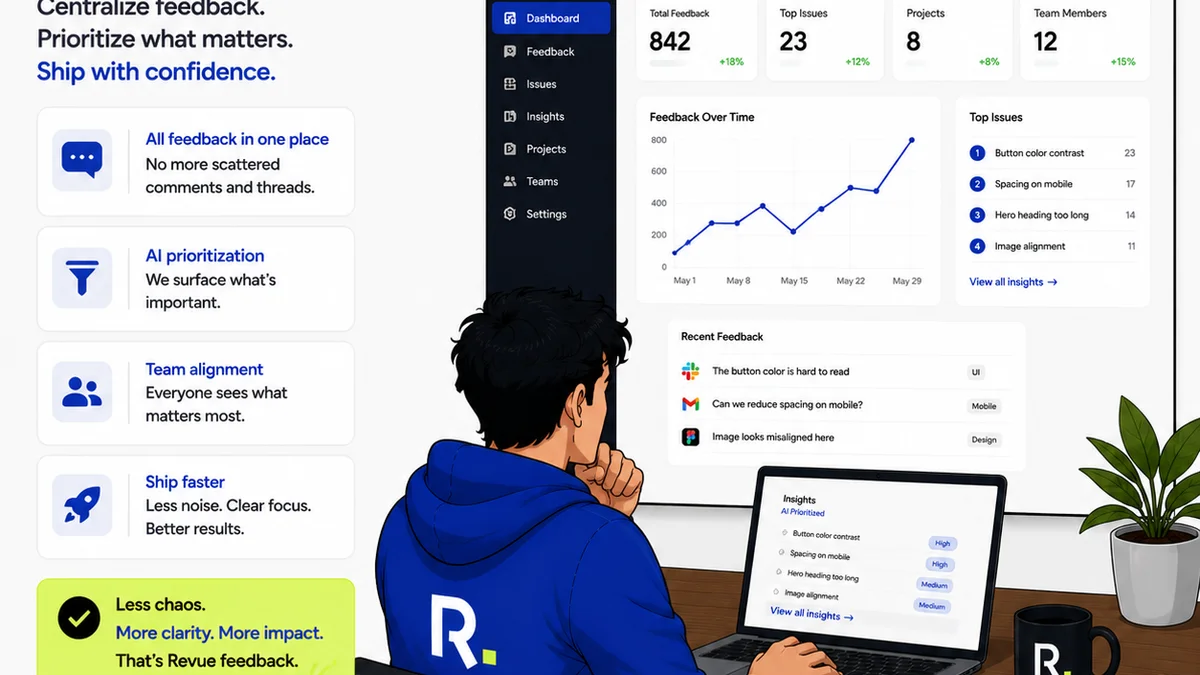
Revue helps maintain the integrity of the brief by centralizing feedback and communication.
- Centralized Feedback: All client comments and stakeholder input are captured in one place, directly linked to the creative assets. No more hunting through email chains or Slack messages.
- Revision Visibility: Track every iteration of a design. See exactly what changed, why it changed (ideally referencing the brief’s objectives), and who approved it.
- Approval Tracking: Formalize the approval process. Ensure that stakeholders sign off on deliverables, confirming alignment with the brief’s goals.
- Quality Checks: Use the platform to conduct internal quality assurance, ensuring that the final output still aligns with the original strategic intent outlined in the brief.
By keeping the brief’s objectives and feedback loops transparent and accessible, Revue ensures that the creative work stays on track, minimizing costly deviations and ensuring the final product meets strategic goals.
6. Final Thought
The cost of a creative brief isn't an expense; it's an investment in project success. It’s the difference between building on solid ground or quicksand.
Are you treating your creative briefs as the strategic cornerstones they are, or just another administrative hurdle?
Frequently asked questions
What is the average cost to create a creative brief?
The cost varies significantly, but for a medium-sized project, expect to invest 8-12 hours of strategic team time, potentially costing $800-$1200 based on an average burdened hourly rate of $100. Larger or more complex projects will require more time and thus incur a higher cost.
Why is a detailed creative brief important?
A detailed brief acts as a roadmap, ensuring everyone understands project objectives, target audience, key messages, and deliverables. This clarity prevents misinterpretations, reduces costly revisions, minimizes scope creep, and leads to more effective creative outcomes.
How can a poorly written brief increase project costs?
A poor brief leads to ambiguity, resulting in endless revisions, scope creep, and creative work that misses the mark. This wastes valuable team time, blows budgets, and can damage client relationships, significantly increasing the overall project cost.
What should I do if a client provides a weak creative brief?
If a client provides a weak brief, you should ideally collaborate with them to refine it, explaining the strategic importance of each section. Alternatively, you may need to build out a more robust brief internally, factoring that time into your project estimate, or clearly communicate the risks of proceeding with the underdeveloped brief.