Everyone knows a bad creative brief leads to bad creative. It’s the oldest story in the agency book. None of that is wrong. But it’s incomplete.
The deeper, harder truth? Bad creative briefs don't just lead to bad creative. They actively cost businesses serious money. We're not talking about a few wasted hours. We're talking about missed opportunities, blown budgets, and brand damage that takes years to repair. It’s an operational failure disguised as a creative one.
Let’s break down the most common, costly brief mistakes and how to avoid them.
1. The Vague Objective: “We Need More Engagement”
This is the most frequent offender. When a client says they want “more engagement,” what do they actually mean? More likes? More shares? More comments? More website traffic? More sales? More leads?
Without a clear, measurable objective, the creative team is flying blind. They’ll make assumptions. These assumptions are rarely aligned with what the business *actually* needs to achieve.
The Cost: Wasted Media Spend and Misaligned Messaging
Imagine a campaign designed to drive social media engagement when the real business goal is lead generation. The creatives nail the “engagement” brief. You get a flood of likes and comments. But the phone doesn't ring. The sales pipeline remains empty. The media budget is spent on vanity metrics, not business outcomes.
Or consider a rebrand where the objective is simply “to look more modern.” Modern according to whom? What specific business problem does this “modern” look solve? Without a defined target audience and desired perception, the result is often a generic facelift that alienates existing customers and fails to attract new ones. It’s a million-dollar paint job on a car that still doesn’t run.
Fix: Define KPIs and Business Goals
- What specific business problem are we trying to solve? (e.g., increase Q3 sales by 15%, reduce customer churn by 5%, acquire 100 new enterprise leads).
- What does success look like? Define specific, measurable, achievable, relevant, and time-bound (SMART) goals.
- What are the Key Performance Indicators (KPIs)? How will we measure progress towards those goals? (e.g., conversion rates, cost per acquisition, customer lifetime value).
- Who is the target audience, and what action do we want them to take? Be precise. “Millennials” is not an audience. “Urban-dwelling, environmentally conscious millennials aged 25-34 who use public transport” is better.
2. The Undefined Target Audience: “Everyone Will Love This!”
This is closely related to the vague objective. When an audience isn't clearly defined, the creative defaults to a lowest common denominator approach. It becomes bland, generic, and forgettable.
Agencies often feel pressure to please the client, so they might nod along when the client says, “This needs to appeal to everyone.” But “everyone” is not a target audience. It’s a void.
The Cost: Ineffective Messaging and Brand Dilution
A campaign trying to speak to everyone ends up speaking to no one effectively. The messaging is watered down. The creative lacks a distinct point of view. It fails to resonate with any specific group because it’s trying too hard to please all groups.
This dilutes brand equity. Instead of building a strong connection with a core customer base, the brand becomes a vague presence. Resources are spread thin, trying to capture different segments with generic tactics, rather than focusing on a high-potential niche with tailored, impactful creative. It’s like shouting into a hurricane – a lot of noise, no clear direction, and eventually, nothing gets heard.
Fix: Create Detailed Personas
- Who is our *ideal* customer? Go beyond basic demographics.
- What are their motivations, pain points, and aspirations?
- Where do they spend their time online and offline?
- What language do they use? What influences them?
- What is their relationship with our brand (or competitor brands)?
A well-defined persona acts as a compass for all creative decisions. It ensures the message, tone, and visuals are laser-focused on the people most likely to convert.
3. The Lack of Competitive Context: “We Want to Be Different”
Every client wants to stand out. But “different” is only valuable if it’s strategically different. A brief that fails to acknowledge the competitive landscape is setting the creative team up for failure.
Creatives need to know what the competition is doing. Not to copy it, but to understand the existing visual language, messaging themes, and audience perceptions in the market. This allows them to identify whitespace and opportunities for genuine differentiation.
The Cost: Blending In or Creating Irrelevant Work
Without this context, a creative team might develop a campaign that looks and sounds exactly like a competitor’s. The client thinks they’re unique, but their audience sees only more of the same. This leads to wasted ad spend and a failure to capture market share.
Conversely, they might create something *so* different that it’s completely irrelevant to the market. It’s avant-garde for the sake of it, failing to leverage existing audience expectations or visual cues that build trust and recognition. The result is often confusion and a lack of adoption.
Fix: Mandate Competitive Analysis
- Who are the direct and indirect competitors?
- What are their key marketing messages and visual styles?
- What are their perceived strengths and weaknesses?
- What are the current trends in the industry?
- Where are the gaps or opportunities for unique positioning?
This analysis should inform the brief, guiding the creative strategy towards meaningful differentiation, not just superficial change.
4. The Unrealistic Mandatories: “Can You Make It Pop?”
Mandatories are essential. They include things like brand logos, taglines, legal disclaimers, and specific product features that *must* be included. But when these become a laundry list of conflicting demands or vague aesthetic requirements, they stifle creativity and lead to bloated, ineffective work.
Phrases like “make it pop,” “add some sizzle,” or “give it more energy” are meaningless without context. They’re often a sign that the client doesn't know what they want, but they know what they *don't* want – and that’s usually something perceived as boring.
The Cost: Bloated, Incoherent Creative and Missed Deadlines
Trying to cram too many elements into a single piece of creative often results in a cluttered, confusing final product. The core message gets lost. The visual hierarchy breaks down.
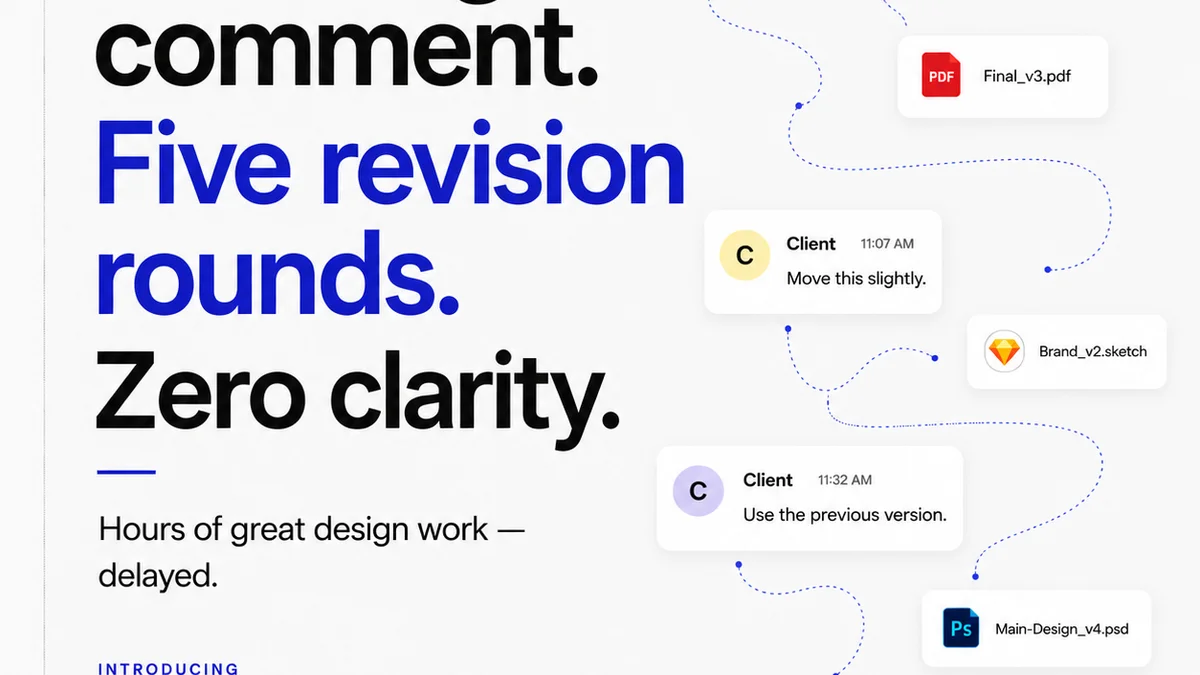
Furthermore, vague requirements lead to endless rounds of revisions. The creative team keeps tweaking “the pop” or “the sizzle” based on subjective feedback, never hitting a moving target. This eats up billable hours, delays launch dates, and frustrates everyone involved.
Fix: Prioritize and Clarify Mandatories
- List all must-have elements clearly.
- Explain *why* each element is mandatory. What business or legal purpose does it serve?
- Provide specific examples for subjective requirements (e.g., instead of “make it pop,” say “we need the call-to-action button to be the most visually prominent element on the page, using our secondary brand color”).
- Be open to discussing *how* mandatories are integrated. Sometimes, a creative solution can fulfill a mandatory requirement in a more elegant or effective way than initially conceived.
5. The Lack of
Frequently asked questions
What is the biggest mistake in a creative brief?
The most common and costly mistake is a vague or undefined objective. When a brief lacks clear, measurable business goals (e.g., increase sales by X%, generate Y leads), the creative team cannot align their work with desired outcomes, leading to wasted effort and budget on ineffective campaigns.
How does a poorly defined target audience hurt a business?
A poorly defined target audience results in generic, ineffective messaging that fails to resonate with any specific group. This dilutes brand equity and wastes resources trying to appeal broadly, rather than focusing on high-potential customer segments with tailored, impactful creative.
Why is competitive context important in a creative brief?
Understanding the competitive landscape helps creatives differentiate effectively. Without it, they might create work that blends in with competitors, wasting budget, or becomes so different it's irrelevant to the market. It informs strategic differentiation.
What should I do if a client provides vague requirements like 'make it pop'?
Push for specifics. Ask clarifying questions about what 'pop' means in terms of desired visual hierarchy, color usage, or call-to-action prominence. Request examples or define measurable outcomes for subjective requests to avoid endless, unproductive revisions.