Everyone talks about creative brief trends. They’ll tell you about AI-generated briefs, hyper-personalization, or the rise of the metaverse brief. None of that is wrong. But it’s incomplete.
The real shift isn't in the *format* of the brief, but in how it's *used*. The hard truth is that a brilliant brief is useless if it’s a black hole where feedback goes to die. The trend for 2026 is about briefs as living documents, integrated into a fluid workflow.
1. The Brief as a Conversation, Not a Decree
For years, the creative brief was seen as the client's definitive statement. A one-and-done handover before the creative team disappeared into their ivory tower. This created inevitable friction.
Clients felt unheard. Creatives felt constrained. Revisions became a battleground, not a refinement process.
The new reality? The brief is the *start* of a conversation. It’s a shared understanding, built collaboratively.
From Static Document to Dynamic Hub
Think of it less like a signed contract and more like a project roadmap. It needs to be accessible, editable (with version control, of course), and a central point for ongoing dialogue.
This means:
- Early and frequent stakeholder input, not just at the sign-off stage.
- Clear channels for clarifying questions *during* the creative process.
- A single source of truth that evolves as the project does.
This isn't about weakening the brief; it's about strengthening the collaboration it enables.
2. Actionable Clarity Over Vague Ambition
Many briefs suffer from a classic affliction: they’re full of aspirational language but lack concrete direction. “We want to be disruptive.” “We need to connect with Gen Z.”
What does “disruptive” actually mean in this context? How do we *know* we're connecting with Gen Z?
The trend for 2026 is about stripping away the fluff and focusing on measurable objectives and specific deliverables.
Defining Success Metrics Upfront
A good brief for the future will clearly articulate:
- The core problem to solve: What specific business challenge are we addressing?
- Target audience pain points: What are their real needs and frustrations related to this problem?
- Key performance indicators (KPIs): How will we measure success *quantitatively*? (e.g., Increase conversion rate by X%, reduce bounce rate by Y%, achieve Z social shares).
- Must-have functional requirements: What absolutely *must* the creative work do or include?
This forces clarity from both sides. It moves the conversation from subjective opinions to objective outcomes.
3. Integrating the Brief with the Workflow
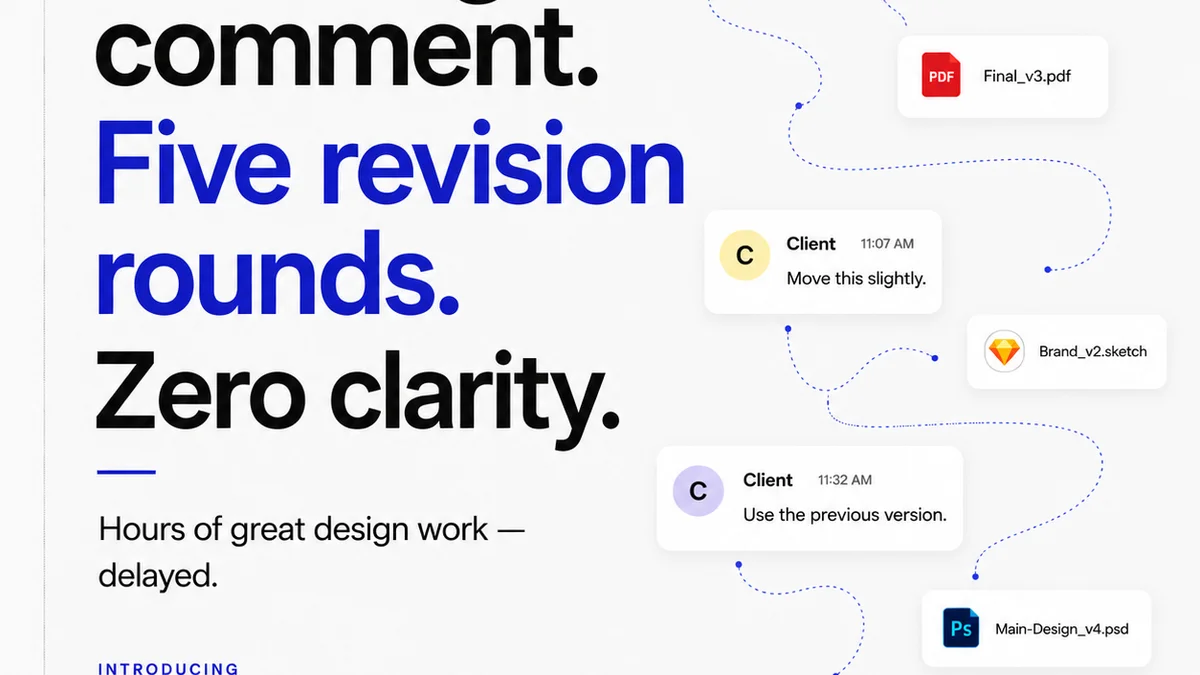
This is where many agencies still struggle. The brief sits in a folder. The designs are done in Figma. Feedback comes via email. Revisions are tracked in a spreadsheet. Approvals are a game of email tag.
This fragmented approach is inefficient and breeds miscommunication.
The 2026 trend is about breaking down these silos. The brief needs to be intrinsically linked to the tools and processes used for creation, feedback, and approval.
The Problem with Disconnected Tools
When your brief lives separately from your design files and feedback channels:
- Context is lost.
- Information gets duplicated.
- Tracking progress becomes a manual chore.
- Identifying the source of a revision request is a treasure hunt.
This disconnect is a primary driver of scope creep and missed deadlines. It’s a productivity killer.
Where Revue Fits In
This is precisely why tools like Revue are becoming essential. They bridge the gap between the initial brief and the final deliverable.
Revue isn't just another platform for client feedback. It’s a system designed to keep the brief’s objectives front and center throughout the entire creative lifecycle.
With Revue, you can:
- Centralize all client feedback: Comments are attached directly to the creative asset, linked to specific versions. No more digging through email chains.
- Manage revisions and approvals visibly: Everyone sees the history of changes, who approved what, and when. This transparency eliminates confusion and disputes.
- Run quality checks against the brief: By keeping the brief’s objectives and requirements within the same system, you can ensure the creative work directly addresses the initial goals.
This integration makes the brief a living, breathing part of the workflow, not just an opening statement.
4. Embracing Iterative Feedback Loops
The old model was linear: brief -> concept -> revision -> final. This often led to significant rework late in the process.
The future is iterative. It embraces the idea that creativity is a process of refinement, not a single stroke of genius.
This means building feedback directly into the schedule, not as an afterthought.
Shifting the Mindset
This requires a cultural shift:
- Educate clients: Help them understand that providing feedback early and often leads to a better final product, faster.
- Empower creatives: Give them the tools to easily solicit and manage feedback from multiple stakeholders.
- Structure for iteration: Plan for multiple rounds of feedback and revisions within project timelines.
This isn't about endless revisions; it's about smart, targeted refinement based on continuous input.
5. The Brief as a Tool for Creative Enablement, Not Restriction
There's a perception that a detailed brief stifles creativity. That it boxes in the brilliant minds.
But the opposite is often true. A *poorly defined* brief leads to wasted effort on concepts that miss the mark entirely. A *well-defined* brief frees up creatives to focus on the *how* once the *what* and *why* are crystal clear.
The trend for 2026 is recognizing the brief's potential as an enabling document.
Enabling Clarity, Enabling Creativity
When the core objectives, target audience, and success metrics are unambiguous:
- Creatives can explore a wider range of solutions within the defined parameters.
- Internal reviews are more focused and productive.
- Client conversations move from subjective
Frequently asked questions
What is the biggest mistake agencies make with creative briefs?
The biggest mistake is treating the creative brief as a static, one-time document. It's often seen as a handover point rather than the beginning of a collaborative conversation. This leads to misinterpretations, wasted effort, and friction later in the project.
How can a creative brief be more actionable?
To be actionable, a brief must move beyond vague aspirations. It needs to clearly define the core problem, specific target audience pain points, measurable KPIs, and essential functional requirements. This provides concrete parameters for the creative team.
How does technology help with modern creative brief trends?
Technology, like centralized feedback platforms, helps by integrating the brief with the actual creative workflow. This ensures feedback is contextual, revisions are tracked transparently, and the creative work stays aligned with the brief's objectives throughout the project lifecycle.
Should creative briefs be collaborative from the start?
Yes, absolutely. The trend is moving towards briefs being dynamic hubs for conversation, not decrees. Involving key stakeholders early and often, and maintaining open channels for clarification, leads to a stronger shared understanding and a more successful outcome.