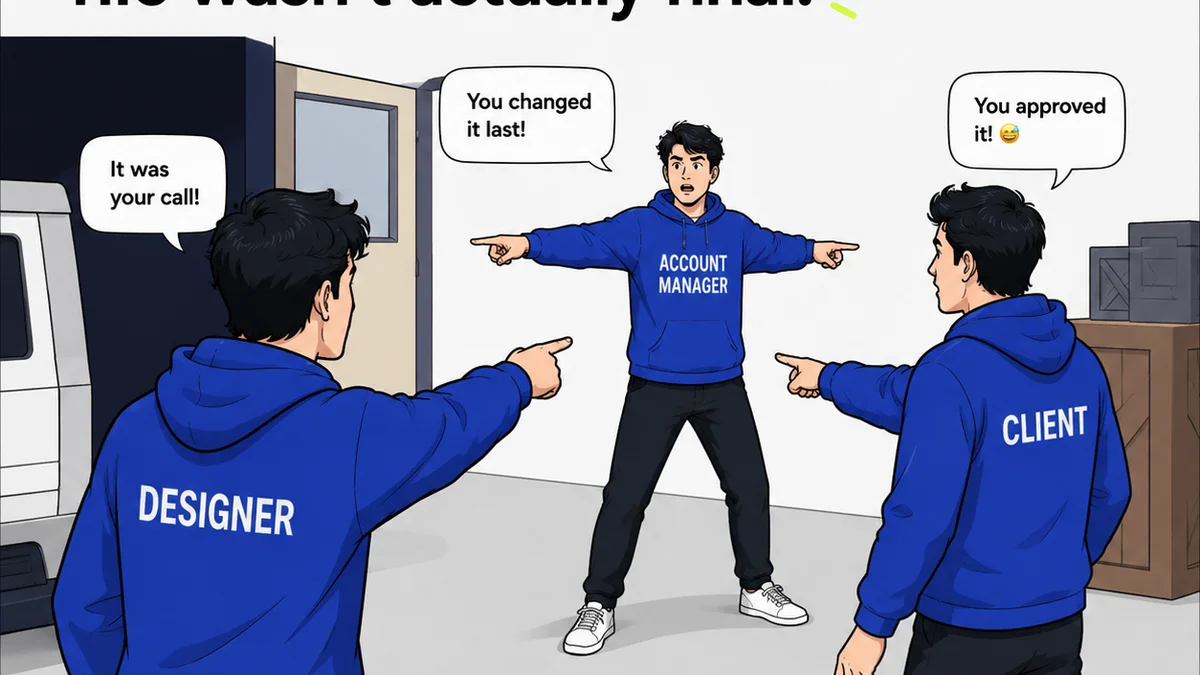
Everyone agrees that getting good feedback on creative work is crucial. It’s the engine of improvement, the compass guiding projects to success. You hear it all the time: better briefs, clearer communication, more strategic thinking. None of that is wrong. But it’s incomplete.
The hard truth is that the *process* of handling feedback, not the feedback itself, is the real bottleneck for modern creative teams. It’s not about the quality of the input, but the chaos of the output.
1. The Illusion of 'Good Feedback'
We chase the unicorn of perfect feedback. We train clients, we refine briefs, we demand clarity. And sometimes, we get it. A beautifully articulated point, a precise suggestion. We pat ourselves on the back, thinking we’ve solved the problem.
But then what?
That perfect piece of feedback gets buried in an email chain. It’s misinterpreted in a rushed Slack message. It gets lost in a meeting where everyone talked over each other. Or worse, it’s never actually acted upon because no one is tracking it.
The problem isn't the *feedback*. It's the *system* (or lack thereof) for capturing, organizing, and acting on it.
2. The Hidden Costs of Scattered Feedback
Think about your current workflow. Where does feedback live?
- Endless email threads?
- Random Slack channels?
- Scattered comments in Google Docs or PDFs?
- Notes scribbled on a whiteboard after a client call?
- Verbal instructions that nobody wrote down?
Each of these is a potential point of failure. Each represents lost time, misdirection, and unnecessary revisions.
Consider the ripple effect:
a. The Revision Spiral
When feedback is unclear or lost, revisions become a guessing game. A designer makes a change based on a vague comment, only to find out it wasn’t what the client meant. Back to the drawing board. This cycle eats up hours, sometimes days, and frustrates everyone involved.
b. The Approval Black Hole
How do you know when a piece of work is truly approved? Is it when the client says "Looks good" in an email? Or when they stop replying? Without a clear audit trail, you’re operating on assumptions. This can lead to launching work that isn’t fully signed off, or holding up projects unnecessarily because of perceived ambiguity.
c. The Quality Control Nightmare
Ensuring a project meets all requirements and standards is tough when feedback is a moving target. Were all the sign-offs obtained? Were all the requested changes implemented correctly? Without a centralized record, quality checks become a manual, error-prone process.
3. Why 'Talking It Out' Fails
Many teams default to meetings or calls to resolve feedback. It feels collaborative, efficient. You can have a real-time conversation, clarify points, and get immediate reactions.
But this often creates more problems than it solves. Key decisions are made verbally, with no permanent record. Important nuances are missed because people are focused on the next agenda item. And who is responsible for documenting the outcome? Usually, no one. The information gets diluted, distorted, and easily forgotten.
The immediacy of a conversation is a poor substitute for documented clarity.
4. The Myth of the 'Creative Genius'
There's a romantic notion that creatives are intuitive geniuses who can just *intuit* what a client wants. That they can absorb a few cryptic comments and conjure the perfect solution. This is a dangerous myth.
Even the most talented creatives need clear direction. They need actionable, specific feedback to do their best work. When that feedback is muddled, contradictory, or missing, it doesn't just slow them down; it stifles their creativity. They start second-guessing, becoming hesitant rather than inspired.
Empowering creatives means giving them the tools and processes to succeed, not expecting them to read minds.
5. The Real Work: Structuring Feedback
The solution isn't to get *better* feedback. It's to build a better *system* for handling it. This means:
a. Centralization
All feedback, comments, and approvals for a given project should live in one place. No more hunting through email, Slack, and disparate documents. This single source of truth eliminates confusion and ensures everyone is working from the same information.
b. Context
Feedback needs to be tied directly to the creative asset it refers to. A comment on a specific image, a paragraph, or a button is infinitely more useful than a general note about the overall design. Visual annotation tools are key here.
c. Clarity and Actionability
The system should encourage clear, specific comments. It should also make it easy to assign actions, set deadlines, and track progress. This turns vague suggestions into concrete tasks.
d. Version Control
Creative work evolves. You need to track different versions of assets and easily compare them. This prevents confusion about which iteration is the latest and ensures you can always refer back to previous versions if needed.
e. Audit Trail
A clear record of who said what, when, and what the final decision was is non-negotiable. This protects both the agency and the client, providing accountability and preventing disputes.
Where Revue Fits In
This is precisely why Revue was built. Agencies and creative teams are drowning in scattered feedback, endless revision cycles, and unclear approvals. They need a better way to manage the creative review process.
Revue provides a centralized platform where all feedback lives. Your clients can comment directly on specific elements of your creative work – images, videos, copy, PDFs. These comments are organized, contextual, and actionable.
You get a clear audit trail of all communication and approvals. You can easily track revisions, manage versions, and ensure everyone is on the same page. This streamlines the entire review and approval workflow, freeing up your team to focus on creating great work, not wrangling feedback.
Final Thought
Are you optimizing for the *quality* of feedback, or the *efficiency* of managing it? Because one without the other is just busywork.
Frequently asked questions
What is the biggest mistake teams make when handling creative feedback?
The biggest mistake is focusing solely on the quality of the feedback itself, rather than the system for managing it. Scattered feedback across emails, Slack, and documents leads to confusion, lost time, and unnecessary revisions, regardless of how good the initial feedback was.
How can I make client feedback more actionable?
Ensure feedback is centralized, contextual (tied to specific elements of the creative asset), and clearly documented. Encourage clients to be specific and use tools that allow for direct annotation on the creative work itself.
Why are meetings often a poor way to handle feedback?
Meetings can lead to verbal feedback that isn't documented, making it easy to forget or misinterpret. They can also lack a clear audit trail, making it difficult to track decisions and approvals accurately. This can create more problems than it solves.
How does a centralized feedback system benefit creatives?
A centralized system provides creatives with clear, organized, and actionable feedback, reducing ambiguity and the need for guesswork. It allows them to focus on execution rather than deciphering scattered comments, ultimately empowering them to do their best work.