Everyone talks about the creative process. They’ll tell you it’s about brainstorming, ideation, execution. That it’s messy, iterative, and requires ‘flow states.’
None of that is wrong. But it’s incomplete.
The hard truth? A great creative process isn’t about *having* a process. It’s about having a *system* that consistently delivers quality work, on time, and on budget. It’s about making the magic repeatable.
A checklist for your creative process isn’t just a list of steps. It’s a blueprint for predictability in a field that thrives on unpredictability. It’s how you turn brilliant sparks into finished campaigns.
1. Defining the Brief: The Bedrock of Everything
You can’t build a house without a foundation. You can’t start creative work without a crystal-clear brief.
Too often, briefs are rushed. They’re vague. They’re treated as a formality before the ‘real work’ begins. This is where most projects go sideways.
1.1 The Briefing Session
This isn’t just a quick chat. It’s a deep dive. Everyone who needs to be there *is* there. Key stakeholders. The creative team. Project management.
Ask the hard questions:
- What does success look like? Quantifiable metrics?
- Who is the target audience, *really*? Demographics, psychographics, pain points?
- What is the core message? What’s the single most important takeaway?
- What are the absolute must-haves? What are the nice-to-haves?
- What are the constraints? Budget, timeline, brand guidelines, technical limitations?
- What’s the competitive landscape? What are others doing?
- What’s the desired tone of voice?
Document everything. Get sign-off.
1.2 The Written Brief Document
Verbal agreements evaporate. A formal brief document is your contract. It’s the source of truth.
It should include:
- Project overview and objectives
- Target audience profile
- Key message and desired outcomes
- Deliverables
- Mandatories and constraints
- Brand guidelines
- Timeline and key milestones
- Budget overview
- Contact information
This document is the first gate. No creative work starts until this is agreed upon.
2. Ideation & Concept Development: Structured Exploration
This is where the ‘creativity’ happens. But even creativity benefits from structure.
Random brainstorming can be fun, but it’s rarely efficient. You need to guide the exploration.
2.1 Setting the Stage
Before the ideation session, ensure everyone has absorbed the brief. They should understand the problem being solved.
Provide context. Share competitor examples. Bring in relevant research or user insights.
This isn't about giving them the answers; it’s about giving them the right questions and the right raw materials.
2.2 Diverse Ideation Methods
Don’t rely on just one technique. Mix it up.
- Brainstorming: Free association, quantity over quality initially.
- Mind Mapping: Visualizing connections between ideas.
- SCAMPER: Substitute, Combine, Adapt, Modify, Put to another use, Eliminate, Reverse.
- Worst Possible Idea: Flipping bad ideas to find good ones.
- Role-Playing: Thinking from the audience’s perspective.
The goal is to generate a wide range of possibilities, not just one ‘golden idea’ immediately.
2.3 Concept Refinement
Once you have a pool of ideas, it’s time to filter. Evaluate them against the brief.
Does it meet the objectives? Does it resonate with the audience? Is it feasible within the constraints? Is it original?
Develop the strongest concepts further. Flesh them out. Create mood boards, rough sketches, or storyboards.
Get initial feedback from internal stakeholders before presenting to the client.
3. Creative Production: Building It Right
This is where the rubber meets the road. The concept becomes a tangible asset.
This phase requires meticulous attention to detail and clear communication.
3.1 Asset Creation Workflow
Break down the production into manageable tasks. Assign ownership. Set clear deadlines for each stage.
Whether it’s design, copywriting, video production, or web development, define the steps:
- Drafting/Sketching
- Content writing
- Design mockups
- Development
- Internal review
- Revisions
Use project management tools to track progress. Keep everyone aligned.
3.2 Quality Assurance (QA)
This is non-negotiable. A creative asset must be technically sound and error-free.
Develop a QA checklist specific to the deliverable:
- Design: Brand consistency, visual hierarchy, accessibility (color contrast, font sizes), responsiveness across devices, pixel perfection.
- Copy: Spelling, grammar, tone of voice, factual accuracy, call to action clarity.
- Development: Browser compatibility, link functionality, loading speed, security, mobile responsiveness.
- Video/Audio: Synchronization, correct formats, audio levels, visual quality.
Don’t rely on the creator to self-check. Have a fresh pair of eyes review.
3.3 Version Control
Chaos reigns when multiple versions of a file exist. Use a system that prevents this.
Cloud storage with version history is a minimum. Dedicated DAM (Digital Asset Management) systems are better for larger teams or complex projects.
Always name files clearly and consistently. Include version numbers.
4. Feedback & Revisions: Navigating the Nuance
This is often the most contentious part of the creative process. Poorly managed feedback leads to frustration, scope creep, and subpar work.
The assumption: Clients know what they want and how to articulate it.
The truth: Clients often react emotionally or provide vague direction. They need guidance to give constructive feedback.
4.1 Establishing Feedback Protocols
Before you even start designing, agree on how feedback will be handled.
- Who provides feedback?
- When will feedback be provided? (e.g., within 24 hours of delivery)
- How will feedback be submitted? (e.g., via a specific tool, email, meeting)
- What constitutes a ‘round’ of revisions?
Set expectations for constructive criticism. Encourage feedback tied to the original brief and objectives, not just personal preference.
4.2 Structuring Feedback Sessions
If feedback is verbal, keep it focused.
Guide the conversation back to the brief. Ask clarifying questions:
- “You mentioned you don’t like this color. Can you tell me why? Does it clash with the brand, or is it a personal preference?”
- “You asked for it to be ‘more exciting.’ What does ‘exciting’ look like to you in this context?”
- “How does this suggested change align with the target audience?”
Summarize decisions and action items at the end of every meeting.
4.3 Managing Revision Rounds
Each revision round should have a clear scope. Track changes diligently.
If feedback introduces new requirements or significantly deviates from the brief, flag it as a potential scope change. This may require a change order and additional budget/timeline.
Don’t fall into the trap of endless tweaking. Know when to push back respectfully, armed with the brief and the project goals.
5. Approvals: The Final Sign-Off
This sounds straightforward, but it’s often a bottleneck.
An ‘approval’ needs to be definitive. Ambiguous sign-offs lead to rework later.
5.1 Clear Approval Gates
Define what constitutes a final approval at each stage. Is it an email confirmation? A signature on a document? A status change in a project management tool?
Ensure the person giving the final approval has the authority to do so.
5.2 Documenting Approvals
Keep a clear record of all approvals. This protects both the agency and the client.
If a client approves a draft, and later requests changes that were present in that approved draft, you have a record to refer back to.
5.3 Handling Post-Approval Changes
Once a deliverable is formally approved, any further changes should be treated as a new request.
This might involve a change order, additional costs, and timeline adjustments. Clearly communicate this policy upfront.
Where Revue Fits In
Managing this entire creative process checklist manually is a recipe for dropped balls. You need a system that supports the workflow, not hinders it.
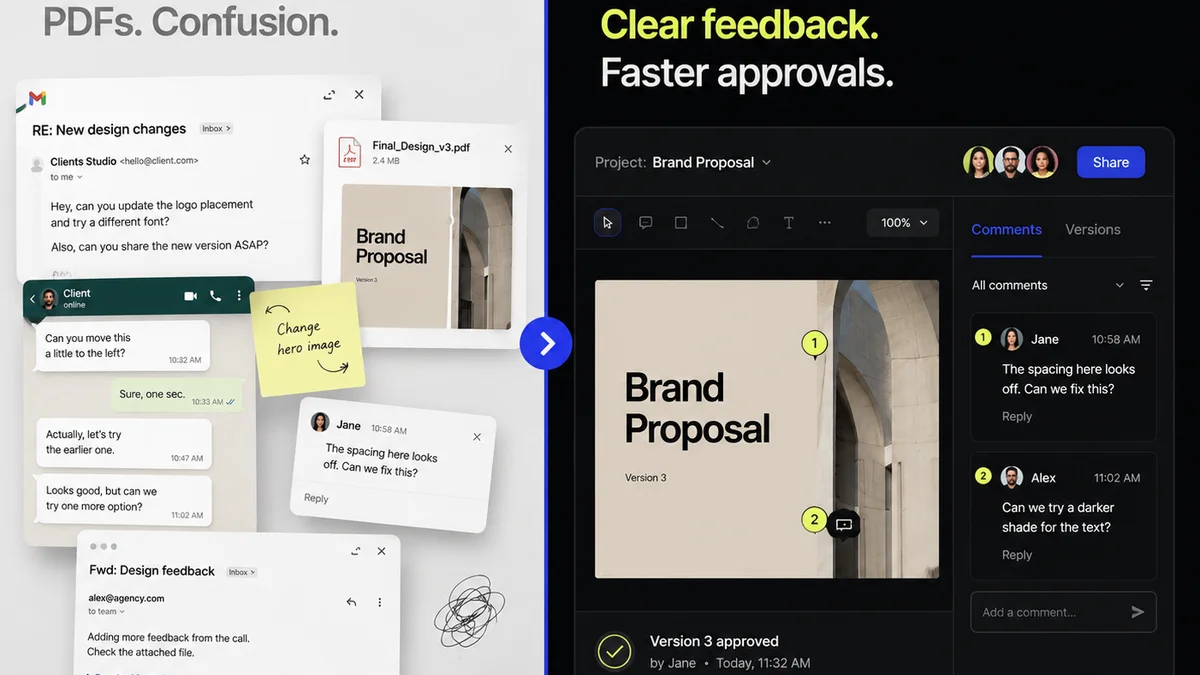
Centralized Feedback: Instead of sifting through endless email threads or Slack messages, Revue brings all client feedback into one place, attached directly to the creative asset. This context is crucial.
Revision Visibility: See exactly who provided what feedback, when it was addressed, and track the history of changes. This transparency reduces confusion and prevents 'he said, she said' scenarios.
Streamlined Approvals: Formalize the sign-off process. Get clear, documented approvals directly within the platform, creating an undeniable audit trail.
Quality Checks: While Revue doesn't replace your QA process, having a structured workflow with clear stages helps ensure that assets are reviewed thoroughly before reaching the final approval gate.
It’s about making the complex manageable. Turning a chaotic sequence of events into a predictable, professional operation.
Final Thought
A creative process checklist is more than just a set of steps. It’s a commitment to clarity, efficiency, and quality.
It’s the difference between hoping for great work and *engineering* great work.
Are you building a creative business, or just hoping for happy accidents?
Frequently asked questions
What are the key stages of a creative process?
A typical creative process includes defining the brief, ideation & concept development, production, feedback & revisions, and final approvals. Each stage requires specific activities and checks to ensure quality and efficiency.
Why is a creative process checklist important for agencies?
A checklist standardizes your workflow, ensuring consistency, reducing errors, improving communication with clients, and making the creative magic repeatable. It moves you from hoping for good results to engineering them.
How can I get better feedback from clients?
Establish clear feedback protocols upfront. Encourage clients to tie feedback to the original brief and objectives. Ask clarifying questions to understand the 'why' behind their suggestions, and guide them towards constructive criticism rather than subjective opinions.
What's the biggest mistake agencies make with their creative process?
The biggest mistake is treating the process as informal or secondary to the creative output. This leads to vague briefs, chaotic feedback loops, scope creep, and missed deadlines. A structured, documented process is essential for predictable success.