Everyone talks about improving their creative process. They’ll point to better brief templates, more agile stand-ups, or adopting the latest design software. None of that is wrong. But it’s incomplete.
The real engine of a smooth creative process isn't just about *how* you brainstorm or *what* tool you use for wireframing. It’s about the underlying operational clarity that allows creative work to flow without friction.
This is the hard truth: most creative process problems stem from a lack of structured information and clear accountability, not a lack of creative talent or good intentions.
1. The Myth of the 'Creative Flow State' as a Process Fix
We romanticize the idea of creatives being 'in the zone.' It's a beautiful image. But relying on this state as a core part of your process management is a recipe for chaos.
Sure, uninterrupted focus is crucial for deep work. But what happens when the 'zone' is constantly interrupted by:
- Unclear feedback?
- Scope creep disguised as 'small tweaks'?
- Endless revision cycles with no clear end in sight?
- Clients or stakeholders who don't know what they want until they see it?
This isn't a creative problem; it's an operational one. The assumption that a perfectly managed creative process looks like fewer interruptions is backward. It should look like *controlled* interruptions, where feedback is structured, revisions are tracked, and decisions are logged.
Operational Clarity Beats Uninterrupted Flow
The goal isn't to eliminate all interruptions. It's to ensure that when interruptions happen, they are:
- Specific and actionable
- Tracked against project goals
- Communicated clearly to the right people
- Resolved efficiently without derailing the entire project
This requires more than just a good project manager. It requires a system that enforces clarity at every stage.
2. Feedback Isn't Free—It Costs Time and Money
Client feedback is essential. But unstructured, vague, or conflicting feedback is one of the biggest drains on creative agency resources. The assumption is that more feedback equals a better final product.
The reality? Poorly managed feedback leads to wasted hours, team frustration, and often, a final product that's worse because it’s been pulled in too many directions.
The Cost of Ambiguity
Consider the common scenarios:
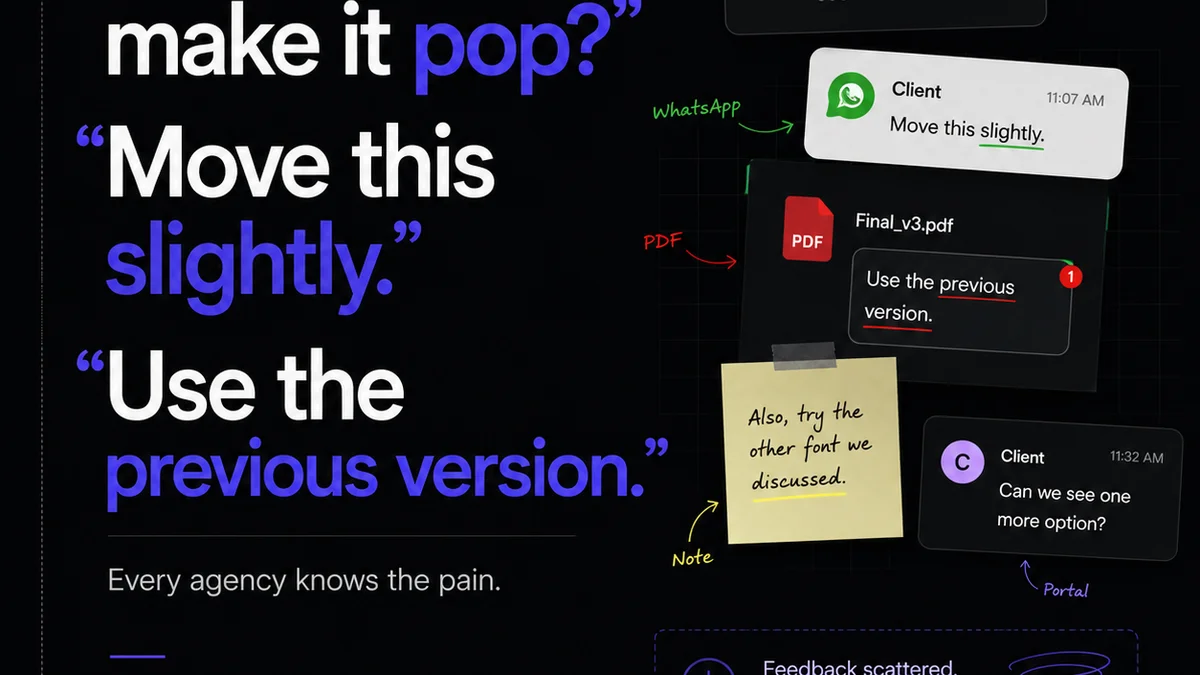
- A client says, 'I don't love it. Make it pop more.' What does 'pop' mean? This single phrase can trigger hours of redesign without a clear direction.
- Multiple stakeholders provide conflicting feedback, and no one is designated to consolidate it. The creative team is left to guess, leading to rework.
- Feedback arrives via email, Slack, text message, and carrier pigeon. Trying to track and synthesize this becomes a full-time job in itself.
This operational inefficiency kills productivity. Every hour spent deciphering vague feedback is an hour not spent on actual creative problem-solving or strategic thinking.
Implementing Structured Feedback
A better approach involves:
- Establishing clear feedback rounds with defined timelines.
- Requiring specific, actionable comments tied to project objectives.
- Using a centralized platform where all feedback is collected, organized, and tracked.
- Designating a single point person for feedback consolidation if multiple stakeholders are involved.
When feedback is managed, it becomes a valuable input, not a productivity black hole.
3. Revision Cycles: The Unseen Project Killer
The assumption is that revisions are a normal, unavoidable part of the creative process. And they are. But the *management* of those revisions is where projects often fail.
Uncontrolled revisions can balloon project timelines, inflate budgets, and destroy team morale. It’s the creeping effect of 'just one more change' that can sink even the most well-intentioned projects.
The Stealthy Scope Creep
What does unmanaged revision chaos look like?
- Endless rounds of minor tweaks that never satisfy the client.
- Changes made without clear documentation, leading to confusion later.
- Scope creep disguised as 'small adjustments' that accumulate into significant extra work.
- Lack of visibility into what has been revised, what hasn't, and who approved what.
This isn't just about the client being difficult. It's about the absence of a clear, auditable process for managing changes.
Establishing Revision Control
Effective revision management requires:
- Defining the number of revision rounds included in the initial scope.
- Using a system to track each revision request, its impact, and its approval status.
- Ensuring that all stakeholders understand what constitutes a 'revision' versus a 'new request.'
- Having a clear sign-off process for each round of revisions.
When revisions are managed, they are controlled. They serve the project's evolution, rather than undermining its completion.
4. The Illusion of 'Good Enough' Creative Quality
Many agencies and in-house teams operate on a 'good enough' mentality for quality checks. The assumption is that once the client signs off, the work is done and the quality is inherently validated.
This is a dangerous assumption. 'Good enough' often means 'barely acceptable' and can lead to downstream issues, brand damage, and missed opportunities for excellence.
The High Cost of Low Standards
What does a lax approach to quality control look like?
- Design elements that don't meet accessibility standards (WCAG).
- Inconsistent branding across different deliverables.
- Technical errors in digital assets that impact user experience.
- Work that technically meets the brief but fails to meet strategic objectives or brand guidelines.
This isn't just about aesthetics. It's about the fundamental integrity and effectiveness of the creative output.
Building a Quality Assurance Layer
A robust creative process must include a dedicated quality assurance (QA) step. This means:
- Establishing clear QA checklists relevant to the project type (e.g., brand consistency, technical specs, accessibility, functionality).
- Assigning responsibility for QA to someone other than the primary creator, ideally.
- Integrating QA into the workflow *before* final delivery, not as an afterthought.
- Using tools that can automate parts of the QA process, like checking color contrast or file formats.
When quality is actively managed, it becomes a proactive differentiator, not a reactive firefighting exercise.
Where Revue Fits In
Managing a creative process effectively is an operational challenge. It requires structure, clarity, and accountability built into your workflow.
Tools that facilitate this are essential. Revue is designed precisely for this purpose.
It centralizes client feedback, making it visible, actionable, and trackable. No more digging through email chains or Slack messages to find that one crucial comment. Every piece of feedback lives in one place, linked to the specific creative asset it pertains to.
Revue provides clear visibility into revision cycles. You can see exactly what’s been requested, what’s been done, and what’s pending approval. This transparency helps manage scope, track progress, and maintain project momentum.
Furthermore, by standardizing how feedback and revisions are handled, Revue inherently supports more rigorous quality checks. When you have a clear audit trail of approvals and changes, it’s easier to ensure the final output meets all requirements and standards.
It’s about moving from a chaotic, reactive process to a structured, proactive one.
Final Thought
The most successful creative teams don't just have talented individuals. They have robust operational systems that amplify that talent. They understand that managing the *process* is as critical as executing the *creativity*.
Are you managing your creative process, or is it managing you?
Frequently asked questions
What is the biggest misconception about improving creative process management?
The biggest misconception is that improving the creative process is solely about adopting new tools or techniques. While tools are important, the real improvement comes from establishing operational clarity, structured feedback loops, and clear accountability, which tools then support.
How does unstructured client feedback impact a creative project?
Unstructured feedback leads to wasted time deciphering vague comments, potential scope creep, team frustration, and often a final product that misses the mark because the direction was unclear. It's an operational drain on resources.
What are the key elements of effective revision management?
Effective revision management involves defining the scope of revisions, using a system to track each request and its approval status, distinguishing between revisions and new requests, and having a clear sign-off process for each round.
Why is a dedicated quality assurance (QA) step important in creative workflows?
A dedicated QA step ensures that creative work meets all requirements, standards, and objectives before final delivery. It prevents downstream issues, maintains brand integrity, and avoids costly rework that can arise from overlooked errors or inconsistencies.