Everyone talks about creative workflow checklists. You’ve seen them. They’re full of things like ‘define the brief,’ ‘get client sign-off,’ and ‘deliver final assets.’
None of that is wrong. But it’s incomplete. It’s the skeleton without the muscle and sinew.
The hard truth? Most agencies focus on the *steps* of a creative project, not the *flow*. They list tasks, but they don’t engineer the movement between them. This is where true inefficiency hides.
1. The Illusion of 'Done'
A creative workflow checklist often implies linear progress. Task A is done, then Task B begins. Simple, right?
Wrong. Creative work is rarely linear. It’s iterative. It’s messy.
The real checklist item isn’t ‘get client sign-off.’ It’s ‘establish crystal-clear, unambiguous feedback loops that prevent rework.’
The Feedback Void
Here’s what happens without engineered feedback:
- Vague comments get misinterpreted.
- Crucial details are missed in long email chains.
- The client thinks they’ve approved, but the agency knows it’s only a partial ok.
- Designers feel like they’re constantly redoing work based on moving goalposts.
This isn’t about the client being difficult. It’s about a broken system for capturing and acting on their input.
Redefining Approval
Your checklist needs to account for:
- Specific points for structured feedback (not just ‘thoughts?’).
- Tools that allow annotation directly on creative assets.
- A clear process for consolidating multiple stakeholder comments.
- Explicit confirmation of what constitutes a ‘final’ approval versus an interim check-in.
This isn’t just about speed; it’s about accuracy and reducing the constant churn that drains creative energy.
2. Revision Hell: The Unspoken Bottleneck
‘Manage revisions’ sounds like a task. In reality, it’s a potential vortex.
A common assumption is that revisions are just part of the process. The deeper truth is that *unmanaged* revisions are a symptom of a flawed workflow, not an inevitable cost.
Your checklist should focus on minimizing the *need* for excessive revisions and maximizing the *efficiency* when they are necessary.
The Root Causes of Revisions
- Poorly defined scope from the start.
- Lack of early-stage alignment on direction.
- Feedback that arrives too late in the process.
- Internal miscommunication about client requests.
Each of these points back to a lack of structured communication and clear accountability.
Checklist Items for Revision Control
- Mandatory internal review before client presentation.
- A system for tracking the history of changes and the rationale behind them.
- Defined limits on the number of revision rounds (and what constitutes a new round).
- Protocols for identifying and escalating scope creep.
If your checklist just says ‘do revisions,’ you’re setting yourself up for pain. You need to engineer the *control* around revisions.
3. Quality Control: Beyond the Final Pixel
Many checklists end with ‘deliver final assets.’ This implies the creative team’s job is done once the files are sent.
The reality is that quality control is an ongoing process, and its most crucial phase happens *before* the final handoff.
A robust creative workflow checklist embeds quality checks at every stage, not just as a final pass.
The Near-Miss Trap
What’s worse than a client rejecting work? A client accepting work that has a subtle but critical flaw that only becomes apparent later.
Think about:
- Inconsistent branding across deliverables.
- Accessibility issues that weren’t caught.
- Technical specs that are slightly off, causing production problems.
- Typos or grammatical errors that undermine credibility.
These aren’t just minor errors; they’re brand risks.
Integrating Quality Assurance
Your checklist needs to include:
- Mandatory pre-flight checks for technical specifications.
- Accessibility audits (e.g., checking color contrast ratios, keyboard navigation readiness).
- Grammar and spell-checking as a distinct step, not an afterthought.
- Cross-browser and cross-device testing for digital work.
- A final stakeholder review specifically focused on quality and adherence to brief, separate from creative subjective feedback.
This isn’t about making the process longer; it’s about making the output *right* the first time, and every time.
4. Collaboration: The Team’s Nervous System
A checklist often implies individual tasks. The modern creative agency runs on collaboration.
The assumption is that a team working together naturally creates a good flow. The truth is that seamless collaboration requires deliberate structure and the right tools.
Your checklist should actively promote and facilitate teamwork, not just list individual responsibilities.
The Silo Effect
When collaboration breaks down, you see:
- Designers working in a vacuum, unaware of copy changes.
- Account managers not having visibility into the latest creative direction.
- Clients interacting directly with multiple team members, leading to conflicting messages.
- Missed opportunities for cross-pollination of ideas.
This isn't just about communication; it’s about shared context and visibility.
Fostering Team Synergy
Build these into your workflow:
- Regular, brief sync-up meetings (stand-ups) with clear agendas.
- A centralized platform for all project assets, communication, and feedback.
- Defined roles and responsibilities for each project phase.
- Protocols for escalating issues that require cross-functional input.
- Encouraging peer reviews and constructive critique within the team.
A great checklist doesn't just assign tasks; it ensures the right people have the right information at the right time.
Where Revue Fits In
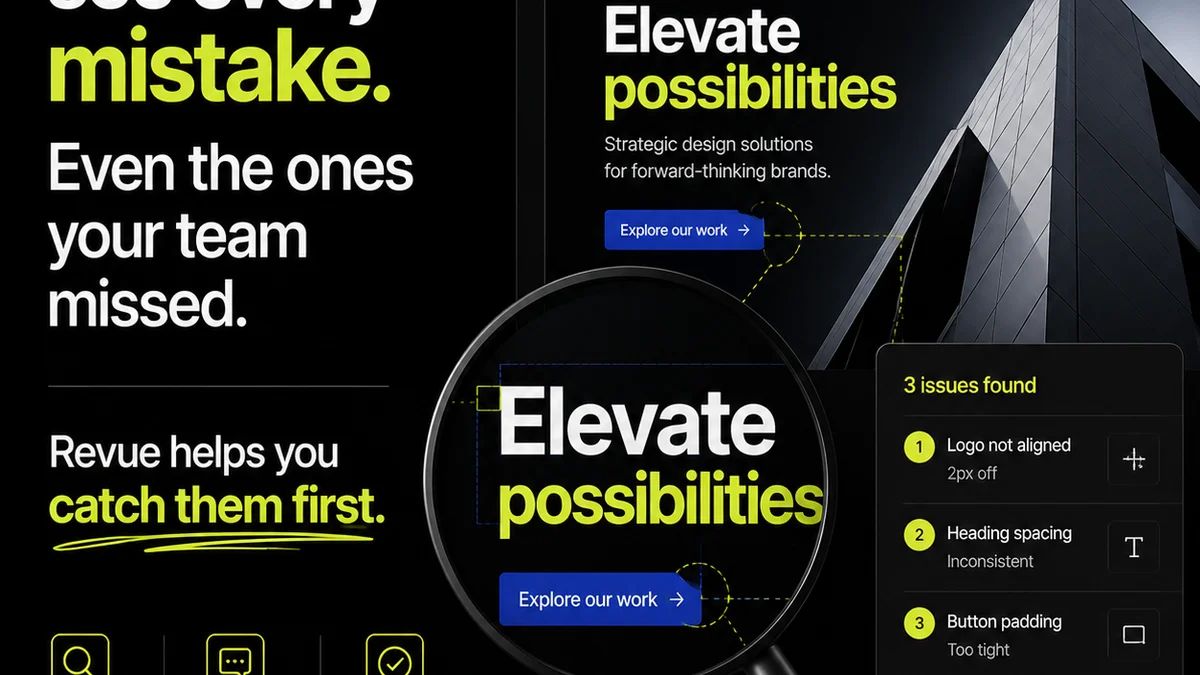
This is where a centralized client feedback and revision management platform becomes indispensable. Your creative workflow checklist should explicitly call for its use.
Instead of just ‘gather feedback,’ your checklist item becomes: ‘Utilize Revue to consolidate all client feedback, track version history, and manage revision rounds with clear audit trails.’
Revue helps transform ambiguous steps into concrete actions:
- Centralized Feedback: Comments are logged directly on the asset, eliminating email chains and ensuring all input is captured in one place.
- Revision Visibility: See exactly what changed, who requested it, and when it was approved, providing clarity for both the team and the client.
- Quality Checks: Use the platform to conduct internal reviews against the brief and previous feedback, ensuring alignment before final delivery.
It’s about moving from a list of ‘what to do’ to a system of ‘how it gets done, together.’
Final Thought
Is your creative workflow checklist a rigid set of instructions, or a dynamic blueprint for collaboration and quality? If it doesn’t actively engineer clarity, accountability, and seamless handoffs, you’re likely still operating on assumptions, not operational excellence.
Frequently asked questions
What's the difference between a task list and a creative workflow checklist?
A task list details individual actions. A creative workflow checklist maps the sequence, dependencies, and communication protocols between tasks to ensure a smooth, efficient project flow from start to finish.
How can I prevent scope creep with a checklist?
Your checklist should include mandatory steps for defining scope upfront, obtaining explicit sign-off on the initial brief, and establishing clear protocols for evaluating and approving any requests that fall outside the original scope.
What are the key elements of a good client feedback loop?
A good feedback loop involves designated points for feedback, clear instructions on how to provide it (e.g., using a specific tool), consolidation of all comments, and confirmation of what constitutes final approval. It should minimize ambiguity and prevent endless back-and-forth.
How does a checklist help with creative quality control?
By embedding specific quality assurance steps at various stages—like technical pre-flight checks, accessibility audits, and final proofreading—a checklist ensures that quality isn't an afterthought but an integrated part of the process, reducing errors and brand risks.