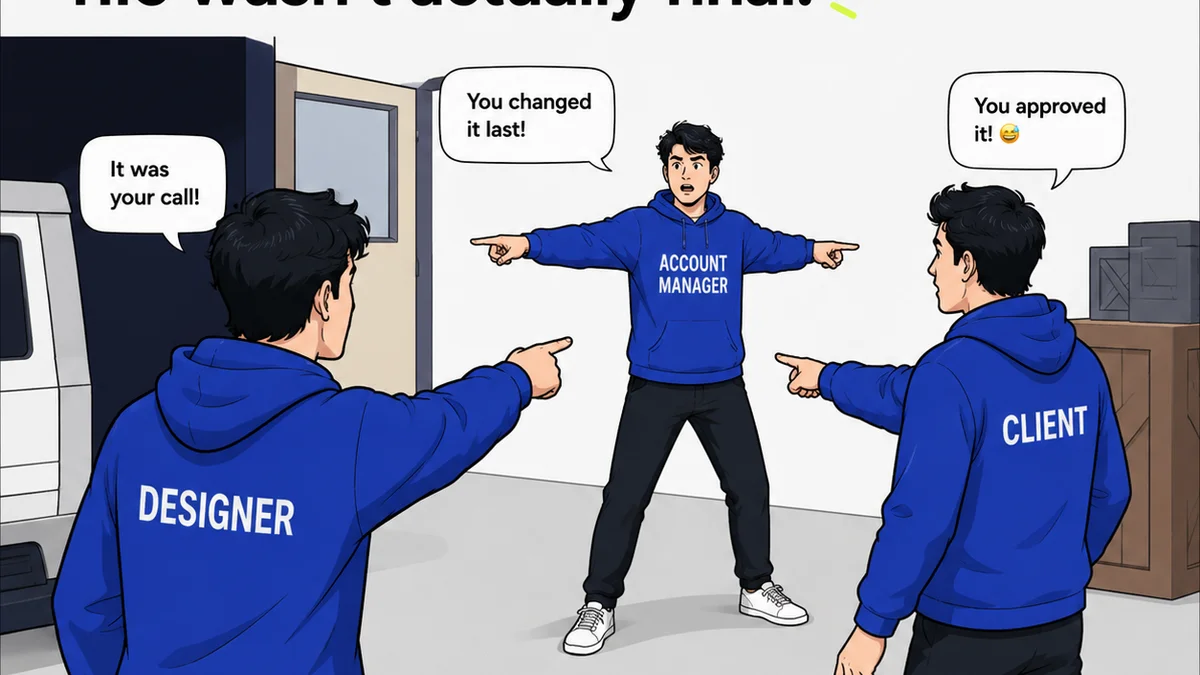
Everyone talks about the cost of creative work. They focus on hourly rates, project fees, and the final invoice. None of that is wrong. But it’s incomplete.
The real cost of creative workflows isn’t just the money you pay. It’s the time lost, the errors made, and the opportunities missed due to inefficient processes. For US businesses in professional services, understanding these hidden costs is critical to profitability and client satisfaction.
1. The Myth of the Fixed Project Bid
Many agencies and in-house teams operate on a fixed bid model. Clients love it. It feels predictable. But it often forces teams to cut corners or absorb unexpected costs.
This leads to a common assumption: that creative projects are predictable and scope creep is the only variable. The hard truth? Inefficient workflows are the biggest, most predictable cost drain.
The Hidden Price of Poor Communication
Think about a typical project. Feedback comes in through email, Slack, text messages, and even verbal notes. Different stakeholders chime in with conflicting opinions.
Each miscommunication, each request for clarification, each time a team member has to hunt down the latest feedback costs money. It’s not just a few minutes here and there. It adds up, silently eating into your margins.
- Lost billable hours searching for feedback.
- Rework due to misunderstood instructions.
- Delayed project timelines impacting other client work.
- Frustrated team members burning out.
Scope Creep vs. Workflow Creep
Scope creep is when the client asks for more work than originally agreed. That’s a known risk, usually managed with change orders.
Workflow creep is different. It’s the gradual increase in time and resources needed to complete a task due to internal inefficiencies. This is often invisible until it’s too late.
- Unclear review processes.
- Lack of a centralized feedback system.
- Manual version control.
- Ineffective client collaboration tools.
2. Quantifying Time Waste in Creative Operations
Time is money, especially in professional services. Every hour spent waiting for feedback, chasing approvals, or fixing preventable errors is an hour that could be spent on billable client work or strategic development.
Let’s break down where that time typically goes:
Feedback Chaos
Imagine a design project. The client sees a draft. Then, three different people from the client’s team give feedback. One likes the blue, another wants it greener, and a third says the overall tone is wrong.
Without a system, this feedback gets scattered. Your team has to reconcile these inputs, often with more back-and-forth. This isn't just about the feedback itself; it’s about the *process* of collecting and acting on it.
- Email Chains: Hours spent reading, sorting, and replying.
- Slack/Teams: Important feedback buried in endless conversations.
- Verbal Notes: Easily forgotten or misinterpreted.
- Spreadsheets: Manual tracking, prone to errors.
Revision Round Robin
Each revision round adds complexity. If you don’t have a clear record of what was changed and why, you risk introducing new issues or reverting previous fixes.
This is where version control becomes crucial. Without it, teams spend time figuring out which file is the latest, what changes were made in each iteration, and whether those changes align with the brief.
Approval Bottlenecks
Waiting for final approval can stall a project for days, even weeks. This isn't always the client's fault; sometimes, the internal approval process is just convoluted.
If stakeholders aren't clear on their role, or if the process relies on manual signatures or emails, it becomes a bottleneck. This delays launch dates and can impact campaign performance.
3. The Cost of Errors and Rework
Mistakes happen. But a poorly managed workflow amplifies them. The cost of fixing errors is far higher than the cost of preventing them.
Misinterpreted Briefs
A creative brief is the foundation. If it’s vague, or if the team doesn't have a clear way to refer back to it, interpretations will vary.
This leads to work that misses the mark from the start. The cost? Significant time spent on revisions that, in essence, are just correcting initial misunderstandings.
Lack of Quality Assurance
Skipping quality checks to meet a deadline is a false economy. A deliverable with typos, broken links, or design inconsistencies damages your reputation and requires costly fixes later.
This is especially true for digital products. A website with accessibility issues, for instance, can lead to legal challenges and alienate users. Understanding standards like the Web Content Accessibility Guidelines (WCAG) is paramount.
Version Control Nightmares
Ever opened a file and realized it’s three versions behind? Or that a critical change was accidentally overwritten?
This is the result of manual file management and lack of a single source of truth. The time spent trying to reconstruct the correct version or redo lost work is a direct financial hit.
4. The Impact on Client Relationships
Your workflow isn't just an internal affair. It directly impacts the client experience.
Slow Response Times
When your team is bogged down by internal inefficiencies, client inquiries can get delayed. This makes you look unresponsive and unprofessional.
Lack of Transparency
Clients want to know where their project stands. If your internal processes are opaque, you can't provide clear updates. This breeds anxiety and distrust.
Inconsistent Deliverables
If your workflow is chaotic, the quality of your output can be inconsistent. One project might be stellar, the next might have visible flaws. Clients notice this.
This inconsistency erodes confidence. They start to question your reliability and expertise.
5. Where Revue Fits In
Managing creative workflows efficiently isn't about magic; it's about process and the right tools. Revue is built to address these exact pain points.
Centralizing client feedback is key. Instead of juggling emails, Slack messages, and random notes, all feedback lives in one place, directly on the creative asset. This eliminates ambiguity and saves countless hours.
Revision and approval visibility becomes crystal clear. Track every change, every comment, and every approval status in real-time. No more chasing down stakeholders or wondering what’s holding up the project.
Running quality checks is streamlined. With a clear audit trail and version history, you can ensure that what’s approved is what’s delivered, minimizing errors and rework.
Revue transforms your workflow from a chaotic cost center into a predictable, profitable engine.
6. Calculating Your Workflow ROI
How much is an inefficient workflow actually costing you? It’s time to get specific.
Start by tracking time spent on non-billable tasks related to feedback, revisions, and approvals. Estimate the cost of rework due to errors.
Consider the cost of delayed projects and the impact on client retention.
The Cost of Inefficiency: A Simple Model
Let’s say your team spends an average of 5 hours per week per person on managing feedback and revisions for a single project, across 3 team members. That’s 15 hours a week.
If each team member bills at $100/hour, that’s $1,500 per week lost to inefficient workflow. Over a year, that’s $78,000 per project, per team.
Now factor in the cost of errors, rework, and potential lost clients. The numbers become staggering.
Investing in Efficiency
Implementing a centralized feedback and approval system isn’t an expense; it’s an investment. The return comes in the form of:
- Increased billable hours.
- Reduced project overruns.
- Improved client satisfaction and retention.
- Higher team morale and productivity.
7. Final Thought
The true cost of creative work extends far beyond the initial estimate. It's embedded in the very fabric of your operational processes.
Are you actively managing and optimizing your creative workflows, or are you letting hidden inefficiencies drain your profitability and damage your client relationships?
Frequently asked questions
What are the hidden costs of a poor creative workflow?
Hidden costs include wasted billable hours spent on managing scattered feedback, time lost to rework due to misinterpretations, delayed project timelines, and the negative impact on client relationships due to slow responses and inconsistent quality.
How does centralized feedback reduce costs?
Centralized feedback systems, like those offered by Revue, consolidate all comments and approvals in one place, directly on the creative asset. This eliminates time spent searching through emails and messages, reduces miscommunications, and speeds up the revision process, leading to significant cost savings.
Is fixed bidding always more expensive for agencies?
While fixed bidding offers clients predictability, it can be more expensive for agencies if workflows are inefficient. Unforeseen time spent on revisions or scope creep due to poor process management can eat into already tight margins, making the project unprofitable. Efficient workflows are key to making fixed bids viable.
How can I quantify the cost of rework in my creative projects?
To quantify rework costs, track the hours spent by your team correcting errors that should have been caught earlier or addressing feedback that was misunderstood. Also, consider the cost of client dissatisfaction and potential loss of future business stemming from errors or delays.