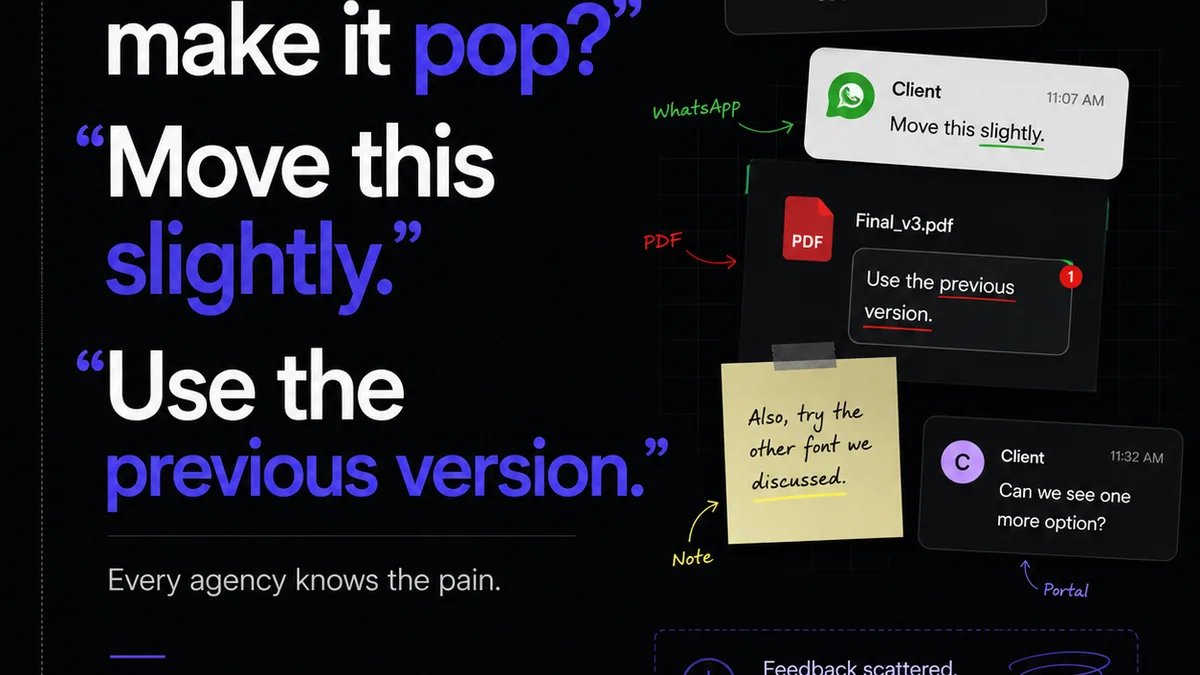
Everyone thinks design approvals are about presenting pretty pictures and getting a 'yes.' That's the theory, anyway.
The hard truth? Most agencies fumble the approval process. They treat it like a single event, not a continuous workflow. This leads to endless revisions, unhappy clients, and stressed-out teams.
1. The 'Big Reveal' Fallacy
You’ve got the perfect design. Your team’s proud. You schedule a big meeting to 'reveal' the work. It feels like a moment of triumph.
This is where it usually goes wrong.
A 'big reveal' forces all feedback into one, high-stakes moment. Clients haven't seen the work in context. They haven't had time to digest it. Or worse, they’ve been giving piecemeal feedback in emails, and now it all comes crashing down.
Why it Fails
- Context Collapse: Clients see the final piece in isolation, not as part of a larger campaign or user journey.
- Decision Paralysis: Too much information, too late. They feel pressure to give definitive feedback when they're not ready.
- Hidden Agendas: A client might have reservations they didn't voice earlier, now amplified by the pressure of a formal review.
- Scope Creep Incubator: Vague feedback given under pressure often leads to subjective 'I don't like it' comments that are hard to act on.
Effective design approvals aren't a single event; they're a series of informed checkpoints.
2. Ambiguous Briefs Breed Ambiguous Feedback
You can't get good approvals if the initial brief was a mess. If the client didn't clearly define their goals, target audience, or success metrics, how can they possibly approve a design that meets them?
This lack of clarity is a breeding ground for subjective feedback.
When goals are fuzzy, clients fall back on personal taste. 'Make the logo bigger.' 'I don't like that shade of blue.' These aren't actionable critiques; they're personal preferences masquerading as strategic direction.
The Vicious Cycle
- Unclear Objectives: Client can't articulate what success looks like.
- Vague Deliverables: The design team doesn't have concrete targets.
- Subjective Feedback: Client relies on gut feelings, not data or strategy.
- Endless Revisions: The design team chases an ever-moving, undefined target.
- Frustration: Both client and agency feel misunderstood and undervalued.
A strong brief sets the stage for objective critique. It defines the 'why' behind the design.
3. The 'Email Chain Avalanche'
Feedback scattered across dozens of email threads, Slack messages, and random Word docs is a nightmare. Trying to consolidate this into actionable design direction is like assembling a jigsaw puzzle with half the pieces missing and the other half from a different box.
This is where many agencies drown.
You're spending more time hunting for feedback than actually designing or iterating.
Symptoms of the Avalanche
- Missed feedback points.
- Conflicting instructions from different stakeholders.
- Wasted time trying to decipher ambiguous comments.
- Difficulty tracking which version was approved, and by whom.
- Team members working off outdated feedback.
Centralizing feedback isn't just about convenience; it's about accuracy and efficiency.
4. Lack of Clear Roles and Responsibilities
Who is the ultimate decision-maker on the client side? Who provides technical feedback? Who's just there for 'moral support' but ends up derailing the process?
Without clear roles, you get conflicting opinions and endless 'clarifications' that aren't clarifying anything.
Every stakeholder has an opinion. Not every opinion is a directive.
Defining Roles
- Primary Stakeholder/Decision Maker: The single point of contact with final sign-off authority.
- Key Stakeholders: Individuals who provide crucial input but don't have final say.
- Subject Matter Experts: Provide feedback within their domain (e.g., legal, technical).
- Observers: Offer general impressions, but their feedback is lower priority or requires validation by the primary stakeholder.
Establishing this upfront prevents chaos later.
5. Ignoring the 'Why' Behind the Feedback
A client says, 'Change this.' You change it. Then they say, 'Actually, that's not quite right.' Sound familiar?
Often, the feedback isn't the real problem; it's a symptom of an unaddressed underlying issue.
Your job isn't just to implement changes; it's to understand the root cause of the client's discomfort.
Digging Deeper
- Ask 'Why?': Gently probe to understand the reasoning behind a request.
- Reframe the Problem: If a client asks for a specific solution (e.g., 'add more white space'), explore the underlying goal (e.g., 'improve clarity'). Is there another way to achieve that clarity?
- Reference the Brief: Always tie feedback back to the original objectives and strategy. Does the requested change align with the goals?
- Educate (Gently): Sometimes clients request things that are technically unfeasible or detrimental to the user experience. Explain the trade-offs.
Understanding the 'why' transforms feedback from a command into a collaborative problem-solving exercise.
6. Treating Revisions as a Free-for-All
The design is 'approved,' then a week later, the client asks for 'just one tiny change.' This 'tiny change' often unravels the entire design and blows up the timeline.
Scope creep disguised as minor tweaks is a silent killer of agency profitability.
Every revision cycle has a cost – in time, resources, and team morale.
Managing Revision Cycles
- Define Scope Clearly: What does the initial fee cover in terms of revisions?
- Time-Box Revisions: Set clear limits on the number of revision rounds or the total hours allocated.
- Charge for Out-of-Scope Work: Have a process for evaluating and pricing significant changes requested after approval.
- Formal Sign-Off: Ensure each major revision stage is formally signed off before proceeding.
Protecting your time and resources is crucial for sustainable agency growth.
Where Revue Fits In
Managing design approvals effectively requires structure, clarity, and centralized communication. That's exactly what Revue is built for.
Revue provides a single source of truth for client feedback. No more hunting through email chains or Slack messages.
You can upload versions, gather annotated feedback directly on the designs, and track the entire revision history. This ensures everyone is working from the same, up-to-date information.
Key features that help:
- Centralized Feedback Hub: All comments, annotations, and discussions in one place.
- Version Control: Easily compare iterations and track changes over time.
- Clear Approval Workflows: Define stages and get formal sign-offs.
- Audit Trail: Maintain a complete record of feedback and approvals for accountability.
By streamlining the feedback and approval process, Revue helps you reduce misunderstandings, minimize scope creep, and deliver exceptional work faster.
Final Thought
Are you managing design approvals, or are they managing you?
The difference lies in shifting from reactive 'yes-mending' to proactive, structured workflow management. It’s about clarity, communication, and control.
Frequently asked questions
What is the biggest mistake agencies make in design approvals?
The biggest mistake is treating design approval as a single 'big reveal' event rather than a continuous, structured workflow with multiple checkpoints. This often leads to overwhelming clients with information too late in the process, resulting in vague or conflicting feedback.
How can I get clearer feedback from clients?
Start with a crystal-clear brief that defines objectives, target audience, and success metrics. When clients provide feedback, gently probe the 'why' behind their requests and always tie it back to the original brief. This shifts feedback from subjective opinion to objective critique.
What's the best way to handle scattered feedback from multiple client contacts?
Centralize all feedback in one platform, like Revue. This creates a single source of truth, preventing missed comments, conflicting instructions, and wasted time deciphering messages from various channels like email and Slack.
How do I prevent scope creep after a design is 'approved'?
Clearly define the scope of revisions included in your initial agreement. Implement formal sign-off stages for each revision round. Treat any requests outside the defined scope as new tasks, and have a process for evaluating and pricing them accordingly.