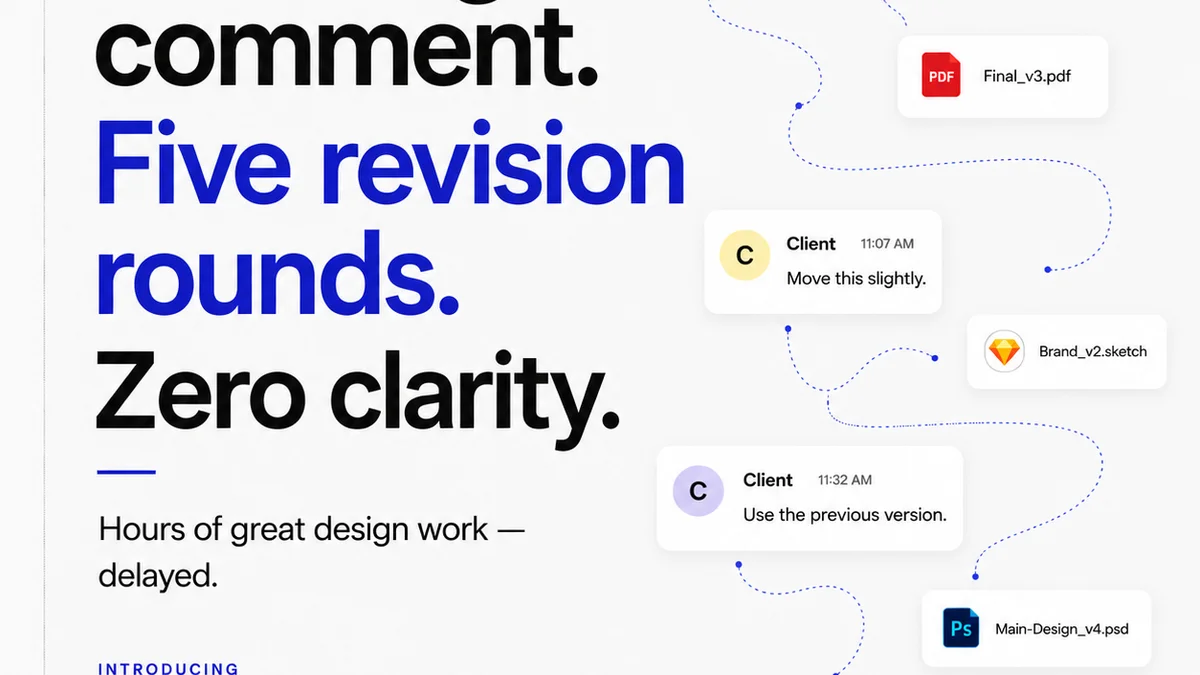
Everyone talks about the best design software. Figma, Adobe Creative Cloud, Sketch – they’re the titans. And sure, they’re essential. But they’re not the whole story.
Many teams assume that having the right design tools means they’re set for client feedback. That the magic happens when the files are open.
None of that is wrong. But it’s incomplete.
The real bottleneck for creative teams isn’t the software used to create the work. It’s the chaos surrounding how that work is reviewed, commented on, and approved.
This is the hard truth: your design feedback process is likely costing you more time and money than your software licenses. And the tools you use to manage that feedback are more critical than the tools you use to create the designs themselves.
1. The Email Black Hole and the Spreadsheets of Doom
Remember when client feedback lived in endless email threads? Each reply a new version, a new set of instructions buried in an inbox.
Or maybe you graduated to spreadsheets. A master document tracking every revision, every stakeholder, every sign-off. It sounds organized, but it’s a fragile beast.
This approach suffers from several fatal flaws:
- Context Collapse: Feedback is detached from the visual. Was that comment on the hero image or the footer?
- Version Control Nightmares: Which is the *actual* latest version? The one in the email, the shared drive, or the Slack message?
- Stakeholder Confusion: Who needs to approve what? Who gave that conflicting feedback?
- Time Sink: Copy-pasting comments, manually updating statuses, chasing down approvals. It’s busywork that kills productivity.
These aren't just minor annoyances. They're operational inefficiencies that erode margins and kill morale.
2. The Illusion of Real-Time Collaboration
Cloud-based design tools like Figma promise real-time collaboration. And they deliver, for the *creation* part.
But what about the feedback loop?
Clients and stakeholders often aren’t in Figma. They’re on the outside, looking in. Their feedback comes via email, Slack, or even a quick phone call.
This disconnect forces your team to act as translators and data entry clerks.
Bridging the Gap
The challenge is to bring that external feedback *into* the design context without requiring every stakeholder to become a power user of your design software.
This means tools that can:
- Allow anyone to leave comments directly on a design mockup, image, or video.
- Organize those comments by version and stakeholder.
- Notify the right people when action is needed.
- Provide a clear audit trail of feedback and approvals.
Without this,
Frequently asked questions
What is the main problem with traditional feedback methods like email?
Traditional methods like email often lead to context collapse, version control nightmares, stakeholder confusion, and significant time loss due to manual tracking and chasing approvals. Feedback gets buried and is easily misinterpreted.
How do cloud-based design tools help with feedback?
Cloud-based tools like Figma facilitate real-time *creation* collaboration. However, they don't inherently solve the problem of collecting and managing feedback from clients or stakeholders who may not be active users of the design software.
What are the key features of effective design feedback tools?
Effective tools allow anyone to comment directly on visual assets, organize feedback by version, notify relevant parties, and maintain a clear audit trail of communication and approvals, all without requiring deep technical knowledge from the client.
Can design feedback tools improve a creative agency's bottom line?
Yes, by reducing time spent on administrative tasks, minimizing revision cycles due to clear communication, and preventing costly errors from mismanaged feedback, these tools can directly improve efficiency and profitability.