Everyone agrees that good design project management is critical. You’ve probably heard it all before: use a Gantt chart, track your tasks, communicate clearly. None of that is wrong. But it’s incomplete.
The real challenge in design project management isn’t just scheduling. It’s navigating the inherent subjectivity, the iterative nature of creative work, and the complex human dynamics involved in client feedback.
1. The Illusion of Predictability
Creative projects are not manufacturing lines. You can't perfectly predict the time needed for a breakthrough concept or the perfect shade of blue. The assumption that a design project can be rigidly planned like building a bridge leads to frustration and rushed work.
This is where many design project management strategies fall short. They treat creative output like a commodity, not a craft.
Why Rigid Timelines Fail
- Creative blocks are real.
- Client feedback loops are inherently unpredictable.
- Scope creep disguised as 'minor tweaks' is rampant.
- The 'perfect' solution often takes longer than expected.
This isn't an excuse for chaos. It's a call for flexibility and smarter planning.
2. Embrace Iteration, Don't Just Tolerate It
Design is iterative. Your project management process must reflect this. The goal isn't to eliminate revisions, but to manage them efficiently and constructively.
This means building revision cycles into your plan, not as an afterthought, but as a core component. It also means defining what 'done' looks like at each stage, even if 'done' means 'ready for the next round of feedback'.
Structuring for Iteration
- Define clear milestones for each phase (discovery, concept, refinement, finalization).
- Allocate time for feedback and revisions *within* each phase.
- Establish a clear process for how feedback is collected and actioned.
- Use prototypes and wireframes to get feedback on structure and flow *before* investing heavily in pixel-perfect visuals.
This approach respects the creative process and sets client expectations.
3. Master the Art of Feedback Management
Feedback is the lifeblood of design, but it's often the project killer. Unstructured, conflicting, or vague feedback can derail the best-laid plans.
Effective design project management means establishing systems to capture, organize, and act on feedback systematically. This turns a messy input into actionable direction.
Common Feedback Pitfalls
- Vague comments: “I don’t like it.”
- Conflicting opinions from different stakeholders.
- Design by committee: every stakeholder gets a say, leading to a muddled output.
- Feedback delivered late, disrupting workflow.
- Focusing on aesthetics over strategy.
Systematizing Feedback
- Use a centralized platform for all feedback.
- Assign clear owners for feedback review and decision-making.
- Request specific, actionable feedback from clients.
- Schedule dedicated feedback review sessions.
- Distinguish between strategic feedback and stylistic preferences.
This discipline protects your team and ensures the project stays on track strategically.
4. The Power of Clear Briefs and Scope Definition
Many project management woes stem from a fuzzy starting point. A weak brief or poorly defined scope is a recipe for disaster.
Your project management process must begin with absolute clarity on objectives, deliverables, and constraints. This isn't just about getting a signature; it's about shared understanding.
Key Elements of a Strong Brief
- Clear project goals and KPIs.
- Target audience definition.
- Key messaging and brand guidelines.
- Deliverables and their specifications.
- Budget and timeline constraints.
- Stakeholder roles and approval processes.
This upfront work is the bedrock of successful design project management.
5. Communication: Beyond Daily Stand-ups
Communication is often cited as the silver bullet. But simply talking more isn't the answer. It’s about the *right* communication, at the *right* time, with the *right* people.
Design project management requires a multi-layered communication strategy that keeps everyone informed without overwhelming them.
Communication Channels and Cadence
- Internal Team Syncs: Daily stand-ups for tactical alignment.
- Client Check-ins: Regular, structured updates focused on progress, decisions needed, and upcoming milestones.
- Milestone Reviews: Formal presentations and feedback sessions at key project stages.
- Ad-hoc: Use instant messaging for quick questions, but document decisions in a central place.
- Status Reports: Concise summaries for stakeholders who don't need daily involvement.
The key is to match the communication method to the message and the audience.
6. Where Revue Fits In
Managing design projects effectively means taming complexity. It requires tools that bring order to the creative chaos, especially around feedback and approvals.
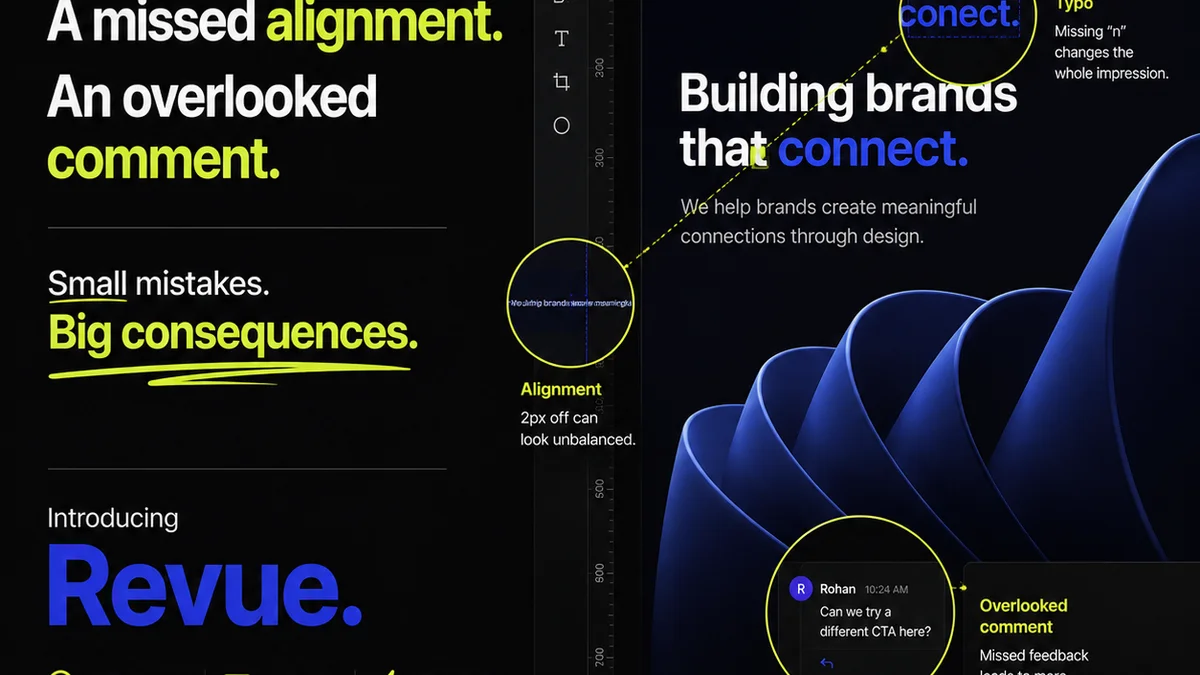
This is precisely where a platform like Revue excels. It’s built to streamline the most challenging aspects of design project management: centralizing client feedback, providing clear visibility into revision history, and ensuring smooth approval workflows.
Instead of scattered email threads, endless Slack messages, and confusing spreadsheets, Revue offers a single source of truth. You can gather all stakeholder comments directly on the design assets, track every revision, and manage approvals with confidence.
This clarity reduces miscommunication, speeds up decision-making, and frees your team to focus on what they do best: creating great design.
7. Measuring Success: It's Not Just About On-Time, On-Budget
Traditional project management metrics like on-time and on-budget delivery are important. But for design, they’re only part of the story.
True success in design project management also includes client satisfaction, the quality of the final creative output, and the health of your team’s working relationships.
Beyond the Basic Metrics
- Client Satisfaction: Are they happy with the process and the outcome?
- Creative Quality: Did the project achieve its strategic goals?
- Team Morale: Is the team burning out or thriving?
- Efficiency Gains: Are processes becoming smoother over time?
A robust design project management strategy should aim to optimize all these areas.
Final Thought
The best design project management isn't about imposing rigid control on a fluid process. It’s about building a flexible, transparent framework that guides creativity, clarifies communication, and ensures that subjective feedback leads to objective progress.
Are you managing your design projects, or are they managing you?
Frequently asked questions
What's the biggest mistake agencies make in design project management?
Treating creative projects like predictable manufacturing processes. This leads to rigid timelines that don't account for iteration, subjective feedback, or creative blocks, ultimately causing frustration and rushed work.
How can I manage client feedback more effectively?
Systematize feedback by using a centralized platform, requesting specific and actionable input, assigning clear owners for review, and scheduling dedicated feedback sessions. This turns vague comments into clear direction.
Is a Gantt chart useless for design projects?
Not entirely, but it's insufficient on its own. Gantt charts are best for tracking linear tasks and dependencies. Design projects require flexibility to handle iteration and subjective feedback, which Gantt charts don't inherently support. They should be part of a broader strategy, not the entire strategy.
How does a platform like Revue help with design project management?
Revue centralizes client feedback, tracks revisions, and manages approvals in one place. This eliminates scattered communication, provides a clear history, and streamlines the decision-making process, leading to more efficient project completion.