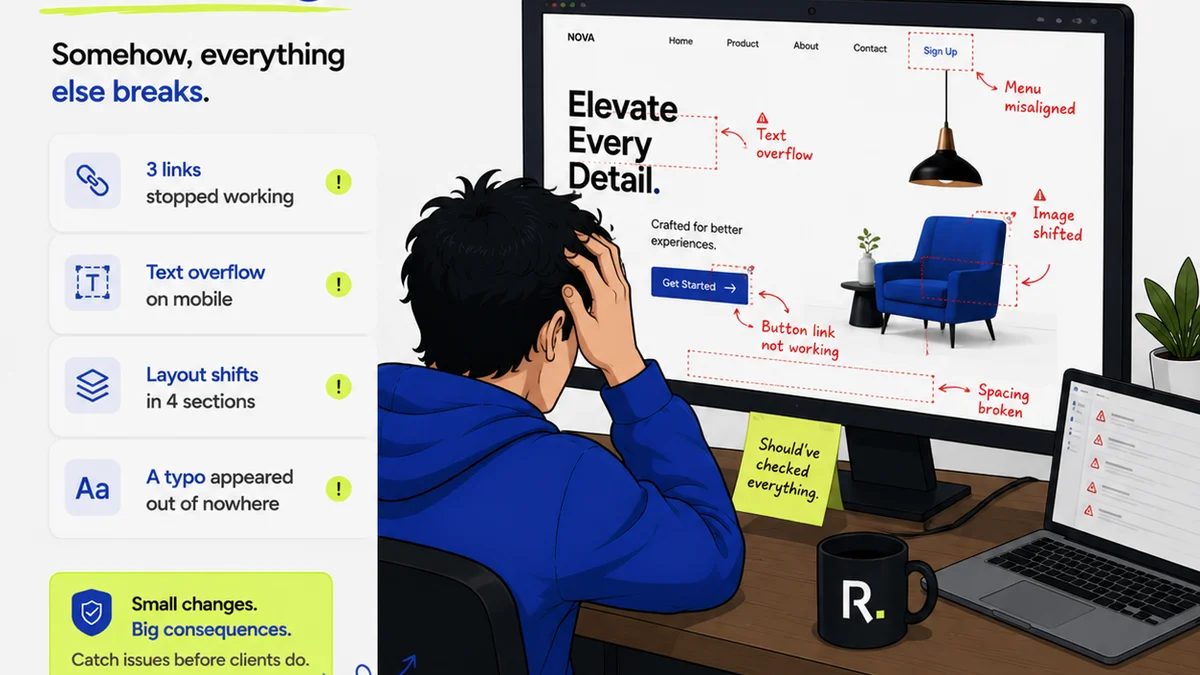
Everyone thinks design Quality Assurance (QA) is about catching typos and broken links right before launch. None of that is wrong. But it’s incomplete.
The hard truth? Design QA isn't a gatekeeper. It's a continuous process that, when done right, accelerates delivery and deepens client trust. It’s about building quality in, not just inspecting it out.
1. Shift Left: Integrate QA Early and Often
The biggest mistake agencies make is treating QA as an afterthought. It’s a separate, final step. This leads to late-stage surprises, rushed fixes, and unhappy clients.
True design QA starts on day one. It means embedding quality checks into every stage of the creative process, not just at the end.
Briefing and Discovery QA
Before a single pixel is designed, QA begins with the brief. Does it clearly define objectives? Are the target audience and success metrics understood?
- Is the scope of work unambiguous?
- Are there clear brand guidelines or design systems referenced?
- Have potential technical constraints been identified?
Misaligned briefs are the root of many design problems. Fixing them early saves immense downstream effort.
Conceptualization and Wireframing QA
As concepts take shape, QA shifts to user flow and information architecture. Is the proposed structure logical? Does it meet user needs and business goals?
- Are key user journeys mapped out and validated?
- Is the navigation intuitive?
- Does the content hierarchy make sense?
This is where you ensure the foundational structure is sound. It’s far easier to rearrange wireframes than to rework finished designs.
Design System and Component QA
For agencies building scalable solutions or working with design systems, component-level QA is crucial. Each button, form field, or card needs to be tested in isolation and in context.
- Do components adhere to established standards?
- Are they accessible (e.g., sufficient color contrast, keyboard navigation)?
- Do they function correctly across different states (hover, focus, disabled)?
A robust design system is only as good as its constituent parts. Rigorous component QA prevents inconsistencies from spreading.
Content QA
Content is king, and its quality directly impacts design. Is the copy clear, concise, and on-brand? Are images and videos optimized and relevant?
- Does the text meet its intended purpose and tone?
- Are there any grammatical errors or typos?
- Are all media assets correctly sized and formatted?
Design can’t polish bad copy. Content and design QA must happen in parallel.
2. Define Your QA Criteria: What Does
Frequently asked questions
What is the difference between QA and UAT?
Quality Assurance (QA) is an internal process focused on ensuring the product meets defined standards and requirements before it's released to users. User Acceptance Testing (UAT) is when the end-users or clients test the product to confirm it meets their needs and expectations in a real-world scenario.
How can I automate design QA?
Automation in design QA often focuses on technical aspects like code validation, accessibility checks, and performance testing. Tools can scan for common issues. However, subjective elements like usability, brand consistency, and aesthetic appeal still require human review.
What are the key elements of a design QA checklist?
A comprehensive design QA checklist typically includes items related to functionality, usability, performance, accessibility (WCAG compliance), cross-browser/device compatibility, content accuracy, brand consistency, and responsiveness.
How often should design QA be performed?
Design QA should be an ongoing process, integrated into each phase of the design and development lifecycle. This includes checks during the briefing, wireframing, visual design, development, and pre-launch stages, rather than a single end-of-project review.