Most enterprise teams think design QA is about a checklist. They imagine a manager, maybe a designer, ticking off boxes: Is the logo correct? Are the colors on-brand? Does the button look right?
None of that is wrong. But it’s incomplete. Wildly incomplete.
The hard truth is that for enterprise teams, effective design QA is an operational system, not just a final inspection. It's about preventing errors before they happen, ensuring consistency at scale, and making sure design actually serves the business goals, not just aesthetics.
1. The Illusion of Centralized Control
Many enterprise leaders assume that because design lives under one department, control is inherent. They think, "We have a design system, so we're covered." That's a dangerous assumption.
A design system is a tool, not a guarantee. Without a robust QA process built around it, a design system can become just another set of guidelines that get ignored or misinterpreted.
The Reality of Distributed Teams
Enterprise organizations are rarely monolithic. Design work often happens across:
- Multiple product teams.
- Various marketing departments.
- Regional offices with their own nuances.
- External agencies and freelancers.
Each of these groups operates with its own priorities, timelines, and interpretations. This diffusion of effort is where QA breaks down.
What to Look For: Systemic Blind Spots
- Are there clear, documented processes for how design assets are requested, created, and approved?
- Who is responsible for QA at each touchpoint, not just at the end?
- How are feedback loops managed when multiple teams touch a single asset?
- Is there a single source of truth for brand guidelines and design system components?
If these aren't clearly defined and enforced, you're not controlling design quality; you're just hoping for the best.
2. Beyond Visuals: Testing the Business Impact
When people talk about design QA, they almost always mean visual QA. Is it pretty? Does it match the mockups?
For enterprise, this is only half the battle. The other half is functional and strategic.
Functional Fidelity
Does the design work as intended? This is critical for software, websites, and any interactive product.
Consider:
- Usability: Can users actually achieve their goals with the interface?
- Accessibility: Does it meet standards like WCAG? Can people with disabilities use it effectively?
- Performance: Are the design choices impacting load times or responsiveness? (Yes, design impacts performance.)
- Cross-Platform Consistency: Does it render correctly and function as expected across different browsers, devices, and operating systems?
A visually perfect design that's unusable or inaccessible is a failure. Full stop.
Strategic Alignment
Does the design support the business objectives? This is where enterprise QA often falls short.
Ask:
- Does this design drive conversions or engagement?
- Does it clearly communicate the intended message?
- Does it reinforce the brand strategy and value proposition?
- Are we solving the right problem with this design?
This requires QA to go beyond the design team and involve product managers, marketing leads, and even sales. It’s about ensuring design is a business driver, not a cost center.
3. The Cost of Inconsistent Feedback
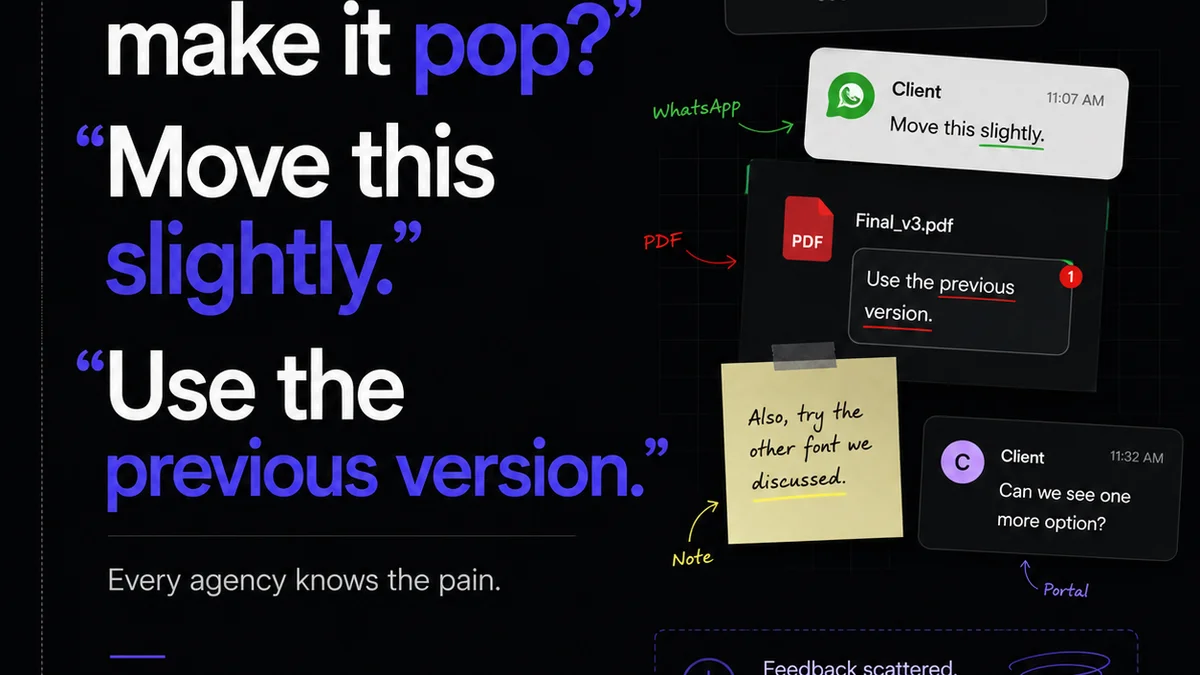
Ambiguous, inconsistent, or delayed feedback is the silent killer of design quality and team morale. Enterprise environments are notorious for this.
Imagine a scenario:
A marketing campaign involves a landing page, email assets, social media graphics, and ad banners. Each element is designed by a different person or team, and feedback comes from three different stakeholders, each with conflicting opinions.
The result?
- Endless revision cycles.
- Designers feeling demoralized and confused.
- Inconsistent messaging across channels.
- Missed launch deadlines.
- A final product that's a Frankenstein's monster of compromises.
What to Look For: Feedback Chaos
- Is there a single, clear point of contact for feedback on a given project?
- Are feedback comments specific, actionable, and constructive?
- Is there a mechanism to track feedback and ensure it's addressed?
- How are conflicting feedback points resolved?
- Is feedback provided within agreed-upon timelines?
Without structured feedback, QA becomes a subjective guessing game, and quality suffers.
4. Building a Scalable QA Framework
So, how do you move from a reactive checklist to a proactive, scalable QA framework for enterprise design?
Define Clear Standards
This starts with an up-to-date, accessible design system and brand guidelines. But it goes further.
Define:
- Visual Standards: Beyond the system – specific rules for iconography, illustration, typography hierarchy, and spacing in different contexts.
- Functional Standards: Expected behavior for interactive elements, form validation, error states, and loading indicators.
- Accessibility Standards: Explicit targets for color contrast ratios, keyboard navigation, screen reader compatibility, etc.
- Content Standards: Tone of voice, grammar, terminology.
Integrate QA Early and Often
QA shouldn't be a gate at the end. It should be woven into the entire workflow.
This means:
- Peer Reviews: Designers reviewing each other's work against standards before it goes to stakeholders.
- Component-Level QA: Testing individual UI components in isolation.
- Staging Environments: Thorough testing of integrated features before deployment.
- Automated Checks: Where possible, use tools to catch common errors (e.g., linting for code, accessibility checkers).
Establish Roles and Responsibilities
Who owns QA? It's not just one person. It's a shared responsibility.
- Designers: Own self-QA and adherence to standards.
- Design Leads/Managers: Own team-level QA, mentorship, and process refinement.
- Product Managers: Own functional and business objective alignment.
- Developers: Own technical implementation quality and cross-browser/platform testing.
- QA Specialists (if applicable): Own end-to-end testing, usability, and accessibility audits.
Clear ownership prevents tasks from falling through the cracks.
Where Revue Fits In
Managing design QA at an enterprise scale demands visibility and control. This is where a platform like Revue becomes essential.
Revue helps centralize client and stakeholder feedback, providing a single source of truth for all comments and revisions. This cuts through the noise of scattered emails and chat messages.
Instead of digging through endless threads, teams can see exactly what feedback was given, who gave it, and whether it was addressed. This visibility is crucial for tracking progress and ensuring that quality checks aren't just theoretical.
By streamlining the feedback and approval process, Revue ensures that design QA is not an afterthought but an integrated part of the creative workflow, leading to more consistent, higher-quality output.
Final Thought
Is your enterprise design QA process truly ensuring quality, or is it just a ritualistic nod to a checklist? The difference impacts everything from brand perception to bottom-line results. It's time to look deeper.
Frequently asked questions
What is the difference between visual QA and functional QA for enterprise design?
Visual QA focuses on aesthetics, brand adherence, and layout accuracy. Functional QA ensures the design works as intended, is usable, accessible, and performs well across different platforms and devices. Both are critical for enterprise-level products.
How can distributed teams maintain consistent design QA?
Consistency is achieved through a centralized, accessible design system, clear documentation of standards (visual, functional, content), integrated peer reviews, and a structured feedback process using tools that provide visibility and accountability.
Who is responsible for design QA in an enterprise setting?
Design QA is a shared responsibility. Designers own self-QA, leads own team processes, developers own technical implementation quality, and product managers own functional and business alignment. Clear roles prevent gaps.
How does a design system impact QA?
A design system provides the foundational standards for QA. It ensures components are reusable, consistent, and pre-vetted. However, a system alone isn't QA; it requires a process to ensure adherence and proper implementation across all projects.