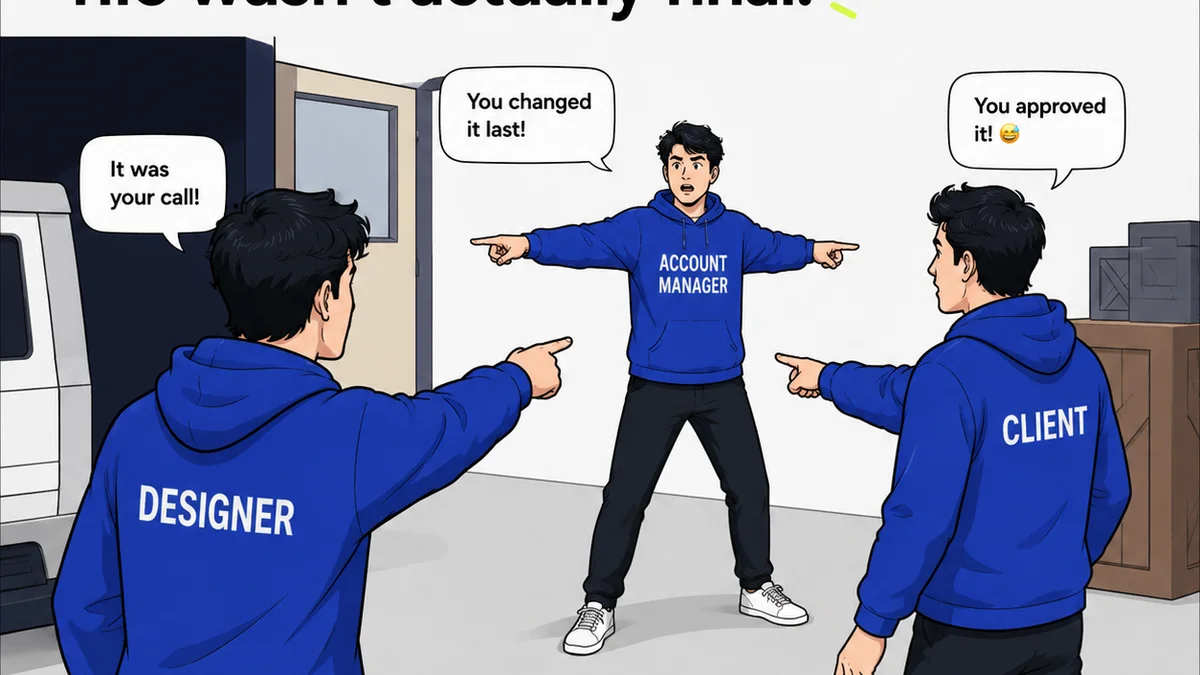
Everyone talks about design quality assurance (QA) for marketing teams. They say it's about catching typos, checking brand guidelines, and making sure the logo is the right size.
None of that is wrong. But it’s incomplete.
The hard truth is that most marketing teams approach design QA like a final gate, when it should be an integrated, continuous process. This reactive approach wastes time, breeds frustration, and ultimately, lowers the quality of your marketing output.
1. The Myth of the 'Done' Design
Think about your current workflow. A designer finishes a piece. It goes to a reviewer. They spot a minor error. It goes back. The designer fixes it. Then it's 'done.'
This linear, 'check-at-the-end' model is a relic. It assumes perfection on the first pass and treats QA as an external policing function, not an internal quality driver.
The Real Cost of Late-Stage QA
- Delayed campaign launches
- Rushed revisions that introduce new errors
- Designer burnout from constant back-and-forth
- Wasted stakeholder time on trivial fixes
- Missed opportunities to improve the design itself
This isn't just about fixing mistakes; it's about building quality *into* the process from the start.
2. Shifting from 'Checking' to 'Ensuring' Quality
True design QA isn't about finding fault. It's about establishing systems that *prevent* faults and elevate the work. This means moving from a reactive 'checking' mindset to a proactive 'ensuring' one.
What does that look like in practice?
Integrating QA into Every Stage
- Briefing: Clear, detailed briefs that anticipate potential issues.
- Concepting: Early feedback on direction, not just execution.
- Development: Incremental reviews of progress, not just the final output.
- Asset Handoff: Standardized checklists and templates.
- Deployment: Post-launch checks for technical rendering and performance.
This requires a cultural shift. QA becomes everyone's responsibility, not just a single person's job at the eleventh hour.
3. The Three Pillars of Effective Design QA
Effective design quality assurance rests on three interconnected pillars:
Pillar 1: Clarity and Consistency
This is the bedrock. Without clear standards, QA becomes subjective and inefficient.
- Brand Guidelines: Are they accessible, up-to-date, and comprehensive? Do they cover digital and print?
- Style Guides: For UI/UX, web, or app design, are there established patterns and components?
- Project Briefs: Do they clearly define objectives, target audience, key messages, and technical requirements?
- Asset Specifications: Are dimensions, file formats, and color profiles clearly defined for each deliverable?
Inconsistency here is the root of many common design errors.
Pillar 2: Process and Workflow
How work moves from concept to completion is critical. A broken process guarantees quality issues.
- Feedback Loops: Are they structured? Is feedback consolidated? Who provides it?
- Revision Management: How are changes tracked? Is there a limit to revisions?
- Approval Gates: Who has the final say? Are approval criteria clear?
- Tooling: Are you using tools that facilitate collaboration and tracking, or hinder it?
A well-oiled machine minimizes friction and maximizes output quality.
Pillar 3: Accountability and Ownership
Who owns quality? In most agencies, it's a shared responsibility. But that often means no one truly owns it.
- Role Definition: Clearly define who is responsible for what aspect of QA at each stage.
- Checklists: Standardized QA checklists for different asset types (e.g., social media graphics, landing pages, email templates).
- Training: Ensure team members understand the standards and processes.
- Post-Mortems: Regularly review what went wrong and how to prevent it next time.
Ownership drives a commitment to excellence.
4. Common Pitfalls in Marketing Design QA
Even with the best intentions, marketing teams stumble. Here are the usual suspects:
- The 'Quick Glance' Review: Assuming a quick look is enough. It rarely is.
- Subjective Feedback: Comments like 'I don't like it' without actionable reasons.
- Conflicting Feedback: Multiple reviewers giving contradictory instructions.
- Ignoring Technical Specs: Focusing only on aesthetics and missing crucial file size, resolution, or accessibility requirements.
- Lack of Centralization: Feedback scattered across emails, Slack messages, and verbal conversations.
These pitfalls are symptoms of a deeper problem: a lack of a robust, integrated design QA process.
5. Where Revue Fits In
Managing design feedback and approvals across multiple stakeholders, projects, and revisions is a constant challenge for creative agencies and marketing teams. This is where a centralized platform like Revue becomes essential.
Revue helps tackle the chaos of design QA by providing:
- Centralized Feedback: All client and stakeholder comments live in one place, attached directly to the design asset. No more hunting through email chains or Slack threads.
- Clear Revision History: Track every version of a design, see what changed, and who approved it. This visibility is crucial for understanding the evolution of a project and identifying patterns of issues.
- Streamlined Approvals: Define clear approval workflows. Stakeholders can approve or request changes directly within the platform, creating an auditable trail.
- Integrated Quality Checks: While not a replacement for human review, a structured process supported by Revue helps ensure that all feedback is captured, addressed, and that the final output meets agreed-upon standards before it's sent out.
By bringing structure to feedback and approvals, Revue empowers teams to move beyond superficial checks and implement a more rigorous, integrated design QA process.
6. Building a Culture of Quality
Ultimately, great design QA isn't just about processes or tools. It's about culture.
It's about fostering an environment where:
- Creativity is encouraged, but rigor is expected.
- Feedback is seen as a collaborative tool for improvement, not criticism.
- Attention to detail is celebrated, not seen as tedious.
- Every team member feels empowered to uphold quality standards.
This cultural shift takes time and consistent effort. It starts with acknowledging that design QA is far more than a final tick-box exercise.
Final Thought
Is your team treating design QA as a fire drill or a daily practice? The answer reveals more about your operational maturity than you might think.
Frequently asked questions
What are the most common mistakes in design QA for marketing?
Common mistakes include treating QA as a last-minute check, providing subjective feedback without clear reasons, having conflicting feedback from multiple reviewers, ignoring technical specifications like file size or resolution, and lacking a centralized system for feedback, leading to scattered communication.
How can I make design QA more proactive?
Shift from 'checking' to 'ensuring' quality. Integrate QA into every stage: clear briefs, early concept feedback, incremental reviews during development, standardized asset handoffs, and post-launch checks. Foster a culture where quality is everyone's responsibility.
What are the three pillars of effective design QA?
The three pillars are: 1. Clarity and Consistency (clear brand guidelines, style guides, briefs, and specs). 2. Process and Workflow (structured feedback loops, revision management, clear approval gates). 3. Accountability and Ownership (defined roles, standardized checklists, training, and post-mortems).
How does a tool like Revue help with design QA?
Revue centralizes all feedback and comments directly on assets, provides clear revision history and version tracking, streamlines approval workflows with an auditable trail, and helps ensure all feedback is captured and addressed before final delivery.