Most agencies think design retainers are just about predictable revenue. That’s not wrong. But it’s incomplete. A retainer isn’t just a monthly invoice; it’s a strategic partnership that unlocks deeper client value and sustained business growth.
The hard truth? If you’re not structuring your retainers for growth, you’re leaving serious money and opportunity on the table. You’re stuck in a reactive mode, always looking for the next project, instead of building a proactive, value-driven business.
1. The Flaw in Project-Based Thinking
We’re conditioned to think in projects. Scope, deliver, invoice, repeat. It’s comfortable. It’s familiar.
But it creates a feast-or-famine cycle. You’re only as good as your last project.
This model also limits client relationships. You’re a vendor, not a partner. The client sees you for specific tasks, not as an extension of their team.
The Hidden Costs of Project Work
- Constant new business acquisition efforts.
- Wasted time on onboarding new clients repeatedly.
- Inability to build deep institutional knowledge about a client’s brand.
- Difficulty in planning long-term team capacity.
- Pressure to cut corners to meet tight project deadlines and budgets.
This isn't sustainable for real growth. It’s just busywork.
2. Retainers: More Than Just Recurring Revenue
A design retainer flips the script. It’s a commitment from the client for ongoing services, usually for a set period and a fixed monthly fee. This provides predictable income, yes. But that’s just the surface.
A well-structured retainer allows you to become indispensable.
It shifts the focus from *output* (deliverables) to *outcomes* (client success).
The Strategic Advantages of Retainers
- Deepened Client Understanding: You learn their business, their audience, their challenges.
- Proactive Problem-Solving: You can anticipate needs and suggest solutions before they become critical issues.
- Efficiency Gains: Reduced onboarding overhead and familiarity with client brand guidelines.
- Talent Retention: Stable workload and meaningful, long-term projects improve team morale and reduce churn.
- Higher Profitability: Over time, the efficiency and strategic value you deliver often exceed the initial retainer cost, leading to higher profit margins.
This is where true agency growth begins.
3. Structuring Your Retainer for Success
Not all retainers are created equal. A poorly defined retainer can be worse than project work. It leads to scope creep, client dissatisfaction, and burnout.
You need a clear framework. This isn’t about locking clients into rigid contracts; it’s about setting expectations and defining value.
Types of Retainer Models
- Dedicated Resource: A set number of hours or a specific team member allocated to the client each month.
- Scope-Based: A defined list of ongoing services (e.g., social media graphics, website updates, email campaign design).
- Project Pool: A retainer that funds a certain amount of project work, allowing the client to draw from it as needed.
Choose the model that best fits your agency’s strengths and the client’s needs.
Key Elements of a Strong Retainer Agreement
- Clear Scope of Work: What’s included? What’s explicitly excluded?
- Defined Deliverables (or Outcomes): What will the client receive or achieve?
- Communication Cadence: Regular check-ins, reporting schedules.
- Revision Process: How many rounds? What constitutes a revision vs. a new request?
- Onboarding & Offboarding: How do you start and end the relationship smoothly?
- Pricing & Payment Terms: Transparent fee structure and payment schedule.
- Performance Metrics: How will success be measured?
Clarity is paramount. Ambiguity breeds conflict.
4. Identifying the Right Retainer Clients
Not every client is a good fit for a retainer. You need clients who understand the value of ongoing partnership and have a consistent need for your services.
Look for clients who:
- Value strategic design input, not just execution.
- Have a consistent pipeline of marketing or product development needs.
- Are looking for a long-term partner, not a transactional vendor.
- Are willing to invest in proactive design solutions.
- Have clear business goals that design can help achieve.
Selling a retainer is different from selling a project. It’s about selling a vision of partnership and shared success.
The Sales Conversation
Focus on their business challenges. How can your ongoing support solve their problems and help them reach their goals?
Instead of saying: “We can design 10 social posts a month for $X.”
Try: “We can help you maintain brand consistency across all your digital channels, freeing up your internal team and ensuring your marketing efforts always resonate with your target audience, for a predictable monthly investment.”
Highlight the ROI. Show them how a retainer saves them money and generates more value than ad-hoc project work.
5. Scaling Your Agency with Retainers
Retainers are the engine of scalable growth for design agencies. They provide the stability needed to invest in your team, your processes, and your future.
With predictable income, you can:
- Hire more talent without fear of layoffs.
- Invest in better tools and technology.
- Develop specialized expertise within your team.
- Pursue larger, more strategic client engagements.
- Build a stronger brand reputation.
This creates a virtuous cycle. Better talent, better processes, better client results. Which leads to more retainer clients, and more growth.
Where Revue Fits In
Managing multiple retainer clients and their ongoing needs can get complex. Ensuring consistent quality and clear communication across all these engagements is critical.
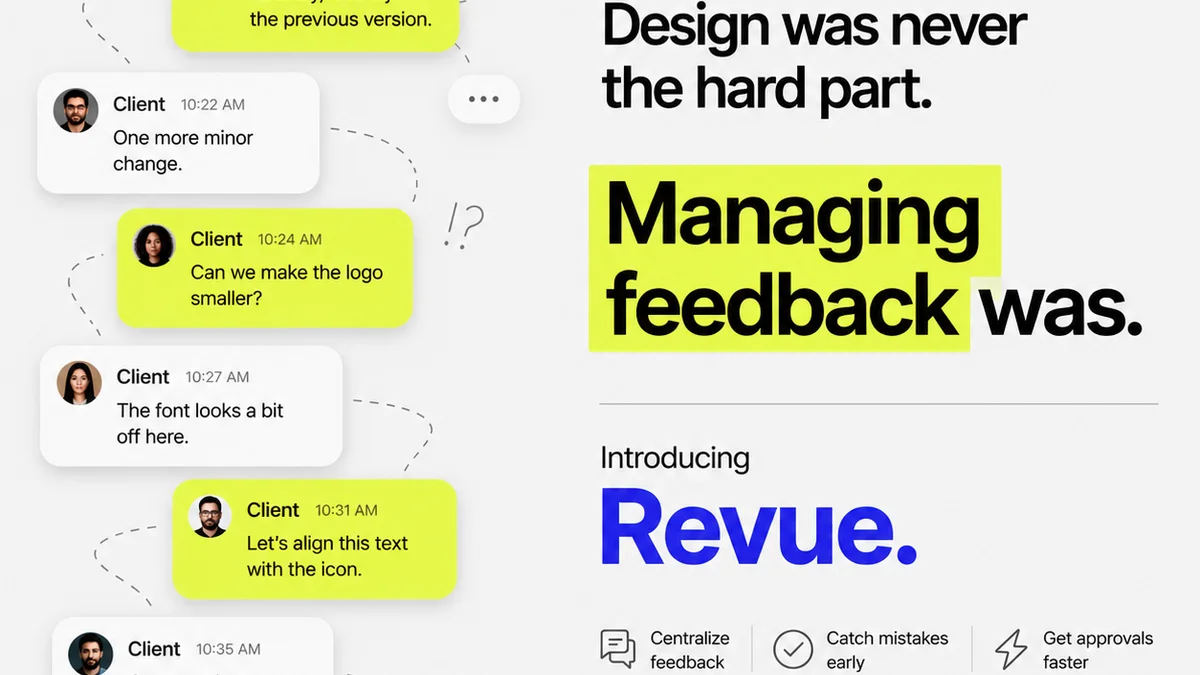
Revue helps streamline this complexity. It centralizes client feedback, making it easy to track revisions and approvals for all your retainer projects.
This visibility ensures you’re always on the same page with your client, reducing misunderstandings and speeding up the approval process.
You can also maintain clear project timelines and track the quality of work delivered, ensuring you consistently meet and exceed retainer expectations.
It’s about bringing order to the ongoing creative workflow, so you can focus on delivering strategic value, not chasing down feedback.
Final Thought
Are you building a business that chases projects, or one that cultivates partnerships? The choice you make today dictates your agency’s growth tomorrow. Don’t just aim for predictable revenue; aim for predictable, exponential value creation.
Frequently asked questions
What is a design retainer?
A design retainer is a contractual agreement where a client pays a fixed fee on a recurring basis (typically monthly) for ongoing design services. This provides predictable revenue for the agency and ensures the client has access to design support as needed.
How do retainers benefit agencies?
Retainers offer predictable revenue, deeper client relationships, increased operational efficiency due to reduced onboarding, better team capacity planning, and the opportunity to become a strategic partner rather than just a vendor.
How do retainers benefit clients?
Clients benefit from consistent access to design expertise, proactive problem-solving, maintained brand consistency, faster turnaround times on design requests, and a more integrated working relationship with their design partner.
What are common retainer models?
Common models include dedicated resources (a set team or hours), scope-based retainers (for defined ongoing services), and project pools (where a retainer funds a bucket of work to be drawn from as needed).
How do I transition from project-based work to retainers?
Start by identifying clients who have recurring needs and value strategic partnerships. Clearly define the scope, deliverables, and communication protocols for your retainer offering. Focus sales conversations on the long-term value and problem-solving capabilities of a retainer.