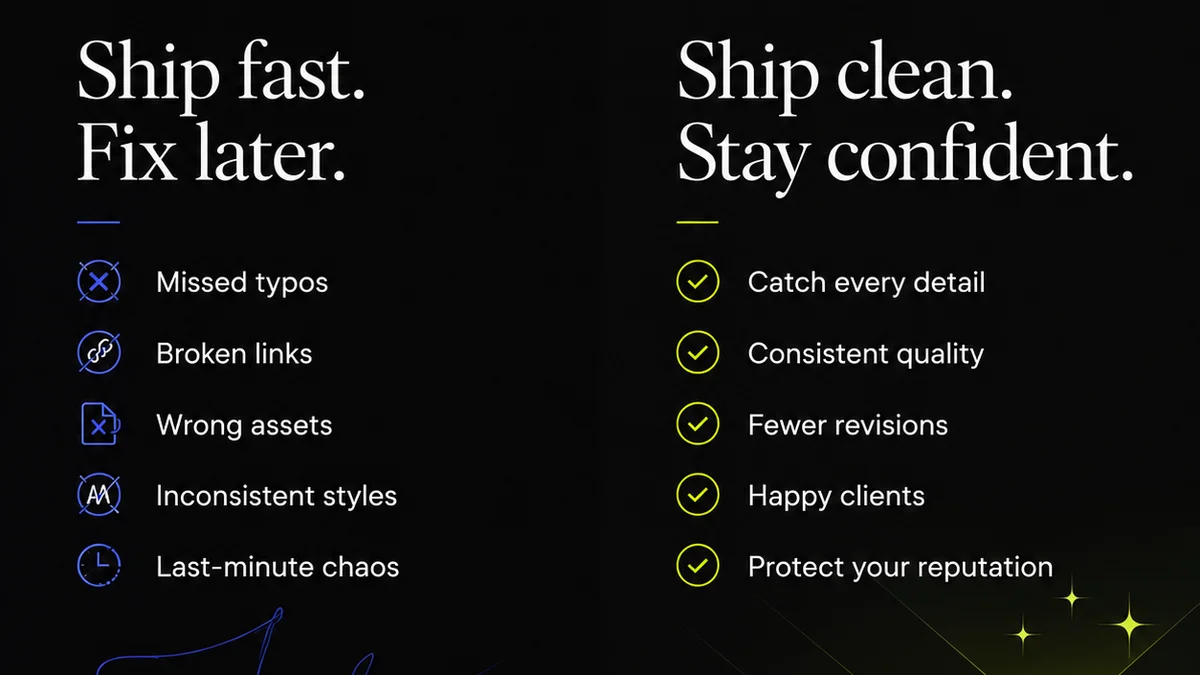
Everyone thinks design review is about catching typos or making sure the logo is the right color. That’s part of it, sure. But it’s not the whole story. And if that’s all you’re doing, you’re missing the point entirely.
The real purpose of design review is to ensure alignment, mitigate risk, and elevate the work. It’s a strategic checkpoint, not just a final polish.
1. Define the Stakes: What Are We Actually Reviewing For?
Before anyone opens a file, clarify the objective of the review. Is this a technical check? A brand alignment check? A client expectation check?
Different stages require different lenses.
Technical Feasibility
Can this actually be built? Does it meet accessibility standards? Are the file formats correct for the intended output?
This isn't about aesthetics. It's about practicality.
Brand Consistency
Does this reinforce the client’s brand guidelines? Are we using approved colors, typography, and tone of voice?
This is where brand guardians earn their keep.
Strategic Alignment
Does this design solve the problem we set out to solve? Does it meet the brief’s objectives and KPIs?
This is the highest level of review. It asks: ‘Is this the *right* solution?’
Client Expectations
Does this meet what the client has been led to expect? Are we managing scope creep through clear communication?
This is about managing relationships as much as creative output.
2. Structure Your Reviews for Maximum Impact
A chaotic review process breeds chaos in the final product. You need structure.
Establish Clear Roles
Who is responsible for what during the review?
- Reviewer: Provides feedback.
- Moderator: Facilitates the review, ensures it stays on track, and synthesizes feedback.
- Owner: The person responsible for acting on the feedback.
Without clear roles, feedback gets diluted or ignored.
Set Time Limits
Reviews shouldn't drag on. Allocate specific time slots for different types of reviews.
A 30-minute review is often more productive than a two-hour marathon.
Use a Checklist (When Appropriate)
For recurring checks like accessibility or brand compliance, a checklist is invaluable.
It ensures consistency and prevents overlooking critical details.
Centralize Feedback
Scattered feedback across emails, Slack messages, and random documents is a recipe for disaster.
Consolidate comments in one place. This is non-negotiable for efficient revision cycles.
3. The Art of Giving and Receiving Feedback
This is where most agencies stumble. Feedback is often subjective, emotional, and unhelpful.
Be Specific, Not Vague
Instead of “I don’t like this,” try “The blue here clashes with the primary brand color, which is HEX #0000FF. Could we explore alternatives closer to the secondary palette, like HEX #00AABB?”
Actionable feedback is concrete.
Focus on the Objective, Not the Person
Frame feedback around the project goals and client brief.
“This layout doesn’t clearly guide the user to the call to action, which is a key objective for this page.”
Distinguish Between Opinion and Requirement
Is this a personal preference, or is it a mandatory change based on the brief, brand guidelines, or technical constraints?
Not all feedback is created equal.
One Voice Rule
Ideally, feedback should be consolidated and delivered by a single point person or team.
This prevents conflicting instructions and confusion for the design team.
Empower Designers to Push Back (Constructively)
Designers should feel empowered to question feedback that doesn't align with the strategy or brief.
This requires trust and a strong feedback framework.
4. Common Pitfalls to Avoid
Many teams fall into predictable traps during the design review process.
The “Rubber Stamp” Review
Approving work without proper scrutiny. This usually happens when reviews are rushed or seen as a formality.
The “Design by Committee” Nightmare
Too many stakeholders giving conflicting, often subjective, feedback. Leads to diluted, compromised designs.
Lack of Clarity on Scope
Reviewers asking for changes that fall outside the agreed-upon scope, leading to scope creep and budget overruns.
Inconsistent Review Criteria
Applying different standards at different times or for different projects. Leads to unpredictability and frustration.
Ignoring Technical or Accessibility Constraints
Focusing solely on aesthetics while overlooking critical functional or compliance requirements.
5. Where Revue Fits In
Managing design feedback and revisions can quickly become unwieldy. This is precisely why tools built for this purpose exist.
Revue offers a centralized hub for all creative feedback, revision tracking, and approvals. Instead of sifting through endless email chains or Slack messages, all stakeholders can provide and view feedback directly on the creative asset.
This ensures everyone is working from the same version, understands the context of feedback, and can track the evolution of the design through revisions. It streamlines the entire design review process, from initial critique to final sign-off, ensuring clarity and efficiency.
6. Final Thought
Is your design review process a bottleneck or a catalyst for better creative work?
The difference often lies not in the tools you use, but in the discipline you apply to the process itself.
Frequently asked questions
What is the primary goal of a design review?
The primary goal of a design review is to ensure strategic alignment, mitigate risks, and elevate the quality of creative work, rather than just catching minor errors.
How can agencies ensure feedback is actionable?
Agencies can ensure feedback is actionable by being specific, focusing on project objectives and client briefs, and clearly distinguishing between subjective opinions and mandatory requirements.
What role does technology play in design reviews?
Technology, like centralized feedback platforms, plays a crucial role in streamlining design reviews by consolidating comments, tracking revisions, and ensuring all stakeholders work from a single source of truth, preventing confusion and scope creep.
How can agencies avoid 'design by committee'?
To avoid 'design by committee,' agencies should establish clear roles, limit the number of stakeholders involved in critical decisions, and ideally, funnel feedback through a single point person or moderator to maintain a consistent direction.