Everyone agrees design review is essential. It’s where ideas get polished, problems get caught, and the final creative product takes shape. Sounds simple, right?
None of that is wrong. But it’s incomplete.
The hard truth is that most design review processes are chaotic, inefficient, and frankly, a colossal waste of time. For in-house teams juggling multiple projects and stakeholders, a broken review process doesn't just slow things down—it actively harms creativity and team morale.
1. Defining Your Design Review Goals
Before you can fix your review process, you need to know what you’re trying to achieve. Most teams skip this. They just want the review done.
But what does ‘done’ mean? Is it:
- Catching all visual inconsistencies?
- Ensuring brand alignment?
- Verifying technical feasibility?
- Confirming stakeholder approval?
- Identifying potential usability issues?
Each of these requires a slightly different approach. Trying to hit all targets in one go leads to diluted feedback and confusion.
The Assumption: One Meeting to Rule Them All
The common assumption is that a single, comprehensive design review meeting can cover everything. Stakeholders from Marketing, Product, Legal, and Engineering all pile into one Zoom call. The designer presents. Questions are asked. Feedback is given. Done.
The Reality: Fragmented Focus and Lost Nuance
In reality, the Marketing lead cares about messaging. Engineering cares about implementation. Legal cares about compliance. They speak different languages and have different priorities. Trying to satisfy everyone simultaneously dilutes the feedback for the designer and often leads to conflicting directives.
Your goal should be clarity. What specific outcomes are you seeking from *this* particular review session?
2. Establishing Clear Roles and Responsibilities
Who is actually *doing* the reviewing? And more importantly, who is *responsible* for making the final call?
A common symptom of a bad review process is ambiguity here. Everyone feels they have a say, but no one has the ultimate authority. This leads to endless back-and-forth and decisions by committee.
The Assumption: Everyone’s Opinion Carries Equal Weight
Many teams operate as if every stakeholder’s feedback is equally valid and actionable. This is a recipe for disaster.
The Reality: Designated Decision-Makers and Subject Matter Experts
You need to identify:
- The Primary Decision-Maker: This person (or small group) has the final say on whether the design is approved or requires further iteration. They understand the strategic goals and have the authority to greenlight the work.
- Subject Matter Experts (SMEs): These individuals provide feedback within their domain of expertise. For example, Legal for compliance, Engineering for technical feasibility, or Brand for consistency. Their feedback is crucial but should be framed as input, not mandates, unless it directly impacts their area of responsibility.
- The Review Facilitator: Often the designer or a project manager, this person guides the review, ensures it stays on track, and synthesizes the feedback.
Clearly defining these roles prevents scope creep and ensures feedback is directed appropriately. It empowers SMEs to contribute their valuable insights without derailing the project.
3. Structuring the Review Process
How and when does feedback happen? A haphazard approach guarantees frustration.
Think about the different stages of a design project. Does the same review process make sense for a quick concept sketch as it does for a fully developed UI?
The Assumption: One-Size-Fits-All Review
Many teams apply the same review checklist and meeting format to every stage of design, from initial wireframes to final production assets.
The Reality: Phased Reviews for Targeted Feedback
Tailor your review process to the stage of the project:
- Concept/Ideation Review: Focus on the big picture. Is the direction right? Does it solve the core problem? Keep it high-level, involve key strategists.
- Wireframe/Flow Review: Focus on user experience and information architecture. Is the user journey logical? Are key actions clear? Involve UX specialists and product managers.
- Visual Design/Mockup Review: Focus on aesthetics, branding, and detailed UI elements. Does it look good? Is it on-brand? Involve brand guardians and visual designers.
- Usability/Prototype Review: Focus on interaction and real-world application. Does it work as intended? Is it intuitive? Involve QA, potential end-users (if possible), and developers.
- Pre-Launch/Final QA Review: Focus on final checks for bugs, inconsistencies, and adherence to all requirements. This is the last line of defense. Involve QA, developers, and project leads.
Each phase should have specific goals, participants, and deliverables. This targeted approach ensures feedback is relevant and actionable at every step.
4. The Art of Giving and Receiving Feedback
This is where most processes truly break down. Feedback is often vague, personal, or outright unhelpful.
Think about the last time you received feedback like “I don’t like it” or “Make it pop more.” What were you supposed to do with that?
The Assumption: Everyone Knows How to Give Good Feedback
We assume that because people understand design (or think they do), they automatically know how to articulate constructive criticism.
The Reality: Feedback Needs Structure and Specificity
Train your team on how to provide effective feedback. This means:
- Focus on the Objective: Frame feedback around the project goals. Instead of “This button is ugly,” try “This button doesn't clearly indicate it's clickable based on our usability goals.”
- Be Specific: Vague comments are useless. Instead of “The layout is off,” try “The spacing between the header and the content block feels too tight on mobile view, making it hard to scan.”
- Offer Solutions (When Possible): If you see a problem, suggest a potential fix. “Consider reducing the line height here to improve readability, perhaps to 24px.”
- Distinguish Preference from Necessity: Clearly state if something is a personal preference versus a critical requirement. “Personally, I prefer a warmer blue, but the brand guidelines clearly state we must use this specific hex code.”
- Use a Framework: Consider the Stanford d.school feedback model (or similar) which encourages describing observations, interpreting them, and suggesting actions.
For designers, receiving feedback requires active listening and thoughtful questioning. Don’t get defensive. Ask clarifying questions: “Can you tell me more about what feels unclear?” or “What specific outcome are you hoping to achieve with that change?”
5. Documentation and Actionability
Feedback that isn't documented is feedback that likely won't be acted upon. And feedback that isn't actionable is just noise.
How do you ensure that valuable insights from a review session aren't lost in translation or forgotten by Monday?
The Assumption: Verbal Agreements Are Enough
Many teams rely on someone remembering the key takeaways from a meeting or assume the designer will just “know” what to do.
The Reality: Centralized, Clear, and Trackable Records
Every design review should result in clear, documented action items. This includes:
- What was decided: A summary of the key decisions made.
- Who is responsible: Assign ownership for each action item.
- What needs to be done: Specific, measurable tasks.
- By when: Set clear deadlines.
- Where the feedback lives: A central repository for all feedback, decisions, and revisions.
This documentation serves as a single source of truth, preventing “he said, she said” scenarios and ensuring accountability. It also builds a historical record that can inform future projects.
Where Revue Fits In
Managing this entire process—from feedback collection to final approval—can become incredibly complex, especially for in-house teams working across multiple projects and departments. This is precisely why tools like Revue were built.
Revue provides a centralized platform designed to streamline creative collaboration and feedback management. Instead of juggling emails, scattered Slack messages, and confusing version control, your team can:
- Centralize Client Feedback: All comments, annotations, and approvals are captured in one place, directly on the creative asset. This eliminates ambiguity and ensures everyone is referencing the same version.
- Manage Revisions Clearly: Track the history of changes, see which feedback led to which revisions, and maintain visibility into the entire iteration process. This transparency helps manage stakeholder expectations and reduces back-and-forth.
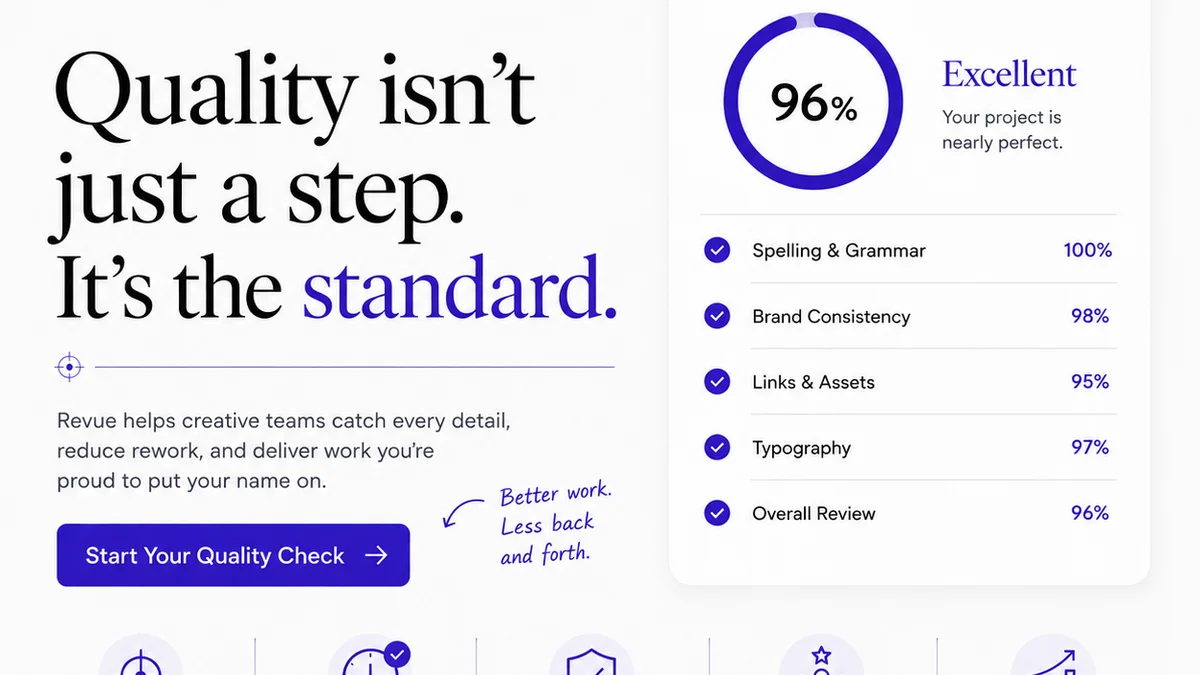
- Run Quality Checks: Ensure that feedback has been addressed and that the final output meets all requirements before it goes live. This integrated approach helps maintain a high standard of quality.
By bringing structure and clarity to the feedback loop, Revue helps in-house teams move faster, make better decisions, and ultimately deliver stronger creative work with less friction.
Final Thought
The goal of design review isn't just to critique work; it's to elevate it. It’s about fostering a collaborative environment where constructive feedback leads to better outcomes. Are your current review practices truly serving that goal, or are they just another hurdle to jump?
Frequently asked questions
What are the most common mistakes in in-house design reviews?
Common mistakes include unclear goals for the review, ambiguous roles and responsibilities (leading to decision paralysis), a one-size-fits-all approach to different design stages, providing vague or personal feedback instead of objective critique, and failing to document feedback and action items properly.
How can I make design feedback more actionable?
To make feedback actionable, focus on the project's objectives, be specific with observations and suggestions, offer potential solutions when possible, and clearly distinguish between personal preferences and critical requirements. Using a structured feedback framework can also help.
Who should be involved in an in-house design review?
The core group includes the design team, the primary decision-maker (e.g., Creative Director, Marketing Lead), and relevant Subject Matter Experts (e.g., Legal, Engineering, Brand). The specific participants should vary based on the review's stage and goals.
How often should design reviews happen?
The frequency depends on the project's complexity and stage. It's best to have phased reviews: early for concepts and wireframes, mid-project for visual design, and late-stage for final checks. Avoid having too many reviews, which can slow down progress; focus on quality and targeted feedback at each stage.