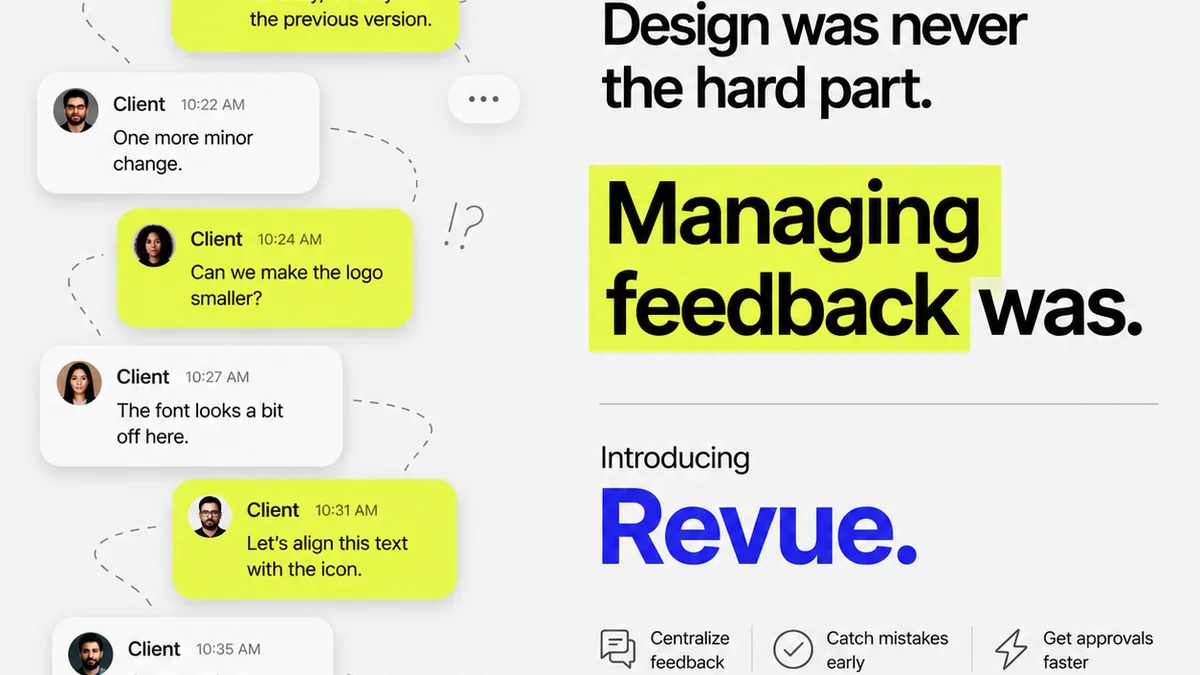
Most in-house creative teams think their design review process is fine. They have a system: a designer sends a draft, a manager gives feedback, maybe a stakeholder chimes in, and the cycle repeats until it’s “good enough.”
None of that is wrong. But it’s incomplete.
The hard truth? That messy, ad-hoc approach is a productivity killer. It breeds confusion, delays launches, and erodes team morale. It’s not a process; it’s a symptom of one missing.
1. The Myth of 'Quick Feedback'
We’ve all been there. A quick Slack message, a comment in a shared doc, an email buried in an inbox. It feels fast. It feels efficient.
But is it?
Consider the hidden costs:
- Context Switching: Every interruption pulls a designer off their focused work.
- Lost Information: Feedback gets scattered, making it hard to track what’s been addressed.
- Ambiguity: Vague comments like “make it pop” or “I don’t like this” lead to wasted revisions.
- Scope Creep: Unstructured feedback can easily introduce new, unplanned features or changes.
- Delayed Approvals: Without clear ownership or a defined workflow, sign-offs can linger indefinitely.
This isn't just about minor inefficiencies. For complex projects, this can add days or even weeks to your timeline.
2. Define Your Design Review Stages
A robust design review process isn't about more meetings; it's about more clarity. Start by mapping out distinct stages for your reviews.
Think of it like an assembly line, not a free-for-all.
Internal Checkpoints
Before anything goes to a client or broader stakeholder group, the work needs internal validation.
- Designer Self-Review: The designer checks their own work against the brief and established guidelines.
- Peer Review: Another designer or team member offers a fresh perspective. This catches errors and suggests improvements early.
- Art Director/Lead Review: A senior team member assesses the work for strategic alignment, brand consistency, and overall quality.
Stakeholder/Client Reviews
These are the critical junctures where external input is gathered.
- Feedback Round 1: Gather initial thoughts from key stakeholders. Aim for consolidated, actionable feedback.
- Revision & Internal Check: Implement the feedback and have the internal team review the changes.
- Final Approval: A clear sign-off point before handoff or launch.
Each stage should have a clear purpose and defined outcomes. This prevents feedback from being a black hole.
3. Establish Clear Feedback Guidelines
Vague feedback is the enemy of efficient design review. You need to train your team and your stakeholders on how to give and receive feedback effectively.
What does actionable feedback look like?
- Be Specific: Instead of “This button is wrong,” say “This button’s color doesn’t meet WCAG AA contrast ratios, and its placement hinders usability.”
- Reference the Brief: Always tie feedback back to the project’s goals and requirements.
- Focus on the 'What' and 'Why,' Not the 'How': Suggest the problem to solve, not the specific solution. Let the designer figure out the best implementation.
- Prioritize: Distinguish between critical issues that *must* be fixed and suggestions that are optional.
- Be Timely: Set clear deadlines for feedback submission.
This requires setting expectations upfront. When kicking off a project, clearly communicate how feedback will be collected and what makes feedback valuable.
4. Centralize Communication and Assets
Scattered feedback across emails, Slack, and random documents is chaos. You need a single source of truth for all project-related communication and assets.
This is where dedicated tools become essential.
Imagine this:
- All design files are in one place.
- All feedback is attached directly to the specific element being discussed.
- Revision history is automatically tracked.
- Approvals are logged and visible to everyone.
This eliminates the “Did you see my email?” and “Where is the latest version?” headaches. It ensures everyone is working from the same, up-to-date information.
5. Automate Where Possible
Repetitive tasks suck time and energy. Look for opportunities to automate parts of your design review workflow.
This could include:
- Automated Notifications: Alerting team members when feedback is ready, a revision is complete, or an approval is pending.
- Version Control: Automatically tracking changes and making it easy to revert if needed.
- Reporting: Generating simple reports on review cycles, time spent, and outstanding items.
Automation frees up your team to focus on creative problem-solving, not administrative busywork.
Where Revue Fits In
Implementing a structured design review process doesn't require a massive overhaul. It requires adopting tools that support clarity and efficiency.
Revue acts as that central hub for your creative workflow.
- Centralized Feedback: All client and stakeholder comments live in one place, tied directly to the creative asset. No more digging through emails.
- Revision & Approval Visibility: Track every version and see who approved what, and when. This transparency avoids confusion and disputes.
- Quality Checks: By having a clear workflow and documented feedback, you naturally build in more rigorous quality control points.
Revue streamlines the back-and-forth, ensuring that feedback is constructive, decisions are documented, and projects move forward with confidence.
Final Thought
Is your current design review process a bottleneck or a catalyst? The difference often lies not in talent, but in structure. Are you building a system that supports your team's best work, or one that hinders it?
Frequently asked questions
What is the biggest mistake teams make in design reviews?
The biggest mistake is treating design reviews as an informal, ad-hoc conversation. This leads to scattered feedback, lack of context, and endless revision cycles because there's no clear structure or documentation.
How can I make client feedback more actionable?
Set clear expectations upfront. Define what constitutes actionable feedback (specific, tied to the brief, focused on the 'what' and 'why') and establish a structured process for collecting it, rather than relying on scattered emails or calls.
What are the key stages of an effective design review process?
Key stages typically include internal checkpoints (designer self-review, peer review, lead review) and structured stakeholder/client reviews (initial feedback, revisions, final approval). Each stage should have a defined purpose and outcome.
How does a centralized tool help with design reviews?
Centralized tools provide a single source of truth for all feedback, assets, and communication. This eliminates confusion, ensures everyone is working with the latest version, and creates an auditable trail of decisions and approvals.