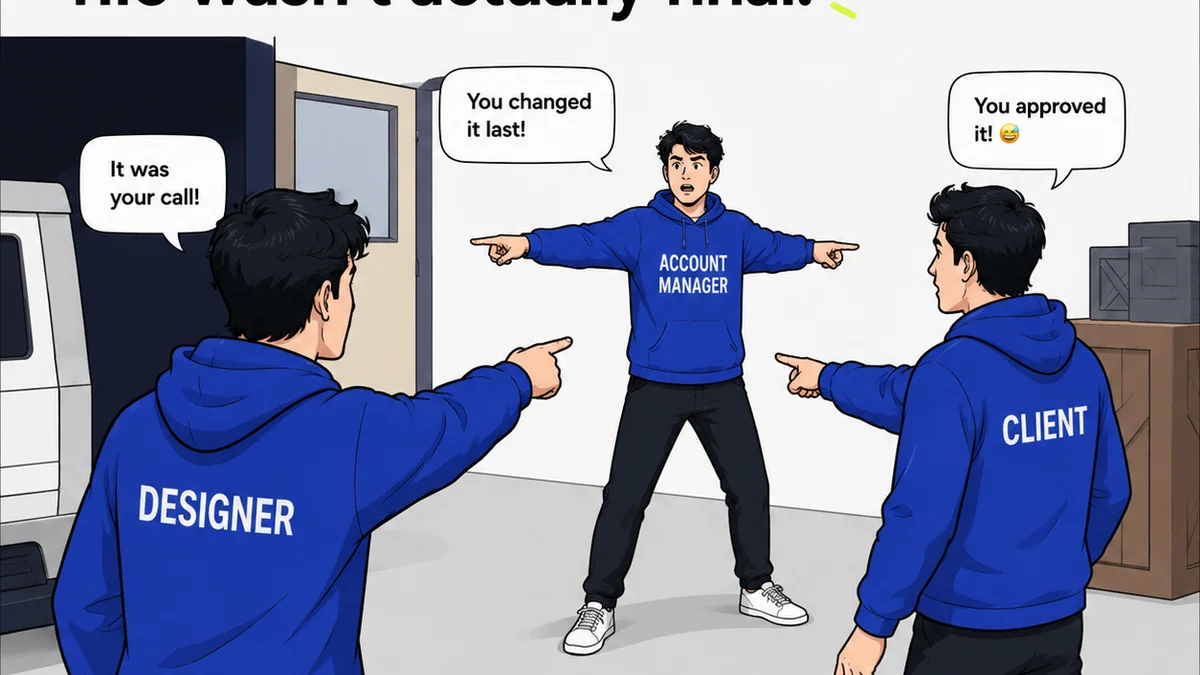
Everyone talks about speeding up design review turnaround time. The assumption is simple: clients are slow, and if they just responded faster, everything would be fine.
None of that is wrong. But it’s incomplete.
The hard truth? Your agency’s own internal processes are often the biggest drag on getting feedback and approvals. Slow design review cycles aren't just a client problem; they're a workflow problem.
1. The Illusion of 'Client Feedback'
We love to point fingers. 'The client is on vacation.' 'They didn't get back to us.' 'They don't know what they want.' These are all valid observations, but they often mask deeper issues.
What if the client *can't* give clear feedback because they're drowning in a sea of unorganized comments? What if they *don't* know what they want because the brief wasn't specific enough, or the revisions weren't clearly presented?
This isn't about blaming anyone. It's about understanding that external feedback is a reflection of your internal system.
The Real Problem Isn't Just Waiting
It's about the quality and clarity of what you send out for review in the first place. If your deliverables are confusing, or if the feedback mechanism is broken, you're setting yourself up for delays.
Consider these common symptoms:
- Feedback arrives in scattered emails, Slack messages, and even text messages.
- Clients are confused about which version is the latest.
- Revisions are made, but the client feels their core concerns weren't addressed.
- The scope of revisions seems to expand with every round.
These aren't client failures. They are process failures.
2. Unpacking the 'Internal Review' Black Hole
Before feedback even reaches the client, it often gets stuck in internal review. This stage is critical, yet frequently overlooked. Is your team providing clear, actionable feedback, or just vague opinions?
Many agencies suffer from 'design by committee' internally, or a lack of clear ownership for final sign-off. This leads to:
- Conflicting internal notes that confuse both the design team and the client.
- Endless internal debates that delay the project.
- A lack of a unified vision presented to the client.
If your internal review process is chaotic, the client's review will be too. You're essentially creating the conditions for slow external turnaround.
The 'Ready for Client' Threshold
What does 'ready for client' actually mean in your agency? Is it a formal checklist? A senior designer's gut feeling? Without a clear, objective standard, you're leaving room for interpretation and delay.
This requires a defined internal quality assurance step. It’s not just about aesthetics; it’s about ensuring the work meets the brief, brand guidelines, and technical requirements.
3. The Feedback Loop from Hell
This is where most agencies feel the pain. The back-and-forth of revisions and approvals is where time truly disappears. The common culprits:
- Vague Feedback:
Frequently asked questions
What is a good design review turnaround time?
A 'good' turnaround time is relative and depends on project complexity and client availability. However, aiming for 24-48 business hours for initial client feedback and 24 hours for internal reviews after each revision is a common benchmark. The key is consistency and clear communication about expected timelines.
How can I get clients to provide feedback faster?
While client speed is a factor, focus on making feedback easy and clear. Provide consolidated feedback channels, set clear expectations for response times in your SOW, and ensure your deliverables are easy to review. Proactive communication and education about the review process can also help.
What are the common reasons for slow design review cycles?
Common reasons include scattered and unclear feedback (both internal and external), lack of a defined internal review process, unclear project briefs, scope creep during revisions, and inefficient communication channels. Often, internal process issues are the primary bottleneck.
How can technology improve design review turnaround time?
Centralized feedback platforms like Revue can streamline the entire process. They consolidate comments, track revisions, provide version history, and improve communication clarity, significantly reducing the time spent chasing feedback or deciphering scattered notes.