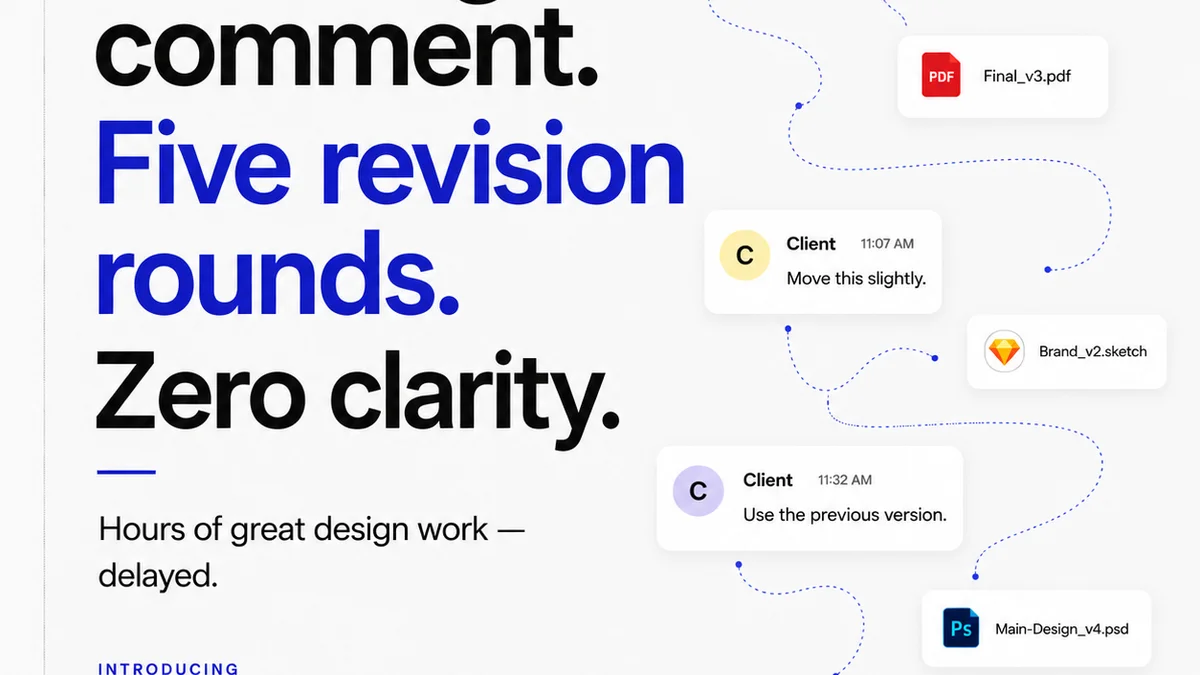
Everyone says design revisions are the enemy of a productive creative agency. That client feedback loops are where projects go to die. That the only way to survive is to build in huge buffers and brace for impact.
None of that is wrong. But it’s incomplete.
The hard truth? Design revisions aren’t the problem. Bad processes are the problem. Uncontrolled, chaotic, soul-crushing revision cycles are the symptom. The disease is a lack of clarity, communication, and control.
1. The Myth of the “Final” Brief
We all nod along when a client says, “This is the final brief.” We build our estimates, our timelines, our entire project around it. And then, inevitably, the feedback starts rolling in, contradicting the brief itself.
This isn't malicious. It's human.
Clients often don't know what they want until they see it. Their internal stakeholders have different ideas. The market shifts. A brief is a starting point, not a sacred text.
Assumption vs. Reality
Assumption: A perfect brief means perfect execution and zero scope creep.
Reality: A brief is a hypothesis. Revisions are how you test and refine it. Expecting otherwise is setting yourself up for frustration.
The Fix: Collaborative Scoping
- Treat the brief as a living document.
- Build in dedicated phases for feedback and iteration *within* the initial scope.
- Use visual aids and mood boards early to align on aesthetic direction before detailed design begins.
This isn't about giving clients free rein. It's about acknowledging that creative direction evolves.
2. Feedback Chaos: The Silent Killer
The real damage isn't the revisions themselves, but how feedback is collected and managed. Emails buried in inboxes. Slack messages lost in the noise. Comments scattered across multiple platforms. Sticky notes on a monitor.
This is where projects drown.
It’s impossible to track what’s been addressed, what’s been missed, and what’s been misinterpreted.
Common Symptoms of Feedback Chaos
- Endless email chains asking, “Did you get my feedback on X?”
- Designers redoing work because they saw a new comment on a different platform.
- Clients saying, “I told you that last week!”
- Missed feedback leading to client frustration and delays.
- Team members spending more time chasing feedback than designing.
The Solution: Centralized, Actionable Feedback
You need a single source of truth for all project feedback. A place where comments are linked directly to the creative asset, timestamped, and assigned.
This means:
- No more digging through email archives.
- Clear visibility on what needs action.
- Easy tracking of feedback history.
When feedback is organized, it becomes constructive, not destructive.
3. Revision Rounds: The Scope Creep Trap
The standard “three rounds of revisions” is often a band-aid on a deeper problem. It’s an arbitrary number that rarely reflects the actual complexity of the work or the client's evolving needs.
More importantly, it doesn't address *why* multiple rounds are needed in the first place.
The Problem with Fixed Rounds
- It encourages clients to “save up” feedback, leading to massive, overwhelming revision requests.
- It can stifle genuine creative exploration, as teams rush to meet the round limit.
- It often leads to scope creep disguised as “just one more thing.”
Rethinking Revision Management
Instead of fixed rounds, focus on clear milestones and deliverables.
Define what constitutes a
Frequently asked questions
What is the biggest mistake agencies make with design revisions?
The biggest mistake is treating revisions as a necessary evil rather than an integral part of the creative process. Agencies often fail to establish clear communication channels and a structured feedback system, leading to chaos, scope creep, and frustration for both the team and the client.
How can I prevent scope creep during design revisions?
Prevent scope creep by clearly defining project scope and deliverables upfront, establishing a structured feedback process with defined milestones, and using a centralized platform to track all feedback. Ensure clients understand what is included in the agreed-upon revision rounds and have a process for addressing out-of-scope requests.
What are the benefits of centralizing client feedback?
Centralizing feedback brings all comments, markups, and approvals into one accessible location. This eliminates confusion, ensures no feedback is missed, provides a clear audit trail, and significantly speeds up the revision process by making it easier for designers to understand and act on client input.
How many revision rounds should a project have?
There's no magic number. Instead of fixed rounds, focus on clear project milestones and deliverables. Define what constitutes a 'revision' versus a 'new request.' A well-managed process often means fewer, more productive revision cycles rather than an arbitrary number of rounds.