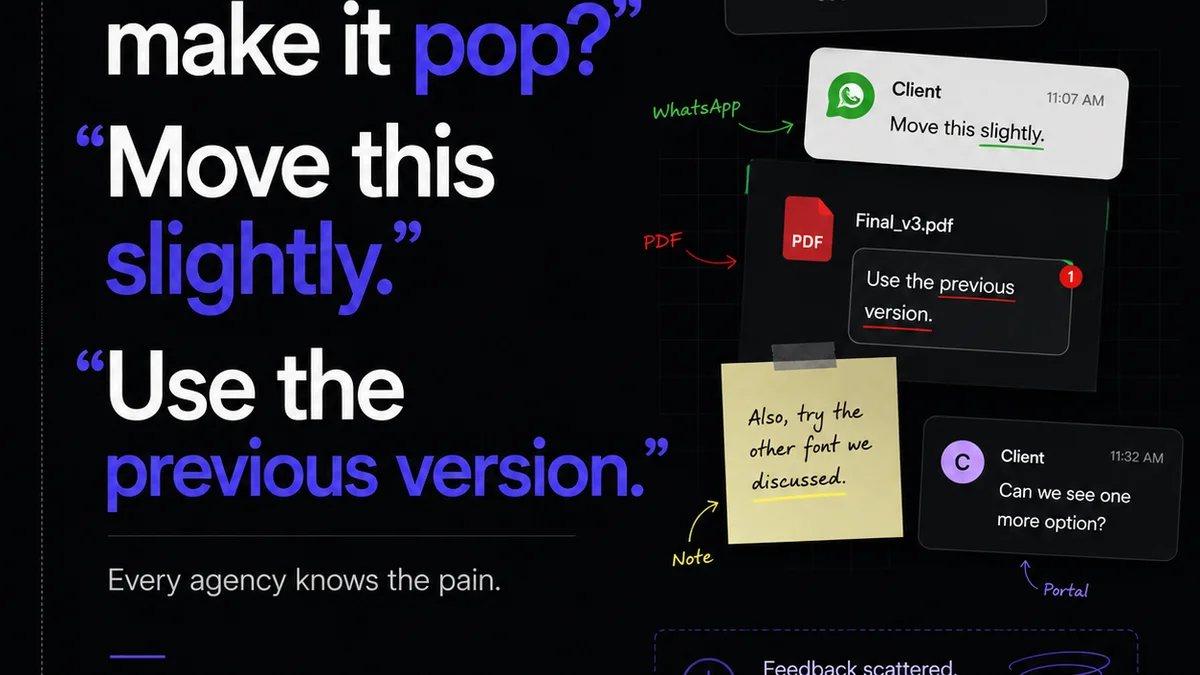
Everyone thinks enterprise revision management is about tracking file versions. You know, the endless email chains with "_v3_final_final_really_this_time.ai" and the frantic Slack messages asking for approval. None of that is wrong. But it’s incomplete.
The hard truth? True enterprise revision management is less about the files and more about the workflow. It’s about visibility, control, and a clear path from concept to final delivery. It’s the engine that keeps complex creative projects moving without grinding to a halt.
1. Define the 'Why' Before the 'How'
Before you can manage revisions effectively, you need to understand what you’re managing them *for*. What are the biggest pain points in your current process? Is it:
- Missed deadlines due to unclear feedback?
- Wasted hours searching for the latest approved asset?
- Scope creep disguised as minor tweaks?
- Client frustration from a lack of transparency?
- Internal friction between teams?
Identifying these specific problems is the first step. Without this clarity, any solution you implement will be a band-aid, not a cure.
2. Map Your Current Revision Workflow
You can't fix what you don't understand. Take the time to meticulously map out your current revision process, from the initial brief to the final sign-off.
This isn't just a flowchart. It's about understanding:
- Who provides feedback at each stage?
- What are the approval gates?
- How is feedback documented and communicated?
- What are the turnaround times expected at each step?
- What tools are currently in play, and where do they break down?
The 'Shadow Workflow' Problem
Often, the documented process is not the actual process. People use personal spreadsheets, email threads, or even sticky notes to track things the official system misses. This is the 'shadow workflow,' and it’s a major source of errors and delays in enterprise revision management.
Uncovering these shadow workflows requires honest conversations with the people doing the work. Ask them how they *really* get things done.
3. Establish Clear Roles and Responsibilities
Ambiguity is the enemy of efficient revision management. Everyone involved needs to know their role and what's expected of them at every stage.
Key Roles to Define:
- Requestor: Initiates the project or revision.
- Reviewer: Provides feedback at specific stages.
- Approver: Gives the final sign-off.
- Project Manager: Oversees the entire process, ensures communication.
- Asset Manager: Ensures the correct versions are stored and accessible.
Document these roles and responsibilities clearly. Make sure everyone understands who owns what decision and who needs to be looped in.
4. Standardize Feedback and Approval
This is where many enterprises stumble. Feedback is often subjective, vague, and delivered inconsistently. Approvals can be rubber-stamped without proper diligence.
Standardizing Feedback:
- Use structured feedback forms: Instead of
Frequently asked questions
What is the biggest mistake companies make with revision management?
Treating it as a purely administrative task after creative work is done, rather than an integrated part of the workflow. This leads to unclear feedback, version control issues, and project delays.
How can I get better feedback from clients?
Standardize the feedback process. Use structured forms, specific annotation tools, and clearly define who provides feedback and when. Train clients on your process, highlighting the benefits of clear, actionable input.
What's the difference between revision and approval?
Revisions are changes made to the creative work based on feedback. Approval is the formal sign-off that the work meets the requirements and is ready for the next stage or final delivery. One is about modification, the other about acceptance.
How does technology help with enterprise revision management?
Technology, like dedicated review and approval platforms, centralizes communication, automates version tracking, provides audit trails, and offers clear visibility into the status of feedback and approvals. This reduces manual errors and speeds up the process.