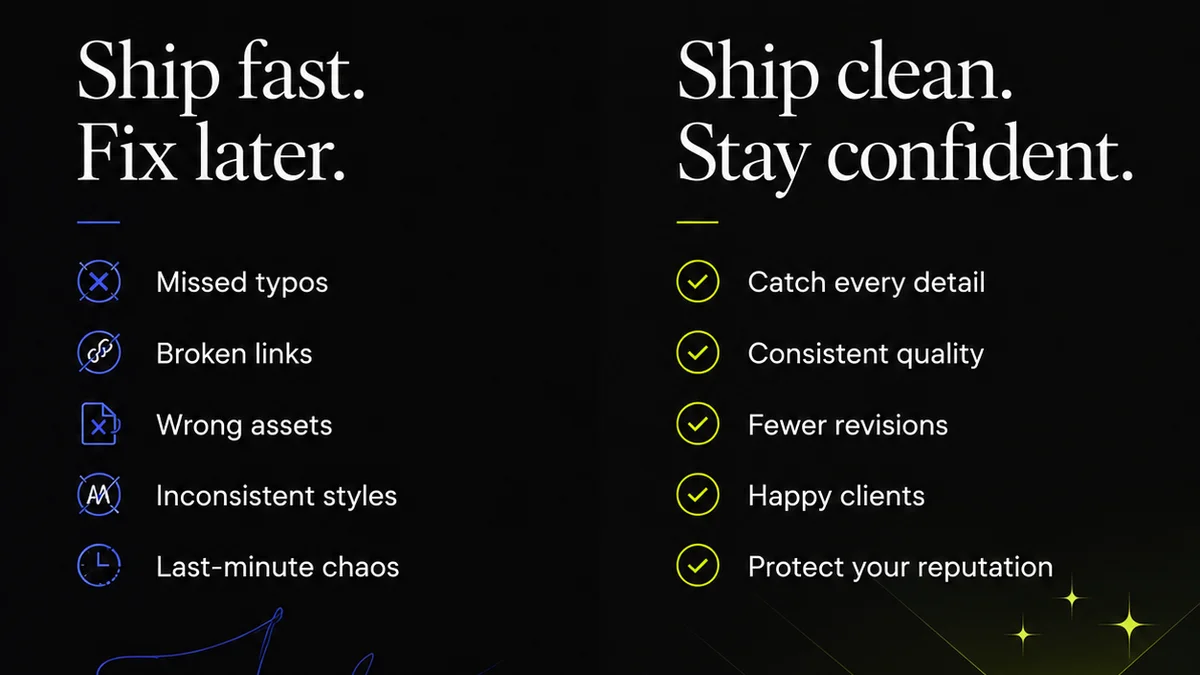
Everyone thinks enterprise revision management software is about digital proofing. You upload a file, clients mark it up, you make changes. Rinse and repeat.
None of that is wrong. But it’s incomplete. Massively incomplete.
The real challenge for large teams and agencies isn't just seeing comments. It's managing the entire lifecycle of creative work, from first draft to final sign-off, across multiple projects and stakeholders, without losing your mind. That's where the right software makes or breaks your operation.
1. Beyond Comments: Context is King
Digital proofing tools are a dime a dozen. They’re table stakes. But they often fail to capture the full context of feedback.
Is the feedback from the client’s marketing manager or their legal department? Does it align with the brief from three weeks ago? Is this a minor tweak or a fundamental strategic shift?
The Problem with Siloed Feedback
When feedback lives in email chains, Slack messages, or disparate tools, you lose the thread. Every new comment becomes a scavenger hunt.
- Key decisions get buried.
- Scope creep goes unnoticed until it’s too late.
- Misinterpretations lead to costly rework.
Enterprise-grade revision management needs to tie feedback directly to specific project assets and versions. It must preserve the conversation history, making it easy to trace the evolution of an idea and the rationale behind decisions.
2. Version Control That Actually Works
This is where most tools stumble. They might show you a list of versions, but do they help you understand the *differences*? Do they prevent accidental overwrites or the dreaded “which one is the latest?” panic?
Effective version control is about more than just chronology. It's about clarity and control.
Key Features to Demand
Look for software that offers:
- Clear Version Stacking: Visually distinct versions, perhaps with color-coding or clear numbering.
- Comparison Tools: Side-by-side or overlay comparisons to instantly spot changes between versions. This is crucial for design reviews.
- Rollback Capabilities: The ability to easily revert to a previous stable version if a new direction proves problematic.
- Audit Trails: A complete log of who did what, when, and why for every version.
Without robust version control, you’re essentially working blind, hoping you’re iterating in the right direction.
3. Streamlined Approvals, Not Just Feedback
Collecting feedback is one thing. Getting a definitive sign-off is another. Many tools treat them as the same, which is a critical operational error.
Approvals need to be formal, trackable, and unambiguous.
The Approval Bottleneck
How many times has a project stalled because someone “forgot” to approve a critical asset? Or worse, an approval was given verbally and later denied?
Enterprise revision management needs a dedicated approval workflow:
- Defined Signatories: Clearly designate who has the authority to approve assets.
- Multiple Approval Stages: Support for sequential or parallel approval flows, accommodating different stakeholder requirements.
- Status Tracking: Real-time visibility into where an asset is in the approval process – pending, approved, rejected.
- Automated Notifications: Reminders for approvers and notifications upon completion or rejection.
This structured approach eliminates guesswork and accelerates project timelines.
4. Integration with Your Existing Stack
Your revision management tool shouldn't be an island. It needs to play well with the other systems you rely on.
Think about the tools you use daily: project management software, cloud storage, design applications.
Seamless Workflow Connections
Enterprise solutions should offer:
- API Access: For custom integrations and data exchange.
- Pre-built Connectors: For popular tools like Adobe Creative Cloud, Figma, Google Drive, Dropbox, Asana, Jira, etc.
- Single Sign-On (SSO): For easier user management and security.
When your tools talk to each other, you reduce manual data entry, minimize errors, and create a more fluid workflow.
5. Scalability and Security for Large Teams
What works for a small team of five might crumble under the weight of fifty, or five hundred.
Enterprise needs are different. You require robust security, granular permissions, and the ability to scale without performance degradation.
Enterprise-Level Requirements
- User Roles and Permissions: Control who can see, edit, approve, or manage specific projects and assets. This is non-negotiable for sensitive client work.
- Performance: The system must remain responsive even with thousands of assets and hundreds of users.
- Security Certifications: Look for compliance with relevant standards (e.g., SOC 2, ISO 27001) if handling highly sensitive data.
- Centralized Administration: Tools for IT or operations teams to manage users, settings, and integrations across the organization.
Don't compromise on these fundamentals. They are the bedrock of a reliable enterprise system.
Where Revue Fits In
This is precisely why Revue was built. We saw agencies and in-house teams drowning in endless email threads and disconnected feedback loops.
Revue provides a centralized hub for your creative workflow. It’s not just about marking up a PDF.
- Centralized Feedback: All client comments and stakeholder input live in one place, directly on the asset. No more hunting through emails.
- Revision & Approval Visibility: Track every version, every comment, and every approval status in real-time. Understand exactly where a project stands and who needs to act.
- Quality Assurance Checks: Build custom checklists and workflows to ensure creative output meets brand standards and client requirements before final delivery.
We focus on the operational backbone, ensuring your team can collaborate efficiently and deliver exceptional creative work, consistently.
Final Thought
The most effective enterprise revision management software isn't just a digital notepad. It's a strategic operational tool that fortifies your workflow, protects your projects from scope creep, and ensures clear, documented sign-offs.
Are you using a tool that simply collects comments, or one that actively manages your creative process?
Frequently asked questions
What is the primary difference between basic proofing tools and enterprise revision management software?
Basic proofing tools focus mainly on collecting comments on a single asset. Enterprise revision management software offers a comprehensive solution for managing the entire lifecycle of creative work, including robust version control, formal approval workflows, detailed audit trails, and scalability for large teams, all integrated into a broader operational strategy.
Why is version control so critical in enterprise revision management?
Critical version control ensures that all stakeholders are working with the correct iteration of an asset. It prevents confusion, reduces the risk of costly rework due to outdated versions, allows for easy comparison between iterations, and provides a clear history of changes, which is essential for accountability and project continuity.
How does enterprise revision management software help prevent scope creep?
By centralizing all feedback and linking it to specific project briefs and asset versions, enterprise revision management software makes it clear when feedback deviates from the original scope. Formal approval workflows also ensure that any changes outside the agreed scope are explicitly acknowledged and approved, making scope creep visible and manageable.
What kind of integrations should I look for in enterprise revision management software?
Look for integrations with your existing tools, such as project management software (Asana, Jira), design applications (Adobe Creative Cloud, Figma), and cloud storage (Google Drive, Dropbox). API access for custom integrations and Single Sign-On (SSO) for streamlined user management are also highly beneficial.