Everyone talks about the best FinTech mobile app design services in the US. They point to sleek interfaces, intuitive user flows, and apps that make complex financial tasks feel simple. None of that is wrong. But it’s incomplete.
The hard truth? Exceptional FinTech app design isn't just about aesthetics or usability. It's about trust, security, and seamless integration into a user's financial life. It requires a deep understanding of regulatory landscapes, risk aversion, and the psychological barriers users face when managing money.
1. Beyond Pixels: The FinTech Design Imperative
Many design agencies can build beautiful apps. Few can build beautiful apps that also instill confidence in users handling sensitive financial data. FinTech requires a different breed of designer and strategist.
Think about it: a misplaced button, a confusing transaction history, or a slow loading time isn't just an annoyance. In FinTech, it can be a red flag, eroding trust and potentially leading users to abandon the app. This isn't the same as a slight delay on a social media feed.
The Stakes Are Higher
Financial applications deal with money. Users expect:
- Unwavering security.
- Crystal-clear information.
- Absolute reliability.
- Effortless transaction processing.
- Compliance with regulations.
These aren't optional extras; they are foundational requirements. A design service that treats them as afterthoughts is a risk you can’t afford.
2. Identifying True FinTech Design Expertise
How do you spot a genuinely capable FinTech mobile app design service in the US? Look past the generic case studies and ask probing questions about their process and experience.
Security-First Mindset
A top-tier service understands that security isn't just a developer's job. It's baked into the design from day one. This means:
- Designing with multi-factor authentication in mind.
- Considering secure data input fields.
- Visualizing clear error states that don't reveal sensitive information.
- Understanding the implications of UI/UX on compliance requirements like KYC (Know Your Customer) and AML (Anti-Money Laundering).
They should be able to articulate how their design decisions support your security posture.
User Empathy for Financial Behavior
FinTech users are often stressed, rushed, or highly analytical. Design must account for this. The best services demonstrate empathy by:
- Simplifying complex financial jargon into plain language.
- Creating clear visual hierarchies for critical information (balances, transaction details).
- Designing for accessibility to ensure all users can manage their finances.
- Minimizing cognitive load during high-stakes actions like transfers or payments.
This empathy translates into user retention and satisfaction.
Regulatory Awareness
While designers aren't lawyers, they operate within a regulated industry. A strong FinTech design partner knows this and:
- Understands how UI elements can impact compliance.
- Designs transparent disclosures and terms.
- Creates interfaces that support audit trails.
- Is aware of common pitfalls that can lead to regulatory scrutiny.
They don't need to be legal experts, but they must respect the legal framework.
3. The Operational Backbone: Process and Collaboration
Beyond the creative output, a service’s operational strength is paramount for FinTech app development. This is where many agencies falter.
Agile and Iterative Development
FinTech moves fast. Your design partner needs to keep pace. Look for:
- A clear, agile design and development process.
- Regular, structured feedback loops.
- The ability to pivot based on testing and market shifts.
- Tools and methodologies that ensure rapid iteration without sacrificing quality.
This isn't about rushing; it's about efficient, intelligent progress.
Cross-Functional Collaboration
FinTech apps involve product managers, engineers, compliance officers, marketers, and legal teams. The best design services excel at integrating with these diverse stakeholders.
They should facilitate clear communication, manage differing opinions constructively, and ensure the design vision aligns with business objectives and technical realities. This often means using collaborative platforms effectively.
Data-Driven Design Decisions
Gut feeling has its place, but in FinTech, data should guide design. The top services:
- Incorporate user research and usability testing throughout the process.
- Leverage analytics to understand user behavior within the app.
- Use A/B testing to validate design choices.
- Can articulate the rationale behind design decisions with data.
This reduces guesswork and increases the likelihood of a successful product.
4. Evaluating Portfolios and Case Studies
When reviewing a design service's portfolio, look for specific indicators of FinTech success, not just pretty pictures.
Depth Over Breadth
Are their case studies detailed? Do they explain the *problem*, the *process*, and the *results*? For FinTech, results often include metrics like:
- Increased user adoption.
- Higher transaction volumes.
- Improved customer satisfaction scores (CSAT/NPS).
- Reduced support inquiries related to usability.
- Successful product launches within regulated markets.
A portfolio filled with only vague descriptions or generic app screenshots is a warning sign.
Client Testimonials and References
What do their actual FinTech clients say? Seek out testimonials that speak to:
- Reliability and meeting deadlines.
- Understanding of financial industry nuances.
- Effective communication and collaboration.
- Problem-solving capabilities.
- The impact of their design on the business.
Don't hesitate to ask for references and follow up.
Longevity and Iteration
Has the agency worked with clients long-term? Have they helped iterate and improve existing FinTech products? This shows a commitment to sustained success, not just a one-off project.
5. Where Revue Fits In
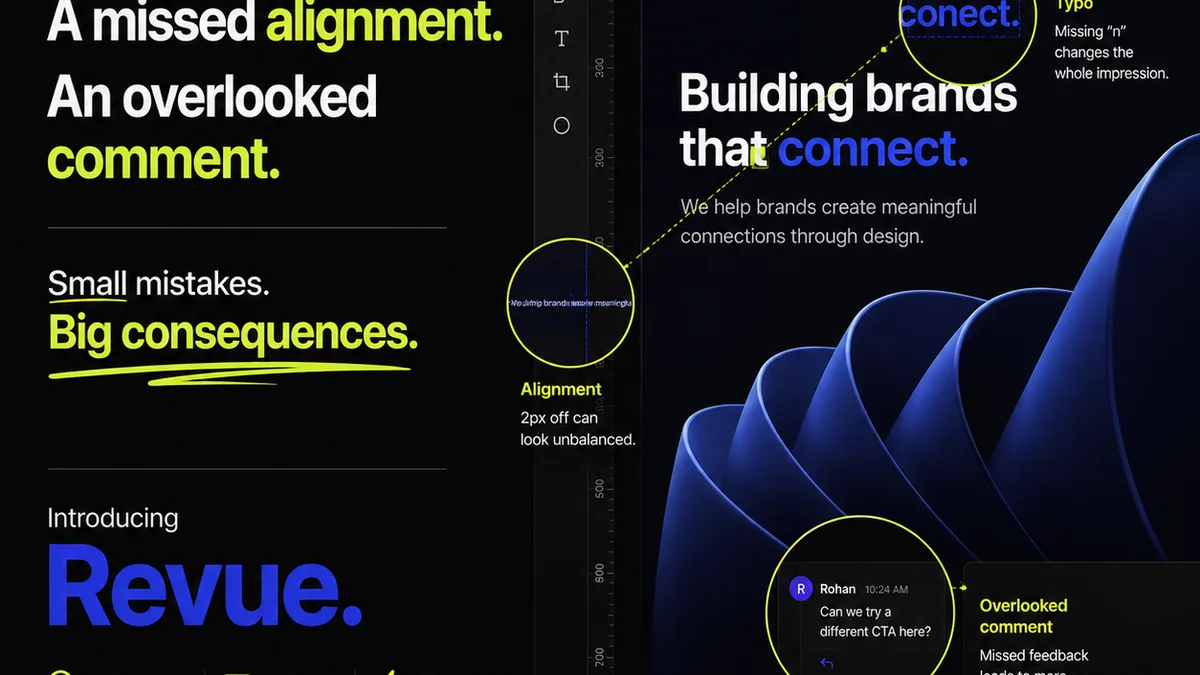
Managing feedback, revisions, and approvals for complex FinTech apps can quickly become chaotic. This is where a centralized platform like Revue becomes essential.
Imagine launching a new budgeting feature. Marketing provides copy, product shares wireframes, legal reviews disclosures, and compliance needs to sign off on transaction flows. Without a central hub, feedback gets lost in emails, Slack messages, and endless Zoom calls.
Revue streamlines this by:
- Centralizing all client and stakeholder feedback in one place, linked directly to the creative asset. No more hunting for comments.
- Providing clear visibility into revision history and approval status. Everyone knows where things stand, reducing back-and-forth.
- Enabling structured quality checks before final delivery, ensuring critical details aren't missed in the rush to launch.
For FinTech, where precision and clear communication are non-negotiable, a tool that manages the workflow around design assets is invaluable. It ensures the beautiful, secure app designed by your agency actually gets built and approved efficiently.
Final Thought
The best FinTech mobile app design services in the US don't just create visually appealing interfaces. They build secure, trustworthy, and compliant digital experiences that empower users financially. They understand that in FinTech, design is not just about form; it's about function, security, and the deep psychological contract between a user and their money. Are you prioritizing these operational realities when selecting your next design partner?
Frequently asked questions
What makes FinTech app design different from other app design?
FinTech app design requires a heightened focus on security, regulatory compliance, and user trust. Mistakes in financial apps can have more severe consequences, demanding rigorous attention to detail, clear communication of complex information, and an unwavering commitment to data protection.
How important is a security-first mindset in FinTech design?
It's paramount. A security-first mindset means integrating security considerations into every design decision, from user authentication flows to data handling and error messaging. The design must actively support and communicate security measures to build user confidence.
What should I look for in a FinTech design agency's portfolio?
Look for detailed case studies that outline the problem, process, and measurable results (e.g., increased adoption, transaction volume, user satisfaction). Prioritize agencies that demonstrate a deep understanding of financial behaviors, regulatory environments, and a robust, iterative design process.
Can a design service help with FinTech regulatory compliance?
While design services are not legal experts, the best ones understand how UI/UX design decisions can impact compliance. They can design transparent disclosures, support audit trails, and create interfaces that align with regulatory requirements, working in tandem with legal and compliance teams.