Everyone talks about increasing agency revenue. More clients, bigger retainers, higher bill rates. That’s not wrong. But it's incomplete.
The real driver of agency profitability isn't just *more* money coming in. It’s about keeping more of the money you earn. And that comes down to something far less glamorous: your workflow.
The Hard Truth: Profitability is a Workflow Problem
You can have the best clients and the most talented team, but if your internal processes are a mess, your profit margins will hemorrhage. We’re talking about the hidden costs of inefficiency: scope creep that goes unchecked, endless revision cycles, client communication breakdowns, duplicated effort, and missed deadlines.
These aren’t minor annoyances. They’re profit killers.
Improving agency profitability isn't about finding more work. It’s about doing the work you have more efficiently.
1. Audit Your Current Workflow: Where Are You Leaking Profit?
Before you can fix anything, you need to see the damage. Most agencies operate on gut feel and habit. That’s a dangerous way to run a business.
Conduct a brutal, honest audit of your end-to-end project lifecycle. From initial client brief to final deliverable and sign-off. Ask yourself and your team:
- What are the biggest bottlenecks?
- Where do projects get stuck?
- When do scope creep issues typically arise?
- How much time is spent on internal communication vs. actual creative work?
- Are client feedback loops clear and efficient?
- What are the most common reasons for project delays or budget overruns?
- Are we consistently tracking time accurately against project phases?
Every hour spent chasing down feedback, clarifying vague comments, or redoing work is an hour that eats into your profit margin. It’s also an hour that could be spent on billable client work or business development.
The 'Busy Work' Drain
Often, teams feel busy because they are constantly context-switching or performing low-value tasks that don’t directly contribute to project completion or client satisfaction. Think about the time spent:
- Searching for files
- Manually compiling feedback from multiple email threads
- Chasing down approvals
- Formatting reports
- Dealing with version control nightmares
This isn't efficient. It’s chaos disguised as work.
2. Standardize Your Processes: Create Predictable Outcomes
Chaos breeds inefficiency. Standardization, on the other hand, breeds predictability. And predictability is the bedrock of profitability.
This doesn’t mean turning your agency into a rigid, soulless machine. It means establishing clear, repeatable steps for common tasks and project phases.
Onboarding New Clients
Have a defined process for kicking off new projects. This includes:
- A standardized client questionnaire
- A clear statement of work (SOW) template
- A structured project kick-off meeting agenda
- Defined roles and responsibilities for both agency and client teams
Getting this right upfront prevents misaligned expectations later.
Managing Feedback and Revisions
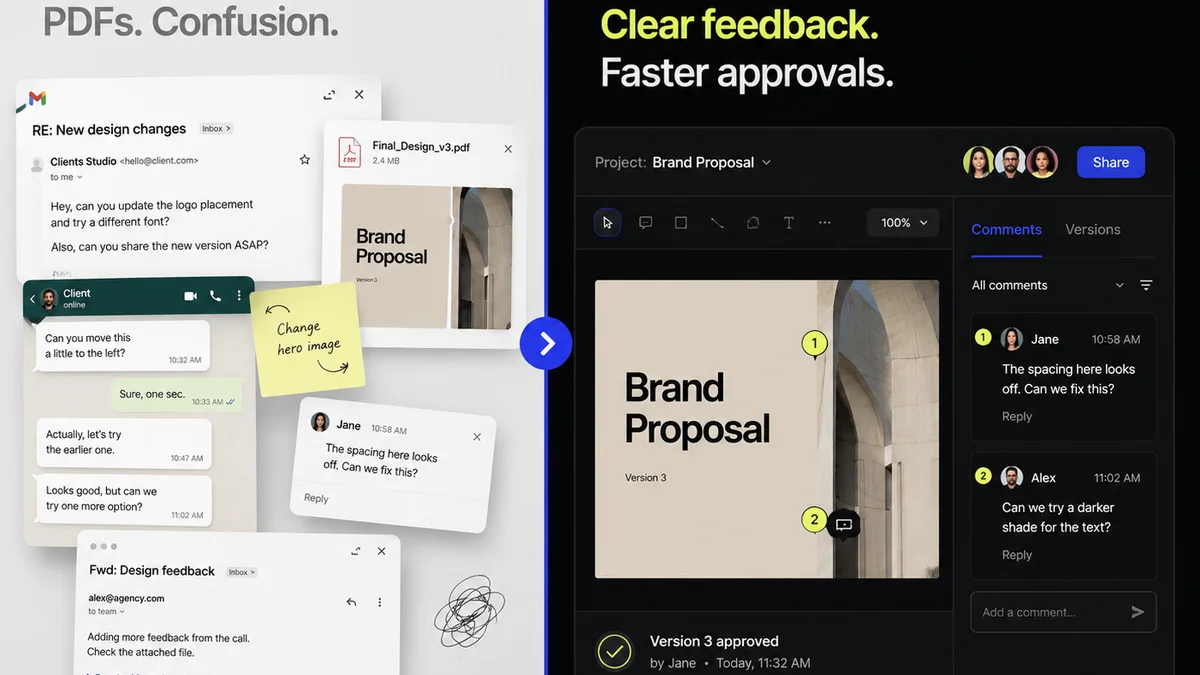
This is where most agencies bleed profit. Email chains, Slack messages, and random annotated PDFs are a recipe for disaster.
- Centralize Feedback: All client feedback should live in one place, directly linked to the creative asset.
- Define Revision Rounds: Clearly state the number of included revision rounds in your SOW.
- Establish Commenting Guidelines: Educate clients on how to provide clear, actionable feedback.
- Use Visual Annotation Tools: Tools that allow clients to click directly on an image or video to leave comments streamline the process immensely.
When feedback is clear, consolidated, and directly tied to the work, you reduce ambiguity, minimize back-and-forth, and ensure revisions are addressed efficiently.
Project Handoffs and Archiving
What happens when a project is done? Is it clearly handed off? Are final files archived correctly for future reference or potential upsells?
- Define a clear project closure checklist.
- Ensure all final assets are organized and accessible.
- Document key learnings for future projects.
A messy end to a project can still cost you time and money.
3. Implement the Right Tools: Technology as a Profit Multiplier
Your team is your greatest asset. But outdated or insufficient tools can actively sabotage their efforts and your bottom line.
Think of your tech stack not as an expense, but as an investment in efficiency. If a tool saves your team even an hour a week in tedious tasks, it pays for itself quickly.
Key Areas for Tooling
- Project Management: Tools to track tasks, deadlines, and team capacity.
- Client Communication & Feedback: Platforms that centralize conversations and annotations.
- Time Tracking: Accurate capture of hours spent on tasks for billing and analysis.
- File Sharing & Storage: Secure, organized repositories for project assets.
The goal is to automate the mundane, clarify communication, and provide visibility into project progress and resource allocation.
The Danger of Tool Sprawl
Be careful not to fall into the trap of having too many disconnected tools. This creates its own inefficiencies.
The best approach is often a well-integrated suite that handles core functions seamlessly.
4. Foster a Culture of Efficiency: It Starts at the Top
Process and tools are only effective if your team buys in. This requires leadership to champion efficiency and profitability.
Educate Your Team
Explain *why* these changes are important. Connect optimized workflows directly to:
- Reduced stress and burnout
- More time for creative thinking
- Greater client satisfaction
- The agency's long-term stability and growth
When your team understands the impact of their actions on the business, they’re more likely to adopt new processes.
Lead by Example
Are you adhering to the new processes? Are you championing the use of the tools? If leadership cuts corners, so will the team.
Incentivize Efficiency
Consider how you can reward teams or individuals who consistently demonstrate efficient practices or identify areas for improvement.
Where Revue Fits In
Optimizing your agency’s workflow for profitability means taming the chaos of client feedback and approvals. This is precisely where a tool like Revue can make a significant impact.
Revue provides a centralized hub for managing client feedback. Instead of sifting through endless email threads or Slack messages, all comments, annotations, and approvals are logged directly against the creative asset.
This means:
- Clearer Feedback: Clients annotate directly on the design, video, or document, eliminating ambiguity.
- Faster Revisions: Your team knows exactly what needs to be changed, reducing guesswork and rework.
- Streamlined Approvals: A clear audit trail shows who approved what and when, preventing disputes.
- Reduced Scope Creep: Easily track the number of revision rounds and identify out-of-scope requests.
- Improved Visibility: Everyone on the team and the client side has a single source of truth for feedback and status.
By bringing structure to client interactions and revisions, Revue helps agencies reclaim hours lost to inefficiency, directly boosting profit margins.
5. Measure, Iterate, and Refine: Continuous Improvement
Workflow optimization isn't a one-time project. It's an ongoing commitment.
You need to constantly monitor your processes and look for ways to improve.
Key Metrics to Track
- Project Profitability: Are projects coming in on budget?
- Billable Utilization Rate: How effectively is your team’s time being used for billable work?
- Client Satisfaction Scores: Are clients happy with the process and the outcome?
- Revision Cycle Time: How long does it take to get from initial deliverable to final approval?
- Internal Handoff Time: How long do projects sit between internal stages?
Use this data to identify what’s working and what’s not. Don’t be afraid to tweak processes, try new tools, or retrain your team.
The Power of Small Wins
You don’t need to overhaul everything at once. Identify one major bottleneck and focus on improving that. Small, consistent improvements compound over time.
Final Thought
Are you building a business that chases revenue, or one that commands profit? The difference lies not in how hard you work, but in how smart you work. Optimizing your agency's workflow is the most direct path to sustainable, predictable profitability. It's time to stop admiring the problem of low margins and start engineering the solution.
Frequently asked questions
What is the most common workflow bottleneck in creative agencies?
The most common workflow bottleneck in creative agencies is often the client feedback and revision process. Miscommunication, vague feedback, and endless back-and-forth cycles can significantly delay projects and erode profit margins.
How can standardizing processes improve agency profitability?
Standardizing processes creates predictability. By having clear steps for client onboarding, feedback management, and project completion, agencies reduce errors, minimize wasted time, and ensure projects stay on track and within budget, directly impacting profitability.
What types of tools are essential for optimizing agency workflows?
Essential tools include project management software for task tracking, client communication and feedback platforms for centralized comments and approvals, accurate time-tracking solutions, and secure file-sharing systems. Integrated tools are often most effective.
How does Revue specifically help improve agency profitability?
Revue helps by centralizing all client feedback and approvals directly on creative assets. This reduces ambiguity, speeds up revision cycles, provides a clear audit trail, and helps manage scope creep, all of which contribute to more efficient project delivery and higher profit margins.