Everyone thinks they know how to handle creative revisions. Just get more feedback, right? Make sure everyone signs off. That’s the common wisdom.
None of that is wrong. But it’s incomplete.
The hard truth is that most creative revision processes are broken because they treat feedback as a simple input. They don’t account for the chaos of communication, the subjectivity of taste, or the operational drag of endless back-and-forth. This isn't just an annoyance; it's a direct hit to your agency's profitability and your team's morale.
Improving creative revisions isn't about adding more steps or more meetings. It's about fundamentally changing how feedback is gathered, processed, and acted upon. It's about building a system that filters noise and amplifies clarity.
1. Define 'Done' Before You Start
The biggest drain on revision cycles isn't bad feedback. It's unclear objectives. When a client (or internal stakeholder) doesn't know what success looks like for a piece of creative, every revision becomes an attempt to guess their evolving desires.
This means the discovery and strategy phases are paramount. Not just for the creative itself, but for the brief.
The Master Brief
Your creative brief isn't just a document for the designers. It's the contract for the project. It needs to be:
- Specific about goals (e.g., increase sign-ups by 10%, not just 'improve engagement').
- Clear on target audience and their motivations.
- Explicit about key messages and calls to action.
- Detailed on technical requirements and constraints.
- A signed-off document that everyone agrees upon before creative work begins.
If a brief is vague, the revisions will be vague. If the brief is subjective, the feedback will be subjective.
2. Centralize Feedback, Not Just Collect It
Email chains. Slack DMs. Scattered comments in a shared doc. This is the graveyard of clear feedback. Every tool has its place, but relying on them for final client feedback is a recipe for disaster.
When feedback is siloed, it’s easy to miss context. A comment on a JPEG might contradict a verbal note from a meeting. An urgent Slack message can get lost in the noise.
The Single Source of Truth
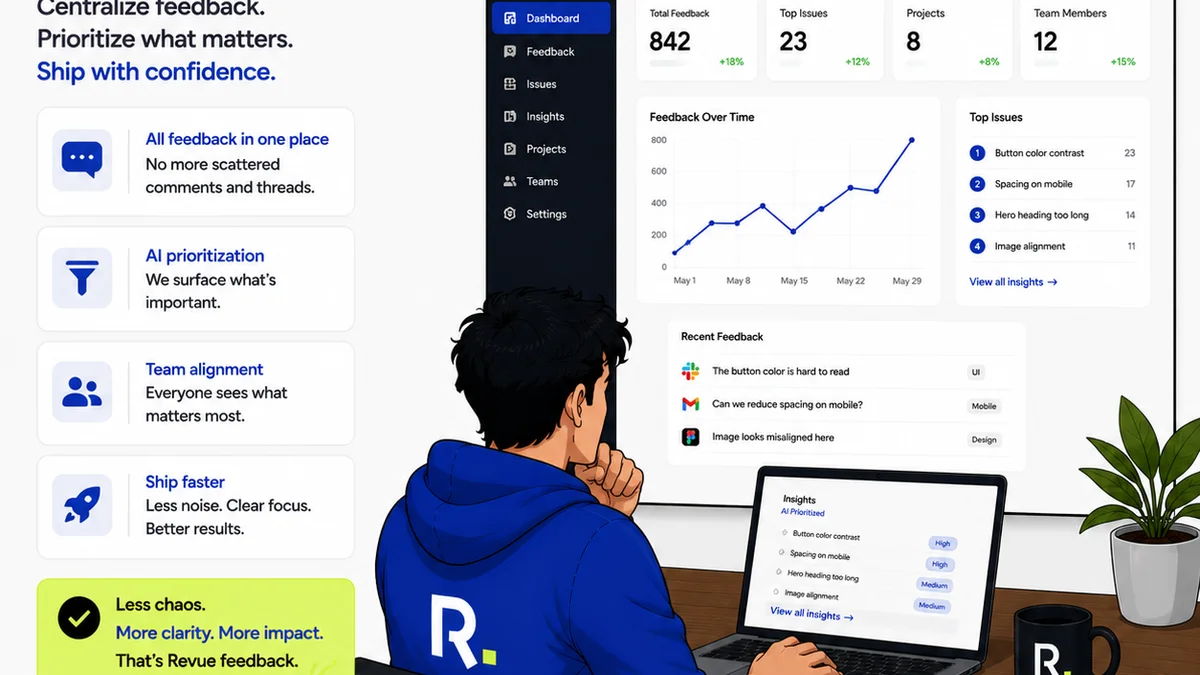
You need a system where all feedback lives in one place, tied directly to the creative asset it pertains to. This means:
- Context is King: Comments should be linked to specific versions, specific areas of the design, and include who left the feedback and when.
- Version Control is Non-Negotiable: No more 'final_final_v3.psd'. Every iteration needs to be tracked and accessible.
- No Ambiguity: Visual annotations remove the guesswork. A red line on an image is clearer than 'move that thingy over there'.
This isn't about micromanagement. It's about creating an auditable trail and ensuring everyone is working from the same, most up-to-date information.
3. Establish a Clear Review and Approval Workflow
Who needs to see what, and when? This question often gets a shrug. The result? Stakeholders are looped in too late, or too early, leading to wasted effort and conflicting input.
A defined workflow transforms revisions from a chaotic free-for-all into a structured process.
Mapping the Flow
Think about the journey of a creative asset:
- Internal Review: Does it meet the brief? Is it technically sound? This is the first quality gate.
- Primary Stakeholder Review: The main client contact who understands the objectives.
- Secondary Stakeholder Review: Other departments or individuals who need to weigh in (e.g., legal, marketing).
- Final Approval: The ultimate sign-off before launch.
Each stage should have clear expectations for turnaround time and the type of feedback acceptable. Legal might only check for compliance, while marketing might focus on messaging.
This structured approach prevents scope creep and ensures that feedback aligns with the project's original goals.
4. Differentiate Between Feedback Types
Not all feedback is created equal. Yet, most agencies treat a gut reaction the same as a strategic imperative.
This conflation leads to endless tweaks that don't actually improve the creative outcome, they just chase subjective preferences.
Categorizing Input
Train your clients and internal teams to categorize feedback:
- Strategic Feedback: Does this align with the brief and goals? (e.g., 'This headline doesn't convey the key benefit.')
- Usability/Functional Feedback: Does it work? Is it clear? (e.g., 'The button is hard to find.')
- Aesthetic Feedback: Matters of taste, color, composition. (e.g., 'I don't like this shade of blue.')
Aesthetic feedback is valid, but it should be the last layer, and often limited to a single round. Strategic and functional feedback should always take precedence.
If a client insists on an aesthetic change that undermines strategy, you have a clear point of reference: the brief.
5. Limit Revision Rounds and Scope Creep
The
Frequently asked questions
What's the biggest mistake agencies make with creative revisions?
Treating feedback as a simple input without a structured process. This leads to unclear objectives, scattered communication, and endless, unproductive revision cycles that hurt profitability and team morale.
How can I ensure client feedback is clear and actionable?
Centralize all feedback in one place tied to the specific creative asset and version. Use visual annotation tools, define 'done' upfront in a clear brief, and train stakeholders to differentiate between strategic, functional, and aesthetic feedback.
What is the role of a creative brief in revisions?
The brief is your contract. It defines the project's goals, audience, and objectives. A strong, signed-off brief provides the objective criteria against which all feedback and revisions should be measured, preventing subjective changes from derailing the project.
How do I avoid scope creep during revisions?
Establish a clear, documented workflow with defined review stages and approval processes. Limit the number of revision rounds and clearly differentiate between types of feedback, prioritizing strategic and functional input over purely aesthetic preferences.