Everyone wants to improve their creative team’s KPIs. It’s the obvious goal. More output, faster turnaround, happier clients. None of that is wrong. But it’s incomplete.
The hard truth? Focusing solely on output metrics misses the forest for the trees. True KPI improvement comes from optimizing the underlying *process* that drives that output. You can’t just demand better numbers; you have to build a better system.
1. Rethink Your Definition of 'Productivity'
What does creative productivity actually mean? Is it hours logged? Number of assets delivered? Or is it the *impact* of that work?
Most agencies and in-house teams conflate activity with achievement. This leads to a focus on speed over quality, or quantity over strategic alignment. It’s a race to the bottom.
The Output Fallacy
Chasing raw output numbers often leads to burnout and subpar work. Your team churns out more, but is it better? Does it achieve the client’s goals? Probably not.
Consider this:
- Are we delivering more *mediocre* social posts?
- Are we rushing through client reviews, leading to rework later?
- Are we prioritizing volume over strategic, high-impact campaigns?
The real goal isn’t just *more*. It’s *better outcomes*. This means measuring what matters, not just what’s easy to count.
Shifting to Outcome-Based Metrics
Instead of just counting deliverables, ask:
- What was the client’s objective for this project?
- Did the delivered creative directly contribute to that objective?
- How did the client perceive the value and effectiveness of the work?
- Did this project strengthen the client relationship?
These are harder to measure, but they point to genuine success.
2. The Feedback Loop is Your Bottleneck (or Your Superpower)
Client feedback. It’s the lifeblood of creative work. It’s also where most projects get bogged down, devolve into chaos, and kill team morale.
Poorly managed feedback is the single biggest drag on creative team KPIs. Period.
Symptoms of Feedback Friction
How do you know your feedback process is broken?
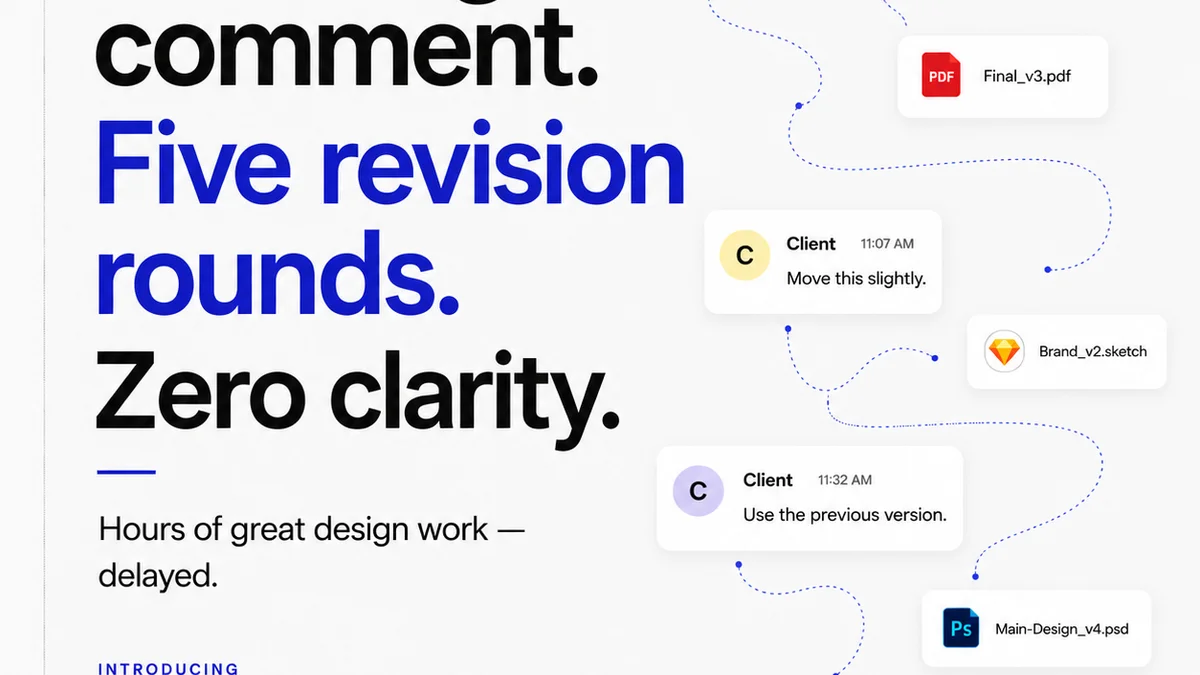
- Endless rounds of revisions that don’t seem to lead anywhere.
- Conflicting feedback from different stakeholders.
- Lost feedback buried in email chains or Slack messages.
- Designers and copywriters guessing what the client *really* wants.
- Frustration on both the client and agency side.
- Projects dragging on far longer than they should.
- “Scope creep” disguised as “minor tweaks.”
This isn't just annoying; it’s a direct hit to your bottom line and your team’s sanity.
Building a Better Feedback System
Stop accepting chaotic feedback as inevitable. Implement systems:
- Centralize everything: All feedback, comments, and approvals should live in one place. No more hunting through emails.
- Define roles: Who is the ultimate decision-maker? Who provides input? Clarify this upfront.
- Set clear revision limits: Agree on the number of revision rounds *before* work begins.
- Structure feedback: Encourage clients to provide specific, actionable comments, not just vague opinions. Use a framework if needed.
- Visualize changes: Use tools that allow for visual annotations directly on the creative.
A streamlined feedback process doesn’t just save time; it leads to more aligned, higher-quality creative work.
3. Revision Management: Where Projects Go to Die (or Thrive)
Revisions aren't the enemy. Unmanaged, unclear, and endless revisions are the enemy.
This is where creative teams bleed hours and clients lose faith. It's a direct KPI killer.
The Revision Abyss
Think about the typical revision cycle:
- Client sends vague notes.
- Team makes changes, often guessing.
- Client receives new version, has more notes.
- Repeat.
This cycle is inefficient, demotivating, and expensive. It’s a black hole for billable hours.
Strategies for Controlled Revisions
Take control:
- Track every version: Maintain a clear history of all iterations.
- Formalize approvals: Ensure each set of revisions is formally approved before moving to the next stage.
- Link feedback to changes: Make it explicit which feedback points correspond to which changes.
- Use status tracking: Clearly indicate the current stage of the project and the status of each deliverable.
- Automate notifications: Keep everyone informed about progress and pending actions.
Effective revision management ensures clarity, accountability, and timely progress.
4. Quality Assurance: The Unsung Hero of Creative KPIs
We talk a lot about getting work *done*. We talk less about getting it *right*.
Quality assurance (QA) isn't a final-stage checkbox; it’s a critical part of the workflow that directly impacts client satisfaction and brand reputation.
The Cost of Cutting Corners on QA
Skipping or rushing QA leads to:
- Typos and grammatical errors in copy.
- Visual inconsistencies across assets.
- Broken links or incorrect formatting in digital deliverables.
- Brand guideline violations.
- Technical issues (e.g., incorrect file types, wrong dimensions).
These aren't just minor oversights. They erode trust, require urgent (and often unbillable) fixes, and can damage the client's brand.
Integrating Robust QA
Build QA into your process, not as an afterthought:
- Develop checklists: Create specific QA checklists tailored to different project types (e.g., web design, social campaigns, print collateral).
- Assign responsibility: Designate someone (or a small team) to own QA, or rotate responsibility.
- Use templates: Standardize project setup and delivery formats to minimize errors.
- Test across devices/browsers: For digital work, ensure thorough testing on relevant platforms.
- Collaborative review: Have at least two people review critical assets before final delivery.
Proactive QA prevents costly mistakes and ensures your team consistently delivers polished, professional work.
Where Revue Fits In
Improving creative team KPIs isn’t about magic formulas. It’s about implementing disciplined workflows. This is precisely why tools like Revue exist.
Revue provides a centralized hub for managing the entire creative lifecycle. Imagine:
- Centralized Client Feedback: All comments, annotations, and discussions happen directly on the creative asset, within a single project space. No more digging through email chains. Clients can see exactly what needs to be addressed.
- Clear Revision & Approval Tracking: Every version is stored, every decision is logged. You have a clear audit trail, making it easy to manage revisions, see who approved what, and prevent scope creep.
- Streamlined Quality Checks: By having a single source of truth for feedback and approvals, the QA process becomes more efficient and less prone to human error. Your team can focus on the final polish, knowing the core feedback has been managed effectively.
By bringing structure to feedback and approvals, Revue helps transform potential bottlenecks into streamlined pathways, directly boosting your team’s efficiency and effectiveness.
Final Thought
Are you measuring the right things? Are you building a system that supports high performance, or just demanding it?
The most successful creative teams don't just produce great work; they have great *processes*. Focusing on the operational mechanics—feedback, revisions, quality—is how you unlock sustainable KPI improvement. It’s the hard truth, but it’s the path to real results.
Frequently asked questions
What are the most important creative team KPIs to track?
Beyond basic output metrics like project completion speed, focus on KPIs that reflect impact and efficiency. These include client satisfaction scores, revision cycle time, number of revisions per project, project profitability, and team utilization rates. Ultimately, measure what aligns with your agency's strategic goals.
How can I reduce the number of client revisions?
Reduce revisions by setting clear expectations upfront regarding scope and the number of revision rounds. Ensure all feedback is consolidated, specific, and actionable. Utilize tools that allow for visual annotations and clear approval tracking. Educate clients on providing constructive feedback.
What's the difference between output and outcome metrics for creative teams?
Output metrics measure the quantity or speed of work produced (e.g., number of designs, tasks completed). Outcome metrics measure the impact or success of that work against goals (e.g., campaign effectiveness, client objective achievement, conversion rates). Focusing on outcomes provides a truer picture of performance.
How does centralized feedback improve KPIs?
Centralized feedback eliminates confusion, reduces the risk of lost comments, and ensures all stakeholders are referencing the same information. This streamlines the revision process, minimizes back-and-forth, and leads to faster approvals and higher-quality deliverables, all positively impacting KPIs.