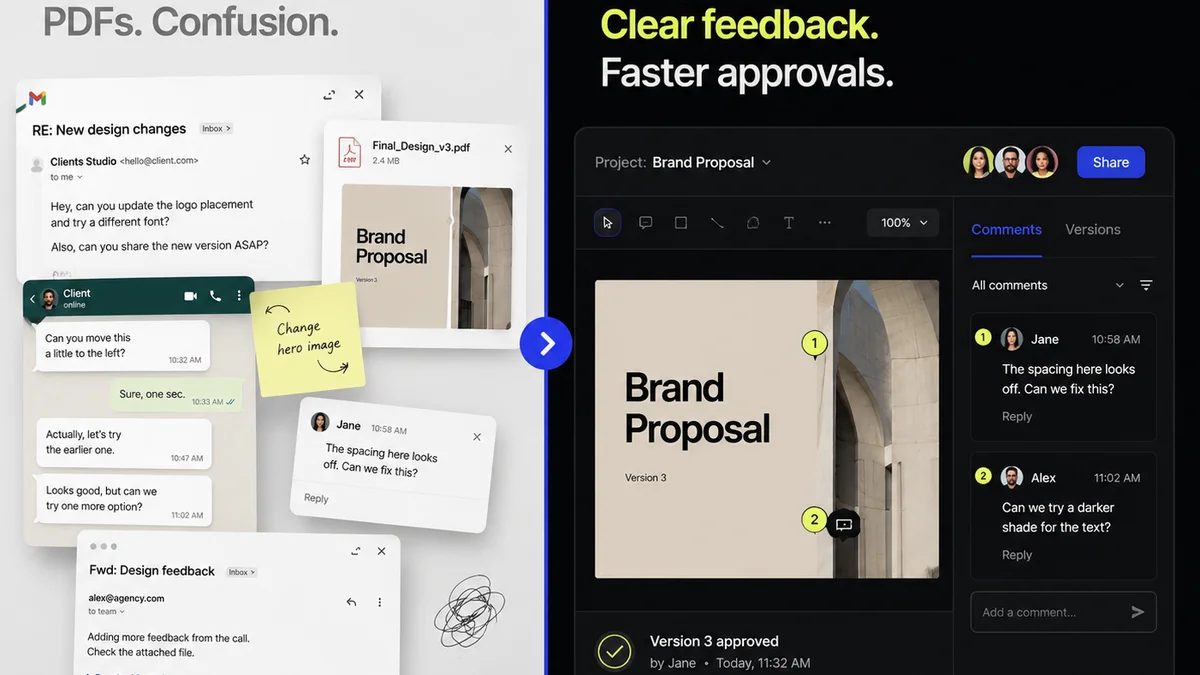
Everyone agrees that clear design change requests are crucial. Clients need to articulate their needs, and designers need to understand them to deliver great work. That’s the common wisdom.
None of that is wrong. But it’s incomplete.
The hard truth is that most teams treat design change requests as a communication problem between two parties. They focus on better wording, more detailed briefs, or clearer annotation. While important, this misses the systemic issues that *cause* bad requests in the first place.
Improving design change requests isn’t just about asking better questions. It’s about building a process that inherently guides people toward clarity and reduces ambiguity before it even becomes a problem. It’s about operationalizing feedback.
1. The Illusion of Clarity: Why Briefs Fail
You’ve seen it a million times. A client signs off on a brief, agrees to the scope, and then the feedback starts rolling in. “I don’t like it.” “Make it pop more.” “It feels… off.”
This isn’t malicious. It’s often a symptom of a fundamental disconnect:
- The brief is a snapshot, not a living document. By the time the design is presented, the client’s understanding or needs may have subtly shifted.
- Subjectivity is inherent. Design is an art *and* a science. Terms like “pop” or “off” are subjective until they are defined within a specific context.
- Lack of shared context. The client might have seen a competitor’s ad or a social media post that sparked an idea, but this context never makes it back into the feedback loop.
The brief is a starting point, but it’s rarely the end of the conversation. Relying on it solely for clarity is setting yourself up for disappointment.
2. The Feedback Friction: When Good Intentions Go Bad
Even with the best intentions, feedback can become a bottleneck. Think about how feedback is typically gathered:
- Scattered emails
- Slack messages
- Random Word documents
- Verbal conversations that are never documented
Each of these methods creates friction. For designers, it means hunting for feedback across multiple platforms. For clients, it means trying to remember where they left that comment or if they already sent it.
This friction leads to:
- Missed feedback. Crucial comments get lost in the noise.
- Conflicting feedback. Different stakeholders provide contradictory direction without realizing it.
- Delayed feedback. The longer it takes to gather and consolidate, the more outdated the input becomes.
This isn’t just annoying; it directly impacts the quality and speed of design iteration. You can’t improve design change requests if you can’t even reliably collect them.
3. The Scope Creep Avalanche: Uncontrolled Revisions
Vague feedback is a breeding ground for scope creep. When a request is unclear, designers often make educated guesses. Sometimes these guesses are wrong.
The client then provides more feedback, which might still be unclear, leading to more guesswork. This cycle continues, and suddenly you’re working on a revision that was never part of the original agreement.
The real problem isn’t the client asking for changes; it’s the lack of a system to:
- Track what was agreed upon.
- Identify when feedback deviates from the agreed scope.
- Flag potential scope creep early.
Without this, every change request becomes a potential negotiation, draining resources and goodwill.
4. The Approval Black Hole: When Sign-off Isn’t Really Sign-off
A client’s “approved” can mean many things. Sometimes it’s genuine satisfaction. Other times, it’s fatigue. They just want the project to be over.
This is especially dangerous when the approval happens without a clear, documented record of what was approved and why.
This leads to:
- “We never agreed to that.” A common refrain when a later issue arises.
- Undocumented assumptions. The client *thought* something was implied, but it was never explicitly stated or agreed upon.
- Missed quality checks. The final output doesn’t meet the original (or evolved) requirements because the approval process was superficial.
True approval requires a clear trail, a definitive moment where all parties agree on the deliverable based on specific criteria.
Where Revue Fits In
Improving design change requests isn’t about magic words or perfect clients. It’s about building a robust workflow that anticipates problems and provides clarity at every stage.
Revue is built for this. It centralizes client feedback, making it impossible for comments to get lost in email threads or Slack channels. Every piece of feedback is logged against the specific version of the creative asset it refers to.
This provides:
- A single source of truth. All comments, discussions, and revisions live in one place.
- Contextual feedback. Designers see feedback directly on the design, eliminating guesswork.
- Clear revision history. Track every iteration, understanding what changed and why.
- Streamlined approvals. Clients can review and approve with confidence, knowing exactly what they are signing off on.
By providing this structured environment, Revue helps transform vague, problematic change requests into clear, actionable feedback, reducing friction and preventing scope creep.
5. The Operational Fix: Building a Better Feedback Loop
So, how do you actually implement these improvements? It’s about process, not just tools.
Establish Clear Feedback Stages
Define what constitutes feedback at each stage of the design process. Early stages might be conceptual; later stages should be about execution and adherence to brief.
Define
Frequently asked questions
What's the biggest mistake teams make with design change requests?
The biggest mistake is treating design change requests as purely a communication issue. While clear communication is vital, the real problem often lies in the underlying workflow. Teams fail to implement systems that proactively guide clients toward clarity, track feedback effectively, and manage scope, leading to vague requests and endless revisions.
How can I get clients to provide more specific feedback?
Encourage specificity by providing structured feedback channels. Instead of open-ended questions, ask clients to comment on specific elements, define what 'success' looks like for a particular revision, or use visual annotation tools. Clearly define what feedback is expected at each stage of the design process, moving from broad concepts to granular details as the project progresses.
How do I prevent scope creep from vague change requests?
Implement a clear process for tracking agreed-upon scope and revisions. Use a centralized platform where all feedback is logged against specific design versions. When a request seems to expand beyond the original scope, flag it immediately for discussion and potential scope adjustment. Documenting every change and its impact on timelines and budget is crucial.
What is the role of a design brief in managing change requests?
A design brief is a critical starting point, but it's not a static document that eliminates the need for further clarification. It sets initial expectations and goals. However, as the design process evolves, so too can client needs. The brief should be a reference, but a robust feedback and revision process is necessary to capture evolving requirements and ensure alignment throughout the project.