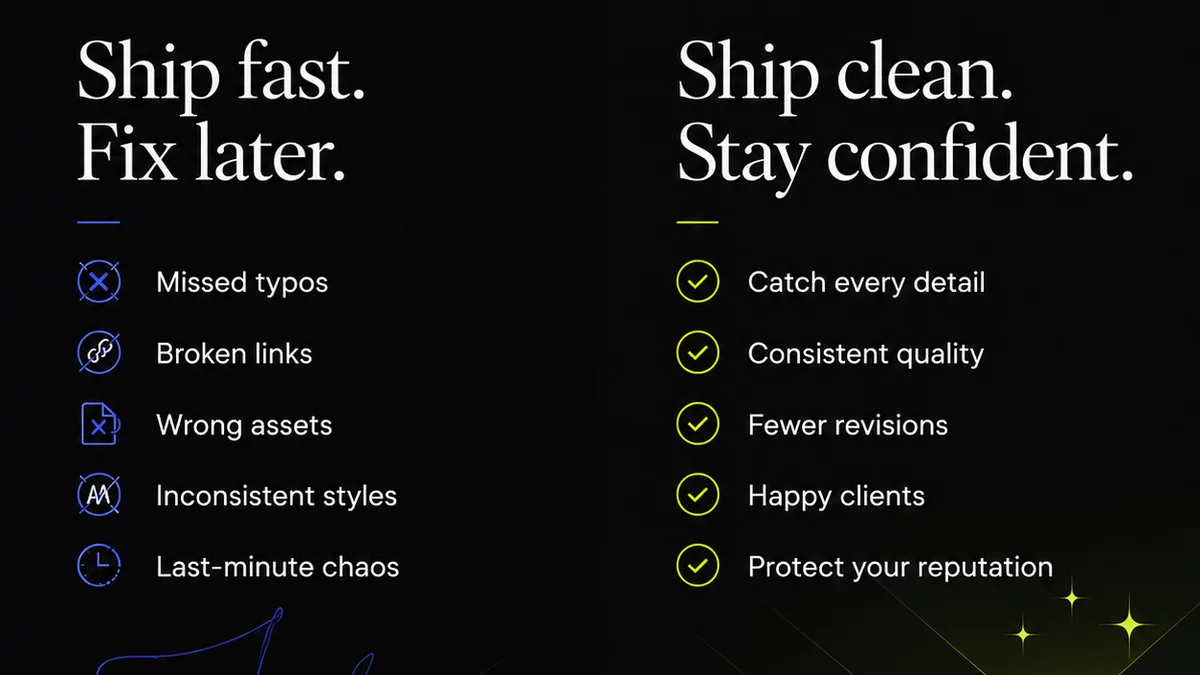
Everyone talks about design QA checklists. You know the drill: check for typos, correct logos, brand guidelines adherence. It’s all true. It’s all necessary.
But it’s not the whole story. Not even close.
Most marketing teams think improving design QA is about finding more errors before launch. The real truth? It’s about preventing errors from happening in the first place, and making sure everyone involved understands what 'done' actually looks like. It’s a workflow problem, not just a final-check problem.
1. The Illusion of 'Final' Feedback
You get the feedback. You make the changes. You send it back. Simple, right? Wrong.
What if the client’s ‘final’ feedback wasn’t actually final? What if a stakeholder who missed the initial review chimes in with a major change *after* you thought you were done?
This is where most design QA processes break down. They assume a linear, one-and-done feedback loop. Reality is messy.
The Symptoms of a Broken Feedback Loop
- Endless revision cycles that feel like they’ll never end.
- Last-minute, high-impact changes requested days before launch.
- Team members working on outdated versions of creative assets.
- Frustration and missed deadlines.
- A QA process that feels like a blame game.
The core issue isn't the QA checklist; it’s the lack of a single source of truth for feedback and approvals. Without it, QA becomes an impossible task of catching changes that are constantly being made, often in silos.
2. Defining 'Done' - Clearly and Collectively
What does 'done' mean? For a designer, it might mean pixel-perfect alignment and adherence to brand guidelines. For a marketer, it might mean the call-to-action is prominent and the message is clear. For legal, it might mean all disclaimers are present and legible.
These definitions often don't align. And when they don't, QA becomes subjective and contentious.
The Problem of Unspoken Expectations
If you’re not explicitly defining what success looks like for each stakeholder *before* the design work begins, you’re setting yourself up for QA nightmares.
This means more than just a brief. It means:
- Clear objectives for the creative piece.
- Defined success metrics.
- Identified stakeholders and their specific input needs.
- Agreed-upon review stages and approval gates.
When these aren't crystal clear, QA teams are left guessing. They’re trying to apply a generic checklist to a project with undefined success criteria.
3. The Bottleneck of Manual Review
Your design QA process is likely manual. Someone, somewhere, is clicking through every single element, comparing it against a document or a previous version. This is slow. It’s error-prone.
And it’s fundamentally flawed because it’s trying to catch errors *after* they’ve already been introduced into the workflow.
Why Manual QA Falls Short
Think about the sheer volume of creative assets a marketing team produces: social posts, banners, landing pages, emails, videos, presentations. Each needs eyes on it.
A manual QA process:
- Takes valuable creative and production time away from actual work.
- Is prone to human error – fatigue, missed details, subjective judgment.
- Cannot scale with the demands of modern marketing.
- Creates a bottleneck that delays campaign launches.
This isn't about blaming individuals. It's about recognizing that a manual, reactive QA process is an unsustainable operational model.
4. Integrating QA into the Workflow, Not Just the End
The biggest shift you can make in design QA is moving it from a final gate to an integrated part of the entire creative process. Quality isn’t checked *at the end*; it’s built in from the start.
Shifting from Reactive to Proactive Quality
This means:
Clear Briefing: Ensure every project starts with a comprehensive brief that outlines objectives, target audience, key messages, and mandatory elements. This sets the quality bar high from day one.
Iterative Reviews: Build in multiple, structured review points throughout the design process. These aren't just for feedback; they're for validating progress against the brief and identifying potential issues early.
Centralized Feedback: All feedback, comments, and approvals should live in one place. This prevents conflicting instructions and ensures everyone is working from the same, most up-to-date information.
Defined Approval Flows: Map out exactly who needs to approve what, and when. This streamlines the process and removes ambiguity about who has the final say.
When QA is woven into these stages, you're not just checking for mistakes; you're ensuring the project stays on track and aligned with its goals.
Where Revue Fits In
This is precisely why Revue was built. We know that the chaos of feedback and approvals is a primary driver of poor design QA and project delays.
Revue provides a single source of truth for all your creative projects. Instead of scattered emails, endless Slack threads, and confusing version control, you have:
- Centralized Client Feedback: All comments and annotations are collected directly on the creative asset, within the project context. No more hunting for that one crucial email.
- Clear Revision and Approval Tracking: See exactly who requested what, who approved it, and when. Every step is logged, creating an irrefutable audit trail. This eliminates the
Frequently asked questions
What is design QA?
Design QA (Quality Assurance) is the process of reviewing creative assets to ensure they meet specified requirements, brand standards, and project objectives before they are finalized or launched. It aims to catch errors, inconsistencies, and compliance issues.
Why is design QA often a problem for marketing teams?
Marketing teams often face challenges with design QA due to fragmented feedback, unclear approval processes, last-minute changes, multiple stakeholders with conflicting input, and a lack of a single source of truth for project status and feedback.
How can I make my design QA process more efficient?
Efficiency comes from integrating QA throughout the workflow, not just at the end. This involves clear briefs, iterative reviews, centralized feedback, and defined approval flows. Using a dedicated platform can automate many of these steps.
What are the key elements of a good design QA checklist?
A good QA checklist should include checks for brand consistency (logos, colors, fonts), accuracy (typos, data), technical specifications (file formats, dimensions), user experience (usability, CTAs), and legal/compliance requirements. However, a checklist alone is insufficient without a solid workflow.
How does centralized feedback improve design QA?
Centralized feedback ensures all comments are in one place, linked to the specific asset and version. This prevents miscommunication, conflicting instructions, and the need to chase down feedback from multiple channels, making it easier to manage revisions and conduct thorough QA.