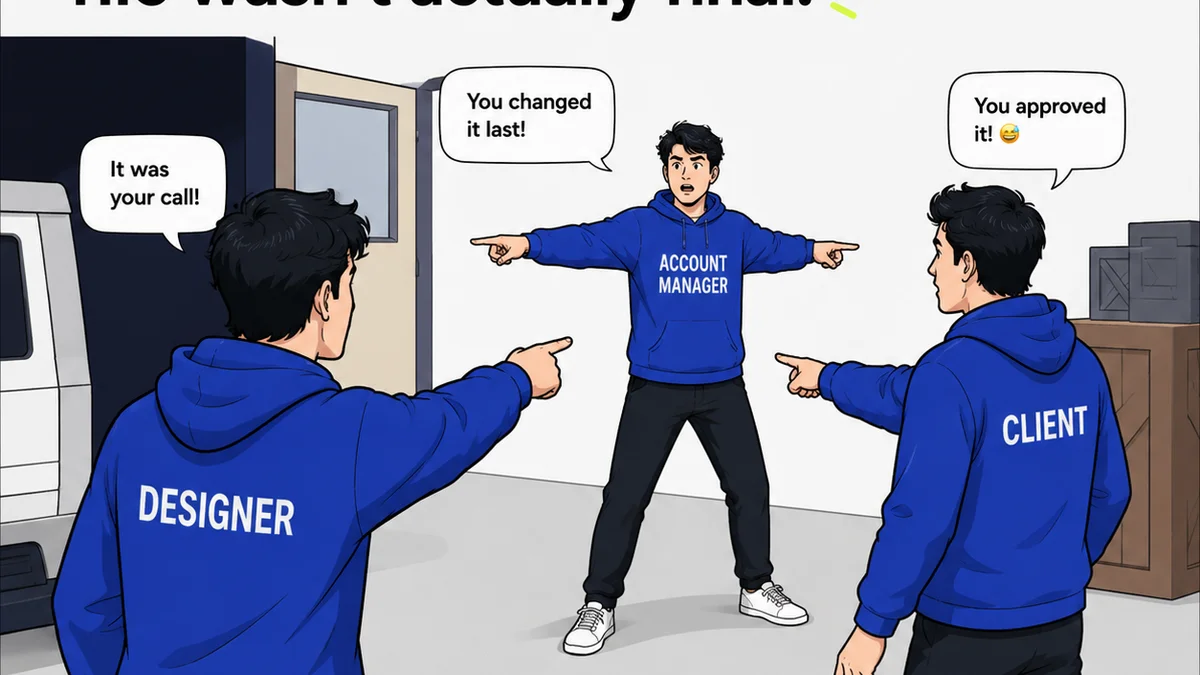
Everyone assumes a smoother design sign-off process is about better communication. More emails, more meetings, more calls. You’ve probably tried it all.
None of that is wrong. But it’s incomplete.
The hard truth? A truly efficient design sign-off process isn’t about *more* communication. It’s about *smarter* communication. It's about centralizing feedback, creating clear revision cycles, and removing ambiguity. It’s about operational excellence, not just creative collaboration.
1. The Myth of 'Just Send It Over'
The most common bottleneck in design approvals isn't the creative work itself. It’s the chaotic handover of feedback. Clients send notes in emails, Slack messages, Word docs, even sticky notes. Your team then has to collate, interpret, and reconcile these disparate inputs.
This fragmented approach leads to:
- Lost feedback in crowded inboxes.
- Misinterpretation of client intent.
- Endless back-and-forth clarifying simple points.
- Wasted hours spent on administrative tasks instead of design.
- Frustrated clients who feel unheard.
The assumption is that everyone knows their role and how to provide feedback effectively. The reality is often far messier.
2. Establish a Single Source of Truth
Your design sign-off process needs a central hub. A place where all feedback lives, all versions are stored, and all communication about a specific asset is logged. This eliminates the 'Where did you send that note?' problem.
Version Control is Non-Negotiable
How many times has a client approved a version only to realize later it wasn't the *latest* version? This happens when version control is manual or nonexistent. Every iteration of a design needs a clear identifier and a history.
Think of it like code. You wouldn’t push code without version control. Design assets deserve the same rigor.
Structured Feedback Channels
Instead of ad-hoc messages, implement structured feedback mechanisms. This could be:
- Annotating directly on the design mockups.
- Using a dedicated feedback tool.
- Filling out a standardized feedback form.
The goal is context. Feedback should be tied directly to the element it refers to. This drastically reduces the need for clarification meetings.
3. Define Clear Revision Cycles
Ambiguity kills efficiency. Clients need to understand how many rounds of revisions are included and what the process entails. Your team needs clarity on what constitutes a 'revision' versus a 'new request'.
The 'Revision' vs. 'New Request' Divide
A revision is a tweak to address feedback on the existing brief. A new request is a significant change that alters the scope, direction, or adds substantial new elements. This distinction is crucial for scope management and billing.
Many sign-off issues stem from blurring this line. Clients may expect major overhauls under the guise of a 'revision'.
Setting Expectations Upfront
At the project kickoff, clearly outline:
- The number of included revision rounds.
- The turnaround time for feedback and revisions.
- The process for handling out-of-scope requests.
- Who the primary point of contact is for feedback.
This upfront clarity prevents scope creep and manages client expectations from day one.
4. Implement Formal Sign-Off Gates
Don't let designs drift into production without explicit approval. Formal sign-off gates act as crucial checkpoints.
The 'Final Approval' Trap
Too often, 'final approval' is a handshake or a casual 'looks good'. This leaves room for doubt and later disputes. A formal sign-off should be a deliberate, documented action.
This could be:
- A digital sign-off within a project management tool.
- A signed PDF document.
- An email confirmation with specific wording.
The key is that it’s unambiguous and recorded.
Pre-Production Checks
Before a design moves to development or print, ensure a quality assurance (QA) step is in place. This isn't just about catching typos; it's about confirming the approved design is the one being implemented. Does the final asset match the approved specifications?
5. Leverage Technology Wisely
The right tools can transform a clunky sign-off process into a streamlined operation. Relying solely on email and spreadsheets is a recipe for disaster.
Centralized Feedback Platforms
Tools designed for creative workflows allow clients to comment directly on designs, track changes, and see the history of feedback. This keeps everything in one place.
Think about how much time is wasted searching through email threads for that one crucial piece of feedback. A dedicated platform solves this.
Project Management Integration
Your feedback and approval tool should ideally integrate with your project management system. This allows for seamless transition from approval to the next stage of the project, automatically updating task statuses and timelines.
Automated Notifications
Automated reminders for pending approvals or overdue feedback can keep the process moving without manual chasing. This ensures momentum is maintained.
Where Revue Fits In
Revue is built to tackle these exact operational challenges in creative workflows. It’s not just another inbox. It’s a system designed to centralize client feedback, manage revisions with clarity, and ensure quality checks happen systematically.
With Revue, you can:
- Centralize All Feedback: No more hunting through emails or Slack. All client comments and stakeholder input are logged against specific creative assets in one accessible location.
- Manage Revisions Visibly: Track every iteration. Clients and internal teams can see the evolution of a design, understand what changes were made based on feedback, and approve specific versions. This eliminates confusion about which version is 'final'.
- Run Quality Checks: Before a design goes live or to print, ensure it meets all requirements. Revue helps maintain a clear audit trail, confirming that the approved design is the one being implemented, reducing costly errors.
- Streamline Approvals: Formalize the sign-off process. Create clear stages for review and approval, ensuring all stakeholders have provided their explicit consent before moving forward.
By bringing structure and visibility to the feedback and approval loop, Revue helps creative teams deliver work faster and with less friction.
Final Thought
Is your design sign-off process a well-oiled machine, or a constant source of friction? The difference often lies not in more talking, but in more structure. Are you ready to move beyond the assumptions and build a process that truly works?
Frequently asked questions
What is the biggest mistake agencies make in their design sign-off process?
The biggest mistake is assuming more communication equals better results. Agencies often rely on scattered channels like email and chat, leading to lost feedback, misinterpretations, and endless clarification loops. A centralized, structured approach is far more effective.
How can I prevent scope creep during the design revision phase?
Clearly define what constitutes a 'revision' versus a 'new request' from the outset. Outline the number of included revision rounds and the process for handling out-of-scope changes in your project proposal and kickoff meeting. Use a system that tracks feedback and approvals to maintain this clarity.
What are the benefits of using a dedicated tool for design approvals?
Dedicated tools centralize all feedback, provide version control, allow for direct annotations on designs, and create a clear audit trail of approvals. This eliminates confusion, reduces administrative overhead, speeds up the approval cycle, and minimizes errors.
How do I ensure the final approved design is what gets implemented?
Implement formal sign-off gates and pre-production quality checks. This means getting explicit, documented approval for the final version and having a QA step to verify that the implemented asset matches the approved specifications before launch or production.