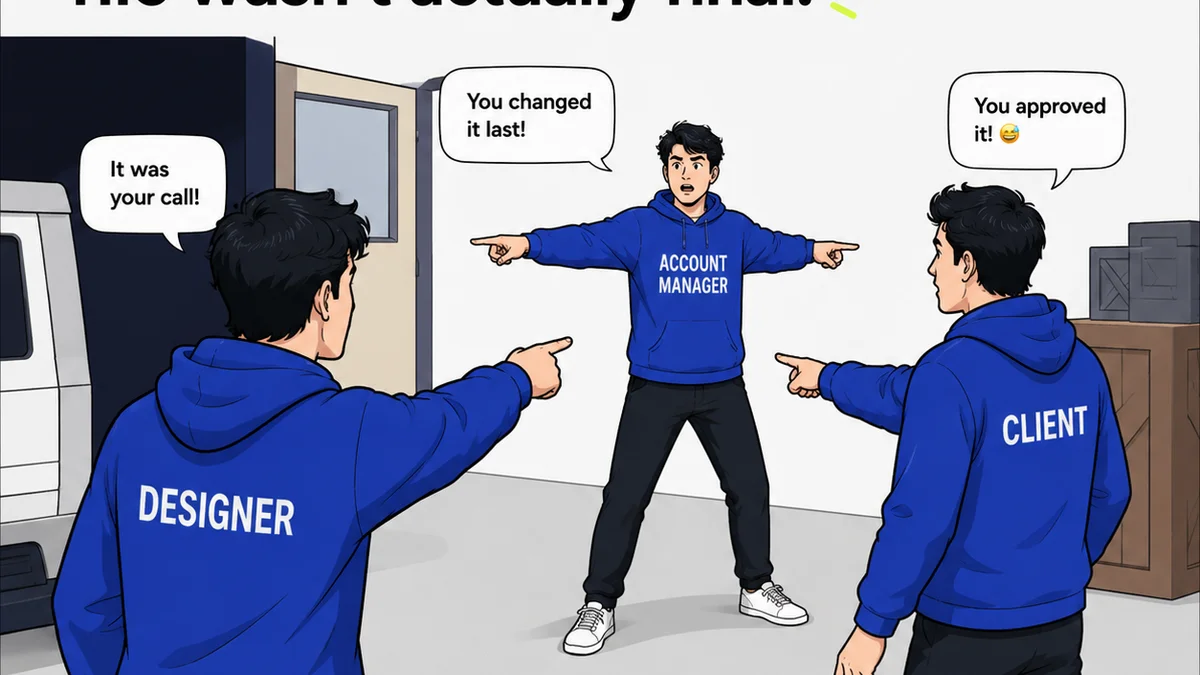
Everyone thinks packaging quality assurance is about ticking boxes. You’ve got your spec sheets, your color targets, your die lines. You check the print proofs against the brief. None of that is wrong. But it’s incomplete.
The hard truth? Flawless packaging QA isn’t a task. It’s a system. It’s about preventing errors, not just finding them. It’s about making sure the millions of tiny details that make up a great package are handled with the same rigor as the big creative idea.
1. The Illusion of the Final Proof
The final print proof. It’s supposed to be the last line of defense. But by the time it lands on your desk, the damage is often done. A typo, a misaligned graphic, the wrong barcode. These aren't just printing mistakes; they're workflow failures.
What does a failed proof really mean?
- A missed deadline.
- A costly reprint.
- A damaged client relationship.
- Wasted creative energy.
Relying solely on a last-minute proof is like a surgeon relying only on a post-op X-ray. It’s too late to fix the problem without major intervention.
2. Deconstructing the Packaging Workflow
Effective packaging QA starts long before the final proof. It starts at the very first touchpoint. Every step in the process is an opportunity for error, and an opportunity for prevention.
The Briefing Stage
This is where many issues begin. Ambiguity in the initial brief leads to assumptions, which lead to mistakes. Clear, concise, and documented requirements are non-negotiable.
- Accurate dimensions and dieline specs.
- Precise color profiles (CMYK, Pantone, etc.).
- Specific material requirements.
- Mandatory legal and regulatory copy.
- Barcode specifications.
If it’s not documented and confirmed, it’s a risk.
Design & Pre-press Handoff
This is a critical juncture. Design files need to be prepared meticulously for print. Missing bleed, incorrect color modes, or rasterized fonts are common pitfalls.
Pre-press teams need:
- Layered, editable artwork.
- Correctly formatted dielines, separate from artwork.
- Embedded fonts or outlines.
- High-resolution images, properly color-managed.
A lack of clear communication here guarantees problems down the line. Don't assume your designer knows the printer's specific requirements. Confirm them.
Printer Communication
Your printer is your partner. Treat them that way. Share your specs, your dielines, and your expectations upfront. Ask them about their preferred file formats and pre-flight checks.
Regular check-ins can prevent misunderstandings about:
- Ink coverage limits.
- Trapping.
- Screen rulings.
- Finishing techniques (foiling, embossing).
This isn't about micromanaging; it's about collaboration to ensure a perfect final product.
3. The Human Element: Training and Accountability
Technology and processes are essential, but they’re only as good as the people using them. Packaging QA requires skilled eyes and clear responsibility.
Specialized Training
Not everyone on your team has the sharp eye needed for packaging details. Consider specialized training for your QA personnel. This includes understanding:
- Color theory and reproduction.
- Print production techniques.
- Common material defects.
- Regulatory requirements for different markets.
A generalist can’t catch what a specialist can.
Defined Roles and Responsibilities
Who is ultimately responsible for catching that typo? Who signs off on the final artwork before it goes to print? Without clear ownership, tasks fall through the cracks.
Define roles for:
- Initial artwork review.
- Pre-press file preparation.
- Proofreading and copy verification.
- Color accuracy checks.
- Final print approval.
Accountability prevents complacency. Everyone needs to know their part in the QA process.
4. Leveraging Technology for Smarter QA
Manual checks are error-prone and time-consuming. Smart agencies use technology to augment their QA process, automating repetitive tasks and highlighting potential issues.
Automated Pre-flighting
Software can automatically check files for common errors like missing bleeds, low-resolution images, or incorrect color modes. This catches many basic issues before they reach human reviewers.
Tools like Adobe Acrobat Pro's Preflight feature or dedicated pre-press software can save hours and prevent basic mistakes.
Color Management Systems
Ensuring color consistency across different print runs and substrates is a major challenge. Robust color management systems, linked with your printers, can help maintain brand color integrity.
Version Control and Audit Trails
Mistakes happen. Knowing exactly *when* a mistake was introduced and *who* made it is crucial for process improvement. This requires proper version control and detailed audit trails for all artwork and feedback.
Centralized Feedback Platforms
This is where many agencies struggle. Email chains, Slack messages, and random documents create a chaotic feedback loop. This makes tracking revisions, ensuring all feedback is addressed, and maintaining a clear record nearly impossible.
Where Revue Fits In
Managing client feedback and revisions for packaging projects can be a nightmare of scattered communication. Emails get lost, Slack messages are missed, and crucial details about color profiles or dieline changes vanish into the ether.
Revue provides a centralized hub for all your creative project feedback. Instead of digging through endless email threads, you have a clear, organized record of every comment, every revision, and every approval.
- Centralized Feedback: All stakeholder comments live in one place, linked directly to the artwork or proof. No more hunting for that one crucial email.
- Revision Management: Track every iteration of the packaging artwork. See exactly what changed and when, ensuring no feedback is overlooked.
- Clear Approval Workflows: Define who needs to approve what, and when. Get explicit sign-offs, reducing ambiguity and the risk of unauthorized changes.
- Audit Trail: Maintain a complete history of communication and approvals. This is invaluable for resolving disputes and for post-project analysis to improve future QA processes.
By streamlining communication and providing a single source of truth, Revue helps your team catch errors earlier, reduce misunderstandings, and ensure the final packaging meets all requirements – not just creatively, but operationally.
5. The Ultimate QA: Pre-Production Runs
Before committing to a massive print run, consider a small pre-production run. This is your final, real-world test.
What to check:
- Physical fit and form.
- Print quality under actual production conditions.
- Color accuracy on the final material.
- Durability and handling.
- Functionality (e.g., ease of opening, sealing).
This small investment can save you from a catastrophic, large-scale error. It’s the ultimate sanity check.
Final Thought
Packaging QA is more than just a final check. It’s about building a robust, integrated system that prevents errors at every stage. Are you treating QA as a reactive task or a proactive strategy? The difference is millions of dollars, and your brand’s reputation.
Frequently asked questions
What are the most common packaging QA mistakes?
Common mistakes include typos, incorrect color profiles (e.g., RGB instead of CMYK), misaligned dielines, low-resolution images, missing bleed, wrong barcode versions, and failure to meet regulatory copy requirements. Many of these stem from unclear briefs or poor communication during the design and pre-press stages.
How can I prevent errors before the final print proof?
Prevention starts with a clear, detailed brief. Implement automated pre-flight checks for artwork, ensure rigorous internal reviews at each stage (design, pre-press), maintain open communication with your printer, and use a centralized feedback platform to track all changes and approvals meticulously.
What is the role of the printer in packaging QA?
The printer is a crucial partner. They have expertise in production constraints and capabilities. Clear communication about your design intent, color specifications, and dielines is essential. They can also perform their own pre-flight checks and advise on potential production issues.
Is a pre-production run necessary for packaging?
Yes, a pre-production run is highly recommended, especially for complex or high-volume projects. It allows you to test the final product under real-world conditions, verifying print quality, color accuracy on the actual material, physical integrity, and functionality before committing to a large, costly print run.