Everyone thinks marketing asset revisions are about getting a final sign-off. That the goal is simply to get the client to say 'yes'.
None of that is wrong. But it’s incomplete.
The hard truth? The real value of managing marketing asset revisions lies not in the final approval, but in the *process* that gets you there. It’s about ironing out kinks, ensuring clarity, and building a smoother path for future creative work. Without a solid marketing asset revisions checklist and a system to back it up, you're just delaying the inevitable problems.
1. The Illusion of 'Final' Feedback
The biggest assumption agencies and creative teams make is that feedback is linear and objective. That a client gives notes, you implement them, and that’s that.
This rarely happens. Feedback is often:
- Vague
- Contradictory
- Delayed
- Sent through the wrong channels
- From the wrong stakeholders
Each of these issues adds friction. Friction costs time, money, and creative energy. It turns a simple revision into a multi-week ordeal.
Your marketing asset revisions checklist needs to account for this chaos from the start.
The Stakeholder Shuffle
Who is actually giving the feedback? Is it the person who signs the checks, or the intern who likes a certain color? Ensure your process clarifies decision-makers early.
The 'Minor' Tweak That Isn't
A client might call a change 'minor.' But if it requires a full re-render, a new animation, or a complete layout shift, it's not minor. It's a scope change.
Your checklist should prompt questions about the *impact* of requested changes, not just the changes themselves.
2. Defining 'Done' for Marketing Assets
What does 'done' actually mean for your marketing asset? Is it just approved by the client? Or does it meet specific strategic, technical, and brand guidelines?
A robust marketing asset revisions checklist goes beyond client approval. It ensures the asset is:
- On-brand
- Technically sound (correct specs, file formats, resolution)
- Strategically aligned (meets the brief's objectives)
- Legally compliant (if applicable)
- Accessible (meeting WCAG standards where relevant)
Without these checks, you might get a 'yes' on an asset that fails spectacularly in the wild. That's not a win.
Brand Consistency is Non-Negotiable
Is the logo the right version? Are the brand colors within tolerance? Is the tone of voice consistent? These are fundamental checks that often get overlooked in the rush to get a sign-off.
Technical Readiness
Sending a 300MB PSD file for a social media ad is a common, costly mistake. Your checklist needs to include technical requirements specific to the final output channel.
Strategic Alignment Check
Does the asset still serve the original campaign goal? Has a 'minor' tweak shifted the core message? This requires a brief reminder and a quick check against the original brief.
3. The Hidden Costs of Inefficient Revisions
Think about the last time a project went sideways with feedback. What was the real cost?
It's rarely just the hours spent on the revisions themselves.
Consider:
- Designer burnout from endless, unclear feedback loops.
- Missed deadlines impacting campaign launches and revenue.
- Client frustration leading to strained relationships.
- Wasted resources on assets that never see the light of day.
- The opportunity cost of your team not working on *new* business or proactive projects.
An effective marketing asset revisions checklist isn't just a document; it's a tool to mitigate these significant costs.
The 'Scope Creep' Trap
Unmanaged revisions are the primary driver of scope creep. Each 'small' change, unquantified and unchecked, adds up. A checklist forces you to pause and assess if a requested change is truly a revision or a new request.
Reputational Damage
Consistently missing deadlines or delivering subpar final assets erodes client trust. This can lead to lost business and negative word-of-mouth.
4. Building Your Marketing Asset Revisions Checklist
Your checklist shouldn't be a one-size-fits-all document. It needs to be adaptable to different project types and client needs. However, core elements remain crucial.
Key Checklist Components:
- Project Brief Recap: A quick summary of the objective and target audience.
- Stakeholder Confirmation: Who provided the brief? Who has final approval?
- Feedback Round Tracker: Log each round, date, and who provided feedback.
- Actionable Feedback Summary: A clear, concise list of changes to be made, derived from client notes.
- Scope Change Flag: A mechanism to identify and flag changes that exceed the original scope.
- Revision Implementation Confirmation: A sign-off from the creative team that changes have been made.
- Quality Assurance (QA) Checks: Pre-defined checks for brand, technical, and strategic compliance.
- Final Approval: A clear sign-off from the authorized stakeholder.
- Asset Delivery Specifications: Confirming the final asset meets all technical requirements for its intended use.
This isn't about adding bureaucracy. It's about building clarity and accountability into your workflow.
Pre-computation vs. Post-computation
Many teams wait until the end to check everything. The best checklists integrate checks *throughout* the process. For example, check brand guidelines *before* you start designing, not after the client approves.
5. Where Revue Fits In
Managing marketing asset revisions effectively requires more than just a checklist. It demands a centralized system for communication and tracking.
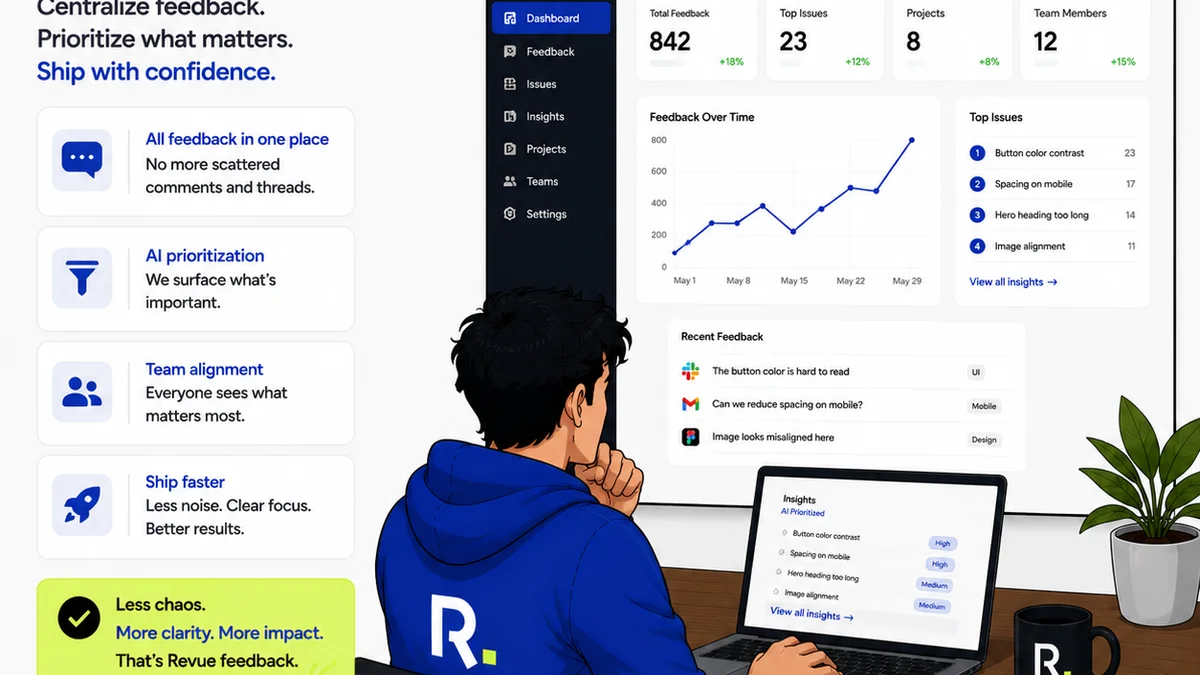
This is where Revue excels. Instead of scattered email threads, Slack messages, and random file versions, Revue provides a single source of truth.
- Centralized Feedback: All client comments and stakeholder feedback live directly on the asset. No more hunting through inboxes.
- Clear Revision History: Track every version, every change, and every approval. See who did what, and when.
- Version Control: Eliminate confusion with clear version management, ensuring everyone works from the latest iteration.
- Streamlined Approvals: Formalize the approval process, making it clear when an asset is ready for final sign-off.
- Integrated QA: Use Revue to manage your internal quality assurance steps, ensuring assets meet all criteria before client review.
Revue helps operationalize your marketing asset revisions checklist, turning a theoretical process into a practical, efficient workflow.
6. Final Thought
Are you managing marketing asset revisions, or are they managing you?
The difference lies in the structure you build around the creative process. It’s about foresight, clarity, and a commitment to efficiency that goes beyond just getting a 'yes'.
What process improvements can you implement today to make your next revision cycle smoother than the last?
Frequently asked questions
What is the primary goal of a marketing asset revisions checklist?
The primary goal is to ensure a smooth, efficient, and clear process for iterating on marketing assets. It moves beyond simple client approval to encompass brand consistency, technical readiness, strategic alignment, and timely delivery, thereby reducing costs and improving client relationships.
How can a checklist prevent scope creep during revisions?
A checklist forces a pause and assessment. It prompts questions about whether requested changes align with the original brief and scope. By flagging potential scope changes early, it allows for necessary adjustments to timelines and budgets before work begins on unapproved additions.
What are the key components of an effective revisions checklist?
Key components include: a brief recap, stakeholder confirmation, feedback round tracking, actionable feedback summary, scope change flagging, revision implementation confirmation, quality assurance (QA) checks, final approval, and confirmation of asset delivery specifications.
How does a tool like Revue help with asset revisions?
Revue centralizes feedback, manages version control, tracks revision history, streamlines the approval process, and integrates QA steps. This creates a single source of truth, eliminating confusion and making the checklist process practical and efficient.