Everyone says you need a Minimum Viable Product (MVP) design agency that understands your industry. For logistics, that means they speak the language of supply chains, warehousing, and last-mile delivery. None of that is wrong. But it’s incomplete.
The hard truth is that simply having logistics experience on a portfolio isn't enough. You need an agency that grasents your operational nuances, anticipates your user’s pain points, and can translate complex workflows into intuitive digital experiences. Finding that agency requires looking past the surface-level qualifications and digging into their process, their problem-solving approach, and their commitment to your business outcomes.
1. Decoding 'Logistics Experience'
What does ‘logistics experience’ actually mean? Does it mean they designed a dashboard for a freight forwarder? Or a mobile app for a delivery driver? These are good starting points, but they don't tell the whole story.
The Danger of Surface-Level Understanding
Many agencies will claim expertise. They might have a few case studies that *touch* on logistics. But do they understand the difference between LTL and FTL shipping? Do they grasp the critical nature of real-time inventory visibility? Or the complexities of customs clearance?
A superficial understanding leads to solutions that look good but fail in practice. Imagine a driver app that doesn’t account for varying signal strength in rural areas, or a warehouse management system that can’t handle batch tracking. These aren’t just design flaws; they’re operational failures.
What to Probe For:
- Ask about their experience with specific logistics sub-sectors: e-commerce fulfillment, cold chain, hazardous materials, international freight, last-mile delivery, etc.
- Inquire about their understanding of key logistics metrics (e.g., On-Time Delivery, Inventory Turnover, Order Accuracy) and how design impacts them.
- Request examples of how they’ve designed for the unique challenges of mobile field workers versus office-based operations.
2. Process Over Portfolio: How They Build
A stunning portfolio is essential, but it’s the product of a process. For a logistics MVP, the process is paramount. How does an agency approach understanding your business, your users, and your technical constraints?
The 'Agile for Agile's Sake' Trap
Many agencies tout agile methodologies. But are they using agile to rapidly iterate based on *your* business needs, or just to churn out features? A true MVP approach involves ruthless prioritization and a focus on core value.
For logistics, this means identifying the absolute minimum features that will solve a critical problem for your users and your business. It’s about learning fast, not building big.
Key Process Questions:
- How do they conduct user research specifically for operational roles (e.g., warehouse staff, dispatchers, drivers)?
- What is their approach to defining MVP scope and prioritizing features based on business impact and user value?
- How do they integrate technical feasibility and existing system constraints into the design process?
- What is their feedback loop for client and user validation during development?
3. User-Centricity in a Complex Environment
Logistics isn't just about trucks and warehouses; it's about people. Drivers, warehouse workers, dispatchers, customer service reps – their daily tasks are often demanding and high-stakes. A great MVP design agency prioritizes their experience.
The 'Sleek UI' Fallacy
It’s easy to create a visually appealing interface. It’s much harder to create an interface that’s usable under pressure, with dirty hands, in noisy environments, or with limited attention spans. An MVP that’s difficult to use isn’t viable; it’s a liability.
Think about the cognitive load on a driver trying to navigate multiple stops, confirm deliveries, and report issues. The design needs to be exceptionally clear, efficient, and forgiving.
Designing for Operational Realities:
- Look for agencies that demonstrate empathy for operational users. Do they talk about reducing errors, saving time, or improving safety?
- Ask how they handle designing for accessibility in diverse environments (e.g., varying light conditions, different screen sizes, potential for gloves).
- Understand their approach to information architecture for complex data sets (e.g., inventory levels, shipment tracking, route optimization).
4. Technology Integration and Scalability
Your MVP won't live in a vacuum. It needs to connect with existing systems – ERPs, WMS, TMS, carrier APIs, etc. The design agency must understand these technical realities.
The 'Design First, Integrate Later' Pitfall
Some design agencies treat technology as an afterthought. They create beautiful mockups without considering the APIs, data structures, or performance implications. This leads to costly rework and delayed launches.
A logistics MVP needs to be technically sound from day one. The design decisions must be informed by what’s possible and practical within your tech stack.
Technical Due Diligence:
- How do they collaborate with your development team or third-party developers?
- What is their understanding of common logistics software integrations (e.g., Salesforce, SAP, Oracle, various TMS/WMS)?
- Do they consider performance implications of design choices, especially for data-heavy applications?
- How do they approach designing for future scalability and potential new integrations?
5. Measuring Success: Beyond Launch Day
Launching an MVP is just the beginning. The real goal is to achieve business objectives. A good agency is invested in measuring the impact of their design.
The 'Ship It and Forget It' Mentality
An agency that disappears after launch isn’t a partner. They haven’t helped you prove the value of your MVP or identify the next steps for iteration and growth.
For logistics, success might mean reduced delivery times, lower operational costs, improved driver satisfaction, or higher inventory accuracy. The design plays a direct role in these metrics.
Post-Launch Partnership:
- What metrics do they typically track to measure the success of an MVP?
- How do they facilitate A/B testing or other validation methods for design improvements?
- Do they offer ongoing support or strategic guidance for product evolution?
Where Revue Fits In
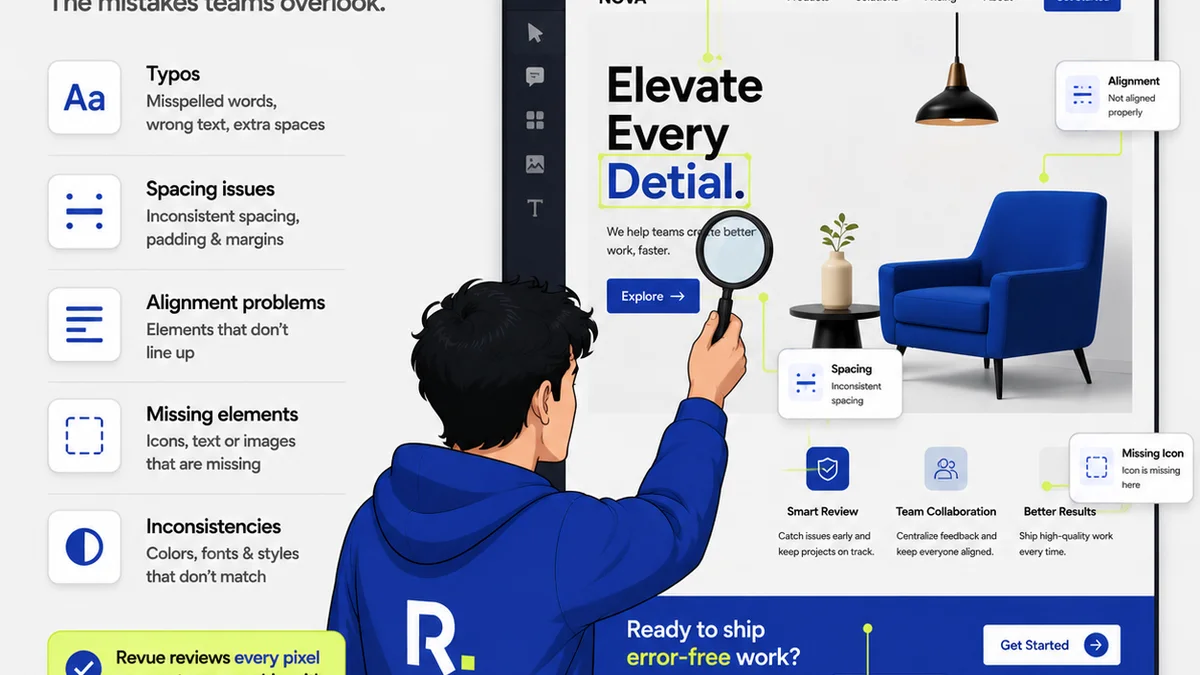
Managing feedback and revisions during the MVP design and development process is critical. Miscommunication leads to scope creep, delays, and ultimately, a product that misses the mark.
Revue acts as the central hub for all creative feedback and client approvals. Instead of scattered email threads or confusing annotation tools, every stakeholder can see the latest version, leave precise feedback directly on the design or prototype, and track the resolution of comments.
For logistics MVPs, this means ensuring that operational stakeholders, product managers, and developers are all aligned. It streamlines the process of iterating on complex workflows and ensures that crucial details aren't lost. Visibility into revision history and approval status builds confidence and accountability, accelerating the path to a truly viable product.
Final Thought
Choosing an MVP design agency for logistics isn't about finding the one with the most impressive client logos. It's about finding a partner who truly understands the operational grind, respects the user’s reality, and is committed to building a digital product that delivers measurable business value. Are you looking for a vendor, or a strategic partner in operational excellence?
Frequently asked questions
What is the most important factor when choosing an MVP design agency for logistics?
Beyond a portfolio, the most critical factor is their depth of understanding of logistics operations and their ability to translate that into an intuitive, efficient user experience. They need to grasp the nuances of your specific business, not just the industry jargon.
How can I assess an agency's 'logistics experience' beyond their case studies?
Ask specific questions about their experience with different logistics sub-sectors, their understanding of key industry metrics, and how they've designed for operational challenges. Probe into their user research methods for field and warehouse staff.
What's the difference between agile development and a true MVP approach?
Agile is a methodology for iterative development. An MVP approach, often using agile, focuses on building the absolute minimum set of features that deliver core value to solve a critical problem, enabling rapid learning and validation before extensive investment.
Why is technology integration crucial for a logistics MVP design agency?
Logistics MVPs must connect with existing systems (ERPs, WMS, TMS, etc.). An agency that understands this from the design phase prevents costly rework and ensures technical feasibility, performance, and scalability from the outset.