Many manufacturing leaders think a Minimum Viable Product (MVP) is just about cutting corners to launch fast. They believe it’s a cheap way to get something out the door.
None of that is wrong. But it’s incomplete.
The real cost of an MVP in manufacturing isn't just the development hours. It's the strategic investment in validating a core idea with minimal risk and maximum learning, specifically for complex industrial applications. It's about understanding the operational impact and the long-term value, not just the sticker price.
1. The Real MVP Cost: Beyond the Build
When we talk about MVP design cost for US manufacturing businesses, we're not just talking about wireframes and code. We’re talking about a carefully scoped project designed to test a critical hypothesis in a real-world industrial setting.
The cost is driven by the complexity of the problem you’re solving.
Defining the Core Problem
What specific pain point is your MVP addressing? Is it:
- Streamlining a specific assembly line process?
- Improving quality control for a particular component?
- Enhancing predictive maintenance for a class of machinery?
- Optimizing inventory management for raw materials?
The clarity and scope of this problem directly influence the complexity of the solution, and thus, the MVP cost.
Scope Creep is the Silent Killer
The biggest budget killer for any MVP, especially in manufacturing, is scope creep. This happens when you keep adding features that weren't part of the original, minimal viable set.
Resist the urge to solve every problem at once. An MVP is about testing *one* core assumption.
2. Key Cost Drivers for Manufacturing MVPs
The price tag for a manufacturing MVP can swing wildly. Here’s why:
Technology Stack and Integration
Are you building a standalone application, or does it need to integrate with existing ERP, MES, or SCADA systems? This is a massive cost differentiator.
Integration with legacy systems often requires custom middleware, specialized APIs, and extensive testing. That adds significant time and expense.
Hardware Requirements
Does your MVP involve new sensors, IoT devices, or custom hardware interfaces? The cost of R&D, prototyping, and sourcing these components can be substantial.
Think about the Bill of Materials (BOM) for any custom hardware. That’s a direct cost.
Data Complexity and Volume
Manufacturing generates massive amounts of data. How will your MVP ingest, process, and store this data? Will you need specialized databases or cloud infrastructure?
The complexity of data models and the required processing power directly impact development and ongoing operational costs.
User Interface (UI) and User Experience (UX) for Industrial Settings
Designing for an industrial environment is different. Interfaces need to be robust, easy to use on a factory floor (often with gloves), and clearly display critical information.
This requires specialized UX research and design expertise, which can increase upfront costs but is crucial for adoption.
Testing and Validation
In manufacturing, testing isn't just about bugs. It's about ensuring the MVP works reliably under demanding conditions, meets safety standards, and delivers accurate results.
Rigorous real-world testing, pilot programs, and validation loops add to the overall MVP cost.
3. Estimating Your MVP Design Cost
While a precise quote requires a detailed discovery phase, you can estimate costs by breaking down the project.
Phase 1: Discovery and Strategy ($5,000 - $20,000+)
This involves defining the core problem, identifying the target users, mapping out user flows, and documenting requirements. For manufacturing, this phase is critical for understanding operational constraints.
Phase 2: Design (UI/UX) ($10,000 - $30,000+)
Wireframing, prototyping, and user testing. Focus on industrial usability and clarity.
Phase 3: Development ($20,000 - $100,000+)
This is the core build. Costs vary based on:
- Platform (web, mobile, embedded)
- Complexity of features
- Integration requirements
- Backend development
- API development
Phase 4: Testing and Deployment ($5,000 - $20,000+)
Quality assurance, user acceptance testing (UAT), and deployment to the production environment.
Phase 5: Post-Launch Support & Iteration (Ongoing)
Bug fixes, performance monitoring, and planning for future iterations based on MVP learnings.
These are rough estimates. A complex IoT integration for a smart factory MVP will be at the higher end, while a simple dashboard for production monitoring might be at the lower end.
4. The ROI of a Manufacturing MVP
The cost of an MVP is an investment, not just an expense. The return on investment (ROI) comes from:
Validated Learning
The primary goal of an MVP is to learn. Did your core assumption hold true? Does the solution solve the problem effectively in the real world?
This learning prevents costly mistakes on larger-scale rollouts.
Reduced Risk
By testing with a minimal product, you avoid investing significant capital into a solution that might not work or isn't needed.
Faster Time-to-Market for Core Value
Get a functional solution into the hands of users quickly to start realizing benefits, even if it's limited in scope.
Data-Driven Decision Making
The MVP provides real-world data on performance, user behavior, and impact, informing future development and strategic decisions.
Attracting Further Investment
A successful MVP can be a powerful tool for securing internal buy-in or external funding for larger projects.
Where Revue Fits In
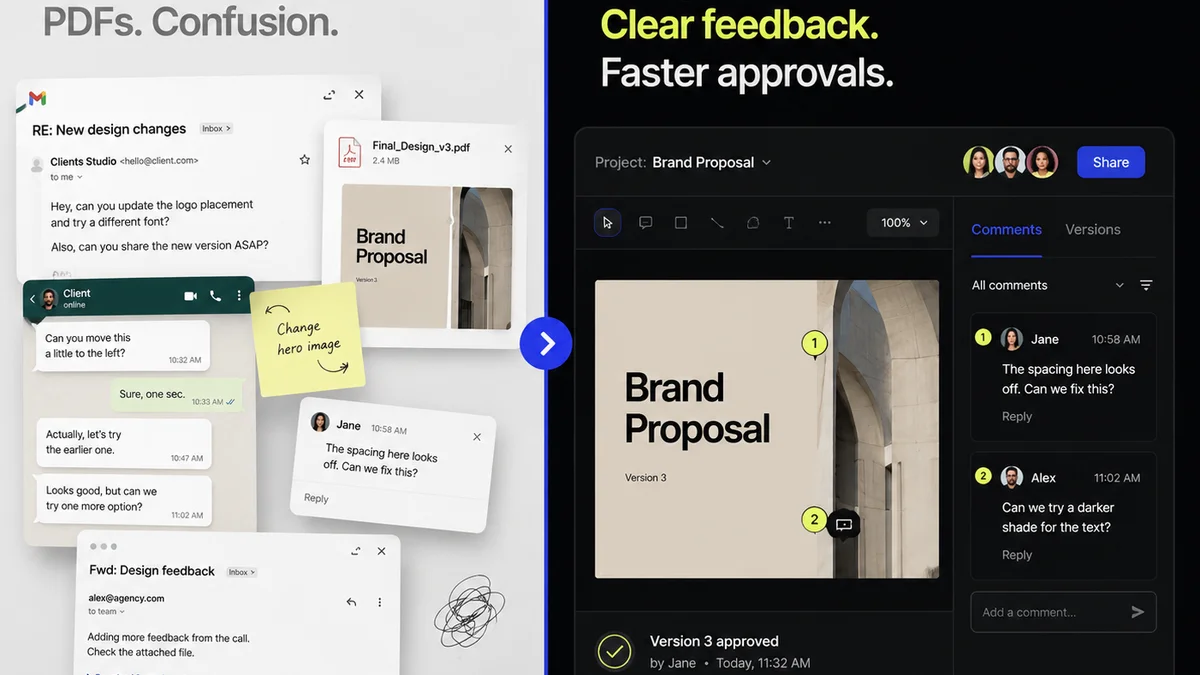
Managing the feedback and iteration cycle for a manufacturing MVP is critical. This is where a platform like Revue becomes invaluable.
Centralizing client and stakeholder feedback ensures nothing gets lost. Visibility into revision and approval stages streamlines the process, especially when dealing with diverse teams—from engineering to operations.
Running quality checks on creative assets or prototypes before they go into the full development or testing phases can catch issues early, saving time and reducing rework. For manufacturing MVPs, this could mean validating UI mockups with factory floor personnel or reviewing technical documentation before hardware integration.
5. Common Pitfalls to Avoid
Even with careful planning, MVPs can go awry. Be aware of these common traps:
- Building Too Much: The temptation to add
Frequently asked questions
What is the average cost of an MVP for a US manufacturing business?
The cost can range significantly, from $30,000 for a very simple application to well over $150,000 for complex solutions involving hardware integration or extensive system connectivity. A detailed discovery phase is necessary for an accurate estimate.
What factors most influence MVP design cost in manufacturing?
Key factors include the complexity of the problem being solved, the need for integration with existing industrial systems (ERP, MES, SCADA), any custom hardware requirements, data volume and processing needs, and the level of UI/UX polish required for an industrial setting.
How does an MVP differ for a manufacturing company compared to a typical software startup?
Manufacturing MVPs often involve higher stakes due to safety, operational continuity, and integration with physical processes or hardware. They may require more rigorous testing, adherence to industry standards, and specialized expertise in areas like industrial IoT or process automation.
What is the primary goal of an MVP in manufacturing?
The primary goal is validated learning. It aims to test a core business hypothesis or solve a specific operational problem with minimal investment, gathering real-world data to inform future development and avoid costly mistakes on full-scale solutions.