Everyone knows packaging needs to be right. The brand colors, the logo placement, the legal disclaimers – it all matters. You'd think that means packaging QA is straightforward, right?
Wrong.
The hard truth is that many agencies treat packaging QA as a final, superficial check. They skim for obvious errors, but miss the deeper, more damaging mistakes that can cost clients, and your agency, dearly.
1. The 'Looks About Right' Approvals
This is the most common failure point. A client signs off on a PDF proof, or even a digital render, and everyone breathes a sigh of relief.
But digital screens and print don't always play nice.
A color that looks electric on screen can turn muddy in CMYK. A subtle gradient might disappear entirely on press. A tiny font size that was readable on a high-res monitor becomes illegible on a small pack.
The Assumption: Digital proofs are sufficient.
The Reality: They are a starting point, not an endpoint.
- Color Shifts: RGB vs. CMYK is a constant battle. Different substrates absorb ink differently, too.
- Substrate Impact: Is it going on matte cardstock, glossy plastic, or textured paper? Each affects how colors and details appear.
- Print Techniques: Spot UV, embossing, foil stamping – these add dimension but require specific checks that a flat PDF can't convey.
- Scale & Readability: What looks fine at 100% on screen might be unreadable when printed at actual size.
The Fix: Print, then review.
Always, always, always get a physical proof. Ideally, a **[Fogra]]** certified press proof on the actual production stock.
If that’s not feasible, at least a high-quality inkjet proof that simulates the final output as closely as possible.
And ensure the right people are reviewing it. Not just the junior designer who made it, but someone with a critical eye for detail and an understanding of print limitations.
2. Ignoring the Fine Print (Literally)
Legal requirements, nutritional information, ingredient lists, barcodes, country of origin – these aren't suggestions. They are non-negotiable.
Yet, they are often the most error-prone elements in packaging design.
The Assumption: The client's legal team has it covered.
The Reality: Clients delegate. Details get lost in translation. Your agency is the last line of defense before it hits the shelves.
- Outdated Information: Regulations change. Is the allergen warning current? Is the recycling symbol the latest standard?
- Inconsistent Data: Does the ingredient list match the nutritional facts? Is the net weight displayed correctly?
- Barcode Issues: An invalid or poorly placed barcode can halt production and distribution.
- Language Requirements: Is the packaging compliant with labeling laws in all target markets?
The Fix: Centralize and verify.
Create a master checklist for every piece of regulatory or informational text.
Don't just copy-paste from previous versions. Verify each data point against the client's latest approved information or official sources.
Use a dedicated tool for managing this kind of critical data. It reduces manual entry errors and provides an audit trail.
3. The 'It's Just a Box' Mentality
Packaging isn't just a container; it's a three-dimensional advertisement and a crucial touchpoint in the customer experience.
Treating it as a flat, static design project leads to critical oversights.
The Assumption: Once the artwork is approved, the job is done.
The Reality: The physical form, the way it's assembled, and its interaction with the end-user all impact the final product.
- Die-lines & Scores: Are fold lines accurate? Will the die-cut allow for easy assembly? Are score lines placed to prevent cracking on thick board?
- Structural Integrity: Will the box hold its shape? Can it withstand shipping? Is the material appropriate for the product's weight and fragility?
- User Experience: How easy is it to open? Is there a clear way to reseal it if necessary? Does the unboxing experience align with the brand?
- Sustainability Claims: Is the packaging truly recyclable, compostable, or made from recycled materials as claimed? Is that claim legally defensible?
The Fix: Think in 3D from Day One.
Involve structural designers or packaging engineers early in the process.
Review 3D mockups, not just flat artwork.
Consider the entire lifecycle: production, shipping, retail display, consumer use, and disposal.
4. Collaboration Chaos
Packaging projects often involve multiple stakeholders: the client's marketing team, legal, product development, printers, and sometimes even third-party regulatory consultants.
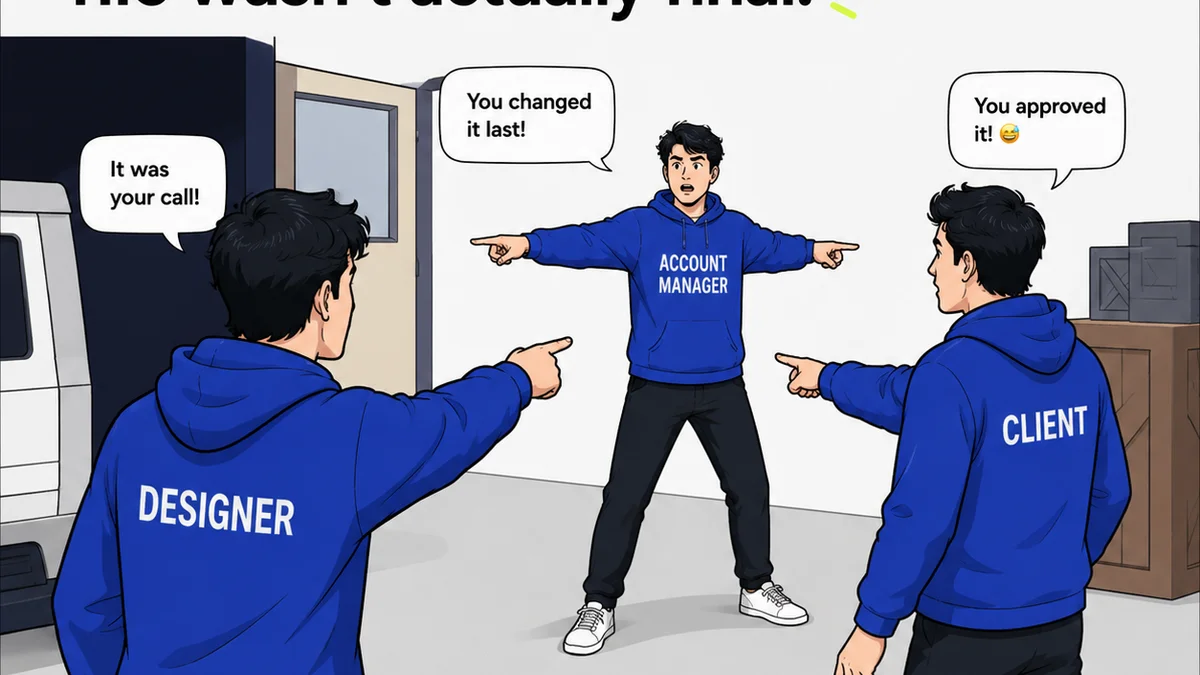
When feedback and approvals are scattered across emails and chat threads, things inevitably fall through the cracks.
The Assumption: Email chains and shared folders are enough to track feedback.
The Reality: This is a recipe for missed comments, conflicting instructions, and lost versions.
- Version Control Nightmares: Which is the *actual* final file? How do you track who approved what, and when?
- Scattered Feedback: Comments from legal are in one email, marketing's are in a Slack channel, and the printer's notes are in a separate PDF.
- Lack of Visibility: It's hard to get a clear overview of the approval status and identify bottlenecks.
- Accountability Gaps: When an error occurs, it’s difficult to pinpoint where the breakdown happened.
The Fix: Centralize everything.
Use a platform designed for creative workflow management.
This ensures all feedback, revisions, and approvals are logged in one place, tied to specific versions of the artwork.
It creates a clear, auditable trail, making accountability straightforward and reducing the risk of human error.
Where Revue Fits In
Managing complex packaging projects requires meticulous attention to detail and seamless collaboration.
This is precisely where Revue excels.
Revue provides a centralized hub for all your creative assets and client communications.
- Centralized Feedback: Consolidate all client comments, from marketing, legal, and product teams, directly on the design files. No more hunting through endless email chains.
- Revision & Approval Tracking: Maintain clear version control. See who approved what, when, and track the entire revision history. This is crucial for packaging where accuracy is paramount.
- Quality Control Workflows: Implement structured review processes to ensure all critical elements – colors, copy, legal disclaimers, barcodes – are checked against approved standards before final sign-off.
By streamlining these processes, Revue helps your agency avoid the common packaging QA mistakes that lead to costly errors and client dissatisfaction.
Final Thought
Packaging is the silent salesperson on the shelf.
It’s the first physical interaction a customer has with a product.
Are you treating its quality assurance with the gravity it deserves, or are you still just checking the 'looks about right' box?
Frequently asked questions
What is the biggest mistake agencies make in packaging QA?
The biggest mistake is treating packaging QA as a superficial check of digital proofs rather than a thorough review of physical samples and all embedded details. This often leads to issues with color accuracy, readability, and print finishes that aren't apparent on screen.
How can I ensure legal and regulatory compliance on packaging?
Create a master checklist for all legal and regulatory text, verify each item against client-approved sources or official regulations, and centralize this information. Use a system that tracks changes and approvals to maintain an audit trail.
Why are physical proofs so important for packaging?
Physical proofs allow you to see how colors will render on the actual production substrate, check the legibility of small text at actual size, and evaluate the impact of special finishes like foil or spot UV. Digital proofs cannot accurately replicate these aspects.
How does a platform like Revue help with packaging QA?
Revue centralizes all feedback and approvals in one place, provides clear version control, and helps implement structured quality control workflows. This reduces the risk of missed comments, conflicting instructions, and errors that can occur with scattered communication.