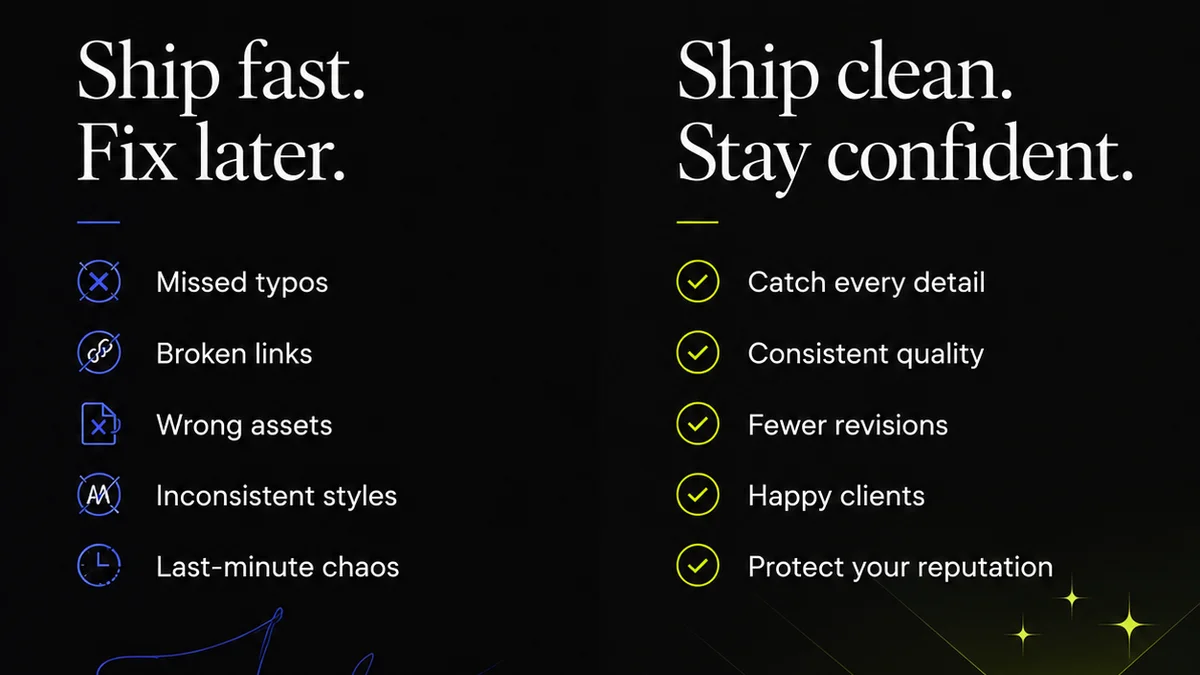
You're looking for packaging QA software. Maybe you've seen the ads, read the lists, and are ready to pick the one with the most features. That's the common approach. But it's often the wrong one.
The real value isn't in the bells and whistles. It's in how well the software solves your specific operational bottlenecks in creative production. The best packaging QA tools don't just find errors; they prevent them and make your entire process smoother.
1. Beyond Spellcheck: True Multichannel Verification
Most agencies think packaging QA is just about catching typos on print files. That's a minimal requirement, not a strategy. Today's packaging needs to live across multiple touchpoints, and your QA process must reflect that.
Consider the full scope:
- Print-ready files (CMYK, spot colors, bleed, trim).
- Digital assets (web banners, social media graphics, product shots).
- Brand consistency across all formats.
- Legal and regulatory compliance (disclaimers, nutritional info, barcodes).
- Localization and regional variations.
Your packaging QA software needs to handle this complexity. It should offer robust checks for print specifications, but also have capabilities or integrations that address digital variations and brand guideline adherence. If it only checks PDFs, you're missing half the problem.
The Cost of Disconnected Checks
When you treat print QA and digital asset QA as separate tasks, you create silos. This leads to inconsistencies and errors that slip through the cracks. A unified approach, supported by intelligent software, is essential.
2. Centralized Feedback & Revision Tracking
The biggest time sink in creative production isn't the design itself; it's the back-and-forth of feedback and revisions. Packaging projects, with their numerous stakeholders and critical details, are notorious for this.
Your packaging QA software must be the single source of truth for all feedback. This means:
- Consolidating comments from clients, legal, marketing, and production teams in one place.
- Providing clear visual annotations directly on the artwork.
- Linking feedback to specific revisions.
- Offering a clear audit trail of who said what, when, and what action was taken.
Without this, you're drowning in email threads, Slack messages, and scribbled notes. It’s inefficient and ripe for misinterpretation.
Why Version Control Matters More Than You Think
Imagine a client approves a design based on an email from three weeks ago, but the actual file you're working on is from yesterday. The discrepancy is a recipe for costly mistakes. Good QA software locks down approved versions and makes tracking subsequent changes effortless.
3. Workflow Integration & Automation
The dream is a seamless workflow. The reality for many agencies is a patchwork of tools that don't talk to each other. Your packaging QA software shouldn't add to the chaos; it should reduce it.
Look for software that:
- Integrates with your existing project management tools (e.g., Asana, Monday.com).
- Connects with your creative tools (e.g., Adobe Creative Cloud, Figma).
- Automates repetitive checks.
- Can flag common compliance issues based on pre-set rules.
Automation isn't about replacing humans; it's about freeing them from tedious tasks so they can focus on critical thinking and creative problem-solving. Think of it as a junior reviewer that never sleeps and never gets bored.
The Bottleneck is Often Process, Not Skill
Many agencies are held back not by a lack of talent, but by inefficient processes. Software that automates checks and integrates smoothly removes these friction points, allowing your team to move faster and with more confidence.
4. Scalability for Agency Growth
What works for a small team today might cripple you tomorrow. As your agency grows, so does the volume and complexity of your packaging projects. Your QA solution needs to scale with you.
Consider:
- User management and permission levels.
- The ability to handle a growing number of projects and assets.
- Performance under load – does it slow down when you have many users or large files?
- Cost structure – does it scale affordably as your usage increases?
A system that’s clunky at small volumes will be unbearable at scale. Invest in a solution that can grow without forcing you to rebuild your entire workflow.
5. Security & Compliance Assurance
You're handling client assets, often including sensitive intellectual property. Security isn't optional; it's a fundamental requirement.
Your packaging QA software must offer:
- Robust data security measures (encryption, access controls).
- Compliance with relevant data protection regulations (e.g., GDPR, CCPA).
- Secure sharing and collaboration features.
- Reliable uptime and disaster recovery plans.
Clients trust you with their brand. You need to ensure the tools you use protect that trust. A breach originating from your workflow can be devastating.
Where Revue Fits In
Packaging QA is a critical part of the creative lifecycle. It's where final checks happen before a product hits the shelf or the digital storefront. But it's not an isolated event. It's deeply intertwined with feedback, revisions, and overall project management.
This is where a platform like Revue can make a significant difference. By centralizing client feedback, managing revisions with clear version control, and providing visibility into the entire approval process, Revue helps ensure that the final output is exactly what was intended. It's not a QA tool in the traditional sense of running automated checks, but it provides the essential foundation for a smooth, error-free review and approval cycle that directly impacts the quality of the final deliverable.
When feedback is organized, revisions are tracked, and approvals are clear, the QA process becomes far more efficient and less prone to human error. You reduce the likelihood of last-minute changes that introduce new mistakes and ensure that everyone is working from the most current, approved version.
Final Thought
The goal of packaging QA software isn't just to catch mistakes. It's to build a more robust, reliable, and efficient creative production process. Are you choosing tools that achieve that, or just tools that feel good on a feature list?
Frequently asked questions
What is the primary goal of packaging QA software for agencies?
The primary goal is to prevent errors and ensure brand consistency across all packaging deliverables, streamlining the review and approval process and reducing costly mistakes before final production.
How does packaging QA software differ from basic spellcheck tools?
Packaging QA software goes far beyond spellcheck. It verifies technical specifications (like color modes, bleed, trim), brand guideline adherence, legal compliance, and can handle multichannel variations (print, digital, etc.), offering a comprehensive verification layer.
Why is centralized feedback important in packaging QA?
Centralized feedback consolidates comments from all stakeholders (clients, legal, marketing) into a single, organized system with visual annotations. This prevents misinterpretations, lost comments, and ensures everyone is working from the same, approved information, drastically reducing revision chaos.
Can packaging QA software automate checks?
Yes, many advanced packaging QA solutions offer automation for repetitive checks, such as verifying color profiles, checking for specific legal text, or ensuring barcode integrity. This frees up human reviewers for more complex tasks.
What role does workflow integration play in choosing QA software?
Workflow integration is crucial. Software that connects with your existing project management and creative tools (like Adobe Creative Cloud) reduces manual data transfer, minimizes errors, and creates a more seamless, efficient production pipeline.